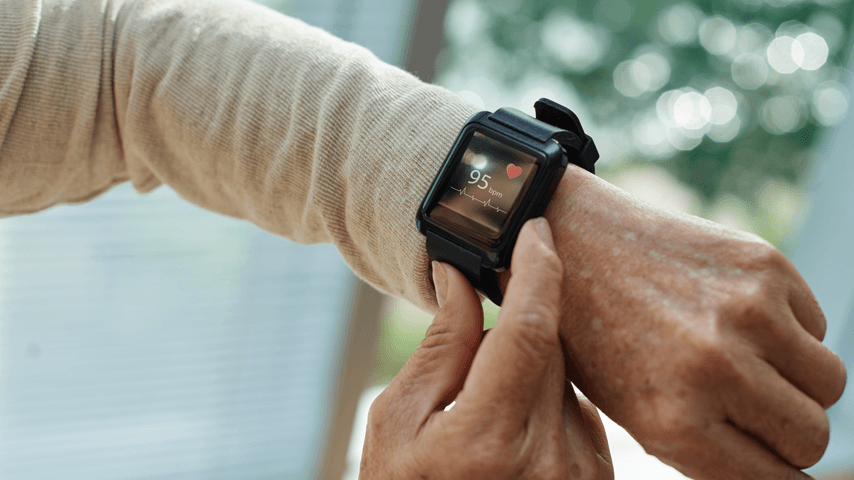
Whether you’re taking a brisk walk with a friend or side-stepping in your Zumba class, you might wonder: Am I working hard enough, or am I overdoing it? Understanding target heart rate zones by age can help you exercise more confidently. These five ranges describe how fast your heart beats during exercise, from low to very high intense activity.
Your maximum heart rate usually decreases as you get older, so your exercise range may look different from someone who’s a bit younger. This guide explains what each heart rate zone feels like, how to estimate and measure your heart rate, and how to use those numbers alongside your body’s natural signals.
What are heart rate zones?
Heart rate zones are ranges of beats per minute (bpm) that reflect different exercise intensities. They are usually calculated as percentages of your maximum heart rate (that’s the fastest your heart can beat during intense effort).
Knowing the different heart rate zones can help you pace your workouts and tailor exercise to your goals, such as improving cardiovascular fitness, burning fat, or building muscle. But keep in mind these aren’t hard-and-fast rules. Your personal health, fitness level, and physical experience matter more than hitting a specific number.
The 5 Heart Rate Zones at a Glance
|
Heart rate zone |
% of maximum heart rate |
How it feels |
Example activities |
|
Zone 1: Low intensity |
50–60% |
You can talk easily. |
Leisurely walking; warming up/cooling down before/after workout |
|
Zone 2: Moderate intensity |
60–70% |
You breathe a little harder, but can talk comfortably. |
Brisk walking, light cycling |
|
Zone 3: Moderate to high intensity |
70–80% |
You breathe harder and speak in shorter sentences. |
Faster walking, dancing, moderate-paced running |
|
Zone 4: High intensity |
80–90% |
You can say only a few words before taking a breath. |
Fast cycling, walking uphill, fast-paced runs |
|
Zone 5: Very high intensity |
90–100% |
You’re working very hard, and talking is difficult. |
Brief sprints; high-intensity bursts on rowing machine |
Different organizations and fitness devices may use different systems for classifying heart rate zones. The five-zone model above provides one way to understand exercise intensity. The American Heart Association uses broader categories, defining moderate exercise as roughly 50–70% of maximum heart rate and vigorous exercise as roughly 70–85%.
Heart rate zones explained
The guidelines in the chart above are approximate. The same walk can feel easy or strenuous, depending on your fitness level.
- Zone 1 Activity: Low Intensity: In Zone 1, you might be doing an easy workout or warming up for a more intense session. Your breathing stays comfortable, and you can chat easily. This zone also suits cooling down after a workout.
- Zone 2 Activity: Moderate Intensity: In this heart rate zone, you’re moving steadily, with slightly deeper breathing. It’s a manageable pace that promotes endurance while placing less strain on the body than higher-intensity workouts.
- Zone 3 Activity: Moderate to High Intensity: Your heart and breathing work harder in this heart rate zone, and conversation takes more effort. Although it’s often labeled “moderate” in exercise guides, this range overlaps with vigorous exercise guidelines. Exercising in Zone 3 can help improve cardiovascular fitness and endurance by challenging your heart and lungs. Muscle strengthening activities, such as resistance training, provide additional benefits such as muscle building and could be added to your exercise routine.
- Zone 4 Activity: High Intensity: Speaking becomes noticeably more challenging in Zone 4. This intensity is demanding and may require additional recovery time. If you're new to vigorous exercise, build up gradually rather than immediately aiming for this intensity. If you've been inactive or have health concerns, talk with your health care provider before beginning high-intensity workouts.
- Zone 5 Activity: Very High Intensity: In Zone 5, you’re giving it all you’ve got! There’s no capacity for talking; your entire focus is on your breathing. While activity in this zone helps strengthen the heart and fast-twitch muscle fibers (the ones responsible for quick movements), you don't need to reach Zone 5 to experience meaningful health benefits. You can still achieve measurable health benefits with moderate-intensity exercise, which can be a more sustainable and accessible way for many older adults to stay active and support their health.
What should my heart rate zone be for my age?
The American Heart Association estimates maximum heart rate as 220 minus your age, with moderate activity at approximately 50–70% and vigorous activity at 70–85% of that estimate. The chart below offers guidance.
|
Age |
Est. maximum heart rate |
Moderate intensity |
Vigorous intensity |
|
50 |
170 bpm |
85–119 bpm |
119–145 bpm |
|
55 |
165 bpm |
83–116 bpm |
116–140 bpm |
|
60 |
160 bpm |
80–112 bpm |
112–136 bpm |
|
65 |
155 bpm |
78–109 bpm |
109–132 bpm |
|
70 |
150 bpm |
75–105 bpm |
105–128 bpm |
|
75 |
145 bpm |
73–102 bpm |
102–123 bpm |
|
80 |
140 bpm |
70–98 bpm |
98–119 bpm |
*These are general estimates.
How to calculate your heart rate zone
To calculate your target heart rate zone for your age using the American Heart Association formula:
- Estimate your maximum: Subtract your age from 220.
- Choose a range: Multiply that number by the lower and upper percentages for your desired intensity (e.g., for 50%, multiply by .50). Start gently and build gradually.
- Personalize it: Ask your health care provider if these estimates align with your general health and the medications you take.
For example: Valentina is 72, so her estimated maximum heart rate is 148 bpm (220 minus 72). Multiplying by 0.50 (50%) and 0.70 (70%) gives her a moderate-activity heart rate range of about 74–104 bpm.
What is the aerobic heart rate zone?
“Aerobic” means your body uses oxygen to support continuous activity, such as walking or swimming. Some organizations and exercise guides call Zone 3 the aerobic zone, but aerobic exercise can span across several intensities. That means there’s no single aerobic range everyone needs to reach.
How to measure your heart rate during exercise
To check your heart rate manually when you’re exercising, take a quick break somewhere safe. Then:
- Place your index and middle fingers on the inside of your wrist, just below your thumb.
- Press gently until you feel your pulse. Don’t use your thumb; it has its own pulse.
- Count the beats for 30 seconds, then multiply by 2 to get your heart rate in beats per minute.
Be sure to check your pulse quickly, before it drops.
How to use a fitness tracker or heart rate monitor
A wearable device with a heart rate monitor, like a fitness tracker or a chest strap model, lets you check your pulse without pausing your activity. Treat these readings as estimates only, since your movement, the way the device fits, and the device itself can all affect accuracy. If a number seems off, check your pulse manually and consider how you feel in the moment.
More on home health monitoring devices:
- Explore the best home blood pressure monitors.
- See our recommendations for the best home pulse oximeters.
- Review our picks for the best medical alert watches.
How to use the talk test
Don’t have a device? Try a simple talk test. According to the Centers for Disease Control and Prevention (CDC), moderate intensity activity “will make you breathe harder and your heart beat faster. You'll also notice that you'll be able to talk, but not sing the words to your favorite song.”
During vigorous activity, you’ll be able to say only a few words before pausing for breath. This simple check helps when your heart rate numbers don’t match the effort you know you’re putting in.
What is a normal heart rate during exercise?
There’s no universal “normal” heart rate. A walk that feels moderate to you may feel strenuous to someone else. Your fitness level, chronic health conditions, and any disabilities you have can affect how much effort an activity takes. Even the medications you take regularly can impact your expected heart rate range.
Plus, different activities can elicit a different heart rate response. “For example, heart rates during swimming are often lower than when someone is running at the same perceived effort because their body is supported horizontally in the water,” explained Pargaonkar.
That’s why it’s important to choose movement that fits your abilities and feels manageable, and build up at your own pace.
Medications affecting your exercise heart rate
Certain cardiac medications such as beta blockers (e.g., Propranolol, Metoprolol), can slow your heart rate. When this happens, you may be working hard without reaching an age-based target.
Ask your provider if your target heart rate needs adjusting. They may recommend an exercise stress test to help find the right range, or suggest using how hard the activity feels as your guide. Important: Don’t change your medication to reach a certain heart rate zone.
When should you stop exercising?
Stop exercising immediately if you experience any of the symptoms below:
- Dizziness or lightheadedness
- Unusual, severe, or unexpected shortness of breath
- Nausea
- Irregular heartbeat (or pulse)
Rest and tell your health care provider about your symptoms. Seek emergency medical help (e.g., call 911) if you have possible heart attack warning signs that may include:
- Chest pain, pressure, or discomfort
- Unusual, severe, or unexpected shortness of breath
- Discomfort in your arms, neck, back, stomach, or jaw
- Unusual fatigue or lightheadedness
- Nausea
- Breaking into cold sweats
Frequently asked questions (FAQ)
What is the best heart rate zone for older adults?
For many older adults, moderate-intensity exercise is a reasonable goal. During this type of activity, your breathing is faster, but you can still talk without too much difficulty. This is roughly 50–70% of your estimated maximum heart rate. If you’re just starting out, begin with lighter activity and build gradually. Your best range depends on your fitness, health, and medications.
How much exercise should older adults get each day?
To help maintain your strength and independence as you age, and reduce your risk of falls, aim for 150 minutes of moderate-intensity aerobic activity each week or 75 minutes of vigorous-intensity activity, or a mix of both. Add strength-training exercises at least twice a week and activities that improve balance to help you stay strong and steady on your feet. Even if you can’t meet these goals, moving more can still benefit your health. You should also include strength work twice weekly and balance activities. Multiple, short sessions of exercise can be just as beneficial as longer sessions; these are called exercise “snacks.” Do what you are comfortably able to do.
Do your heart rate zones change as you get older?
Yes. Your maximum heart rate generally gets lower as you get older, so your estimated heart rate zones shift lower, too. Changes in your fitness, health, or medications can also affect your exercise heart rate. Use age-based ranges as a guide, and pay attention to your breathing and how you feel.
What is a dangerous heart rate when exercising?
There’s no single exercise heart rate that’s dangerous for everyone. Your age, fitness, health conditions, and medications all play a role. Age-based ranges are estimates, so pay attention to how you feel, too. Stop exercising if you have chest discomfort, dizziness, unusual shortness of breath, or a new irregular heartbeat. Call 911 for chest pain that may signal a heart attack, fainting, or serious trouble breathing.