
MDHearing Review: Should You Try This Inexpensive Hearing Aid Brand?
Looking for OTC hearing aids at a low price with professional support? Read our MDHearing review to learn more about the products they offer and if they are right for you.
- MDHearing makes affordable OTC hearing aids for people with mild to moderate hearing loss.
- MDHearing hearing aids range in cost from $297–$597 per pair.
- All MDHearing models are rechargeable, and several include portable charging cases for extra power on the go.
- The brand offers access to a team of licensed hearing specialists. This feature allows users to receive support and care from the comfort of their own homes.
- Most MDHearing hearing aids are simple and don’t have a ton of features in order to keep costs down.
- MDHearing is a better fit for shoppers who want affordable, easy-to-use hearing aids than for those seeking advanced tech features.
We’ve spent more than 5,000 hours researching hearing aids to give you the most accurate product reviews. To find the best hearing aids, we:
- Consulted with audiologists, hearing instrument specialists, and aging care experts
- Put more than 50 hearing aids through a series of 21 different tests
- Mystery shopped more than 20 brands
- Surveyed hundreds of older adults who use hearing aids
- Interviewed experts on hearing loss
- Sent hearing aids to our friends and family with hearing loss to provide long-term testing notes
- Read thousands of verified customer reviews
We’re constantly testing new hearing aids to give you the most accurate and up-to-date recommendations. Read more about our hearing aid review methodology.
Sticker shock is not uncommon when purchasing hearing aids. Many people are unaware that insurance typically doesn’t cover the cost. And a new pair of hearing aids can set you back thousands of dollars. The majority of people we surveyed (83%) cited cost as their top consideration when buying hearing aids.1 The FDA approval of over-the-counter hearing aids has helped people with mild to moderate hearing loss afford these devices. Some OTC hearing aids can be much more reasonably priced, as you can see in our guide to the best affordable hearing aids.
MDHearing is one brand known for its low-cost hearing aids, starting at $297 per pair. They keep costs low by limiting features and selling hearing aids directly to consumers. The brand offers five different devices, all with rechargeable batteries and customizable settings.
For those seeking a budget-friendly hearing aid, MDHearing offers a lot. We tested several of the brand’s models to help you decide if MDHearing aids are the right fit. In this MDHearing review, we’ll take a closer look at these hearing aids. We’ll also highlight key features, discuss the pros and cons, and explain who may benefit the most.

Many brands offer free online hearing tests, but these are no substitute for an in-person exam with a qualified hearing specialist. An initial hearing evaluation can help rule out other medical issues and diagnose the type of hearing loss you have.
Why we recommend MDHearing hearing aids
MDHearing offers a good value for the cost in terms of comfort, quality, and customer support. Its range of rechargeable hearing aids offers 15–20 hours of battery life, depending on the specific model. Five MDHearing models, the Volt 4, Volt Max 2, NEO XS, NEO XS Pro, and the Air, come with a portable charging case for an extra 60–100 hours of on-the-go charging.
If you’re looking for advanced technology, such as intelligent noise reduction and feedback cancellation, or a smartphone app, these features are only available in the Volt Max 2. The Volt Max 2 is a behind-the-ear (BTE) hearing aid costing $597. This is the least expensive hearing aid we’ve found to offer those features.
We appreciate that all MDHearing hearing aids are rechargeable and come with a 45-day trial period. They also come with a one-year warranty and lifetime support from audiologists and hearing specialists at no extra cost. Users can also purchase MDHearing’s VIP Care package for $200 to add remote, clinic-level care for fittings, onboarding, coaching, and follow-up.
Our tests found MDHearing’s hearing aids to be fairly discreet (though not invisible), comfortable, and secure. We found that these hearing aids can be a good choice for anyone who isn’t comfortable with advanced technology and wants an affordable hearing aid.
MDHearing
Suitable for those with mild to moderate hearing loss, all models feature rechargeable batteries
MDHearing hearing aids compared
| Comparison Features | ||||||
|---|---|---|---|---|---|---|
| Hearing aid type | BTE |
BTE |
ITC |
CIC |
CIC |
BTE |
| Battery type (disposable or rechargeable) | Rechargeable |
Rechargeable |
Rechargeable |
Rechargeable |
Rechargeable |
Rechargeable |
| Bluetooth | No |
No |
No |
No |
Yes |
Yes |
| Dual-directional microphones | No |
Yes |
No |
No |
No |
Yes |
Our MDHearing hearing aids video review
To find out if MDHearing delivers both value and quality, we put the company’s hearing aids, such as the popular Volt Max 2, through a series of hands-on tests. From water-resistance checks and Bluetooth to customer support, warranty policies, and trial periods, we looked closely at how these budget-friendly devices perform in real life.
How we tested MDHearing Aids
All of our recommendations go through comprehensive testing. You can learn more by reading our full hearing aid testing methodology. Our hearing aid testing process includes:
Understanding MDHearing hearing aid models
MDHearing Volt 4
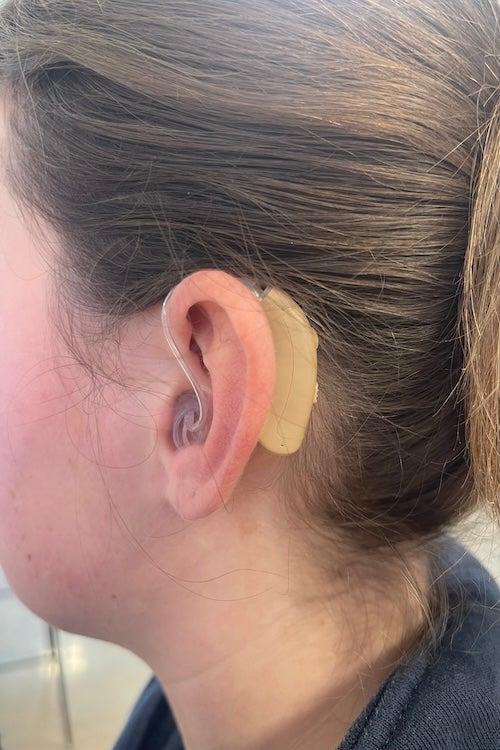
The Volt 4 is MDHearing’s most popular BTE model. Costing $397, it has the longest battery life of all the brand’s models (20 hours), but does not come with a portable charging case. Unlike the Air (the brand’s $297 BTE model), the Volt includes dual-direction microphones and advanced noise reduction technology. But it lacks the smartphone compatibility available in the Volt Max 2. The MDHearing Volt 4 is a good option for someone looking for an affordable, basic hearing aid with minimal extras.
MDHearing Volt 4
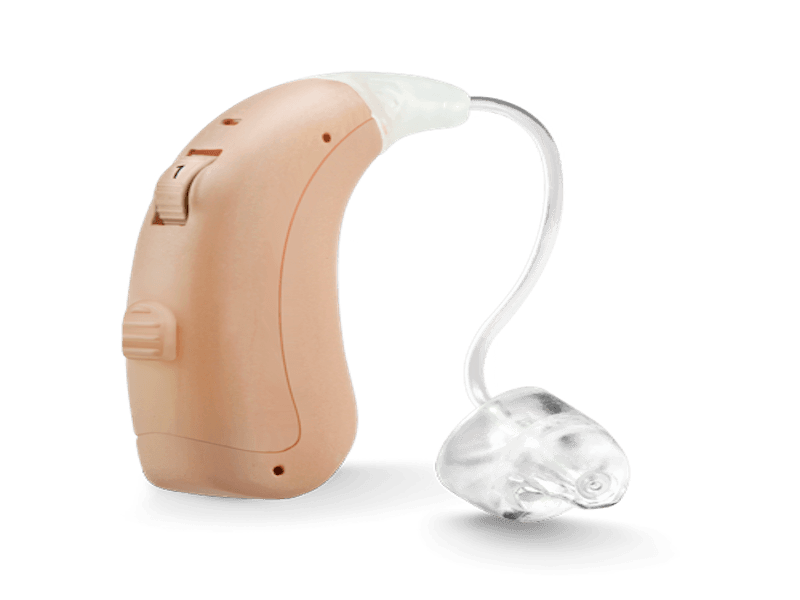
Type of hearing aid: BTE
Type of hearing loss: Mild to moderate
- Noise-canceling technology: Yes
- Battery type: Rechargeable
- Battery life: 20 hours
- Bluetooth compatible: No
- Trial period: 45 days
MDHearing Volt Max 2
The newest behind-the-ear model from MDHearing is the Volt Max 2. This model builds on the original Volt design, adding features such as Bluetooth streaming, app-based controls, and a portable charging case for on-the-go use. It also includes noise reduction and feedback control to help support everyday listening.
MDHearing Volt Max 2
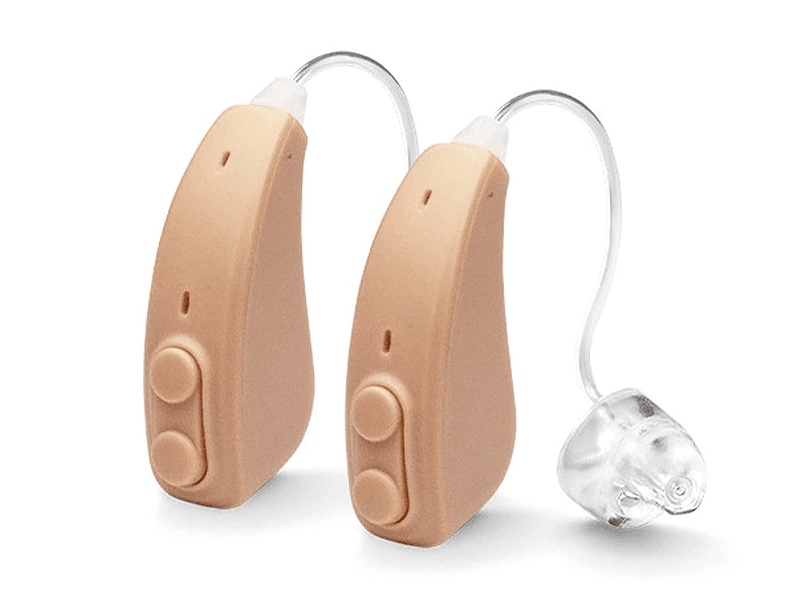
Type of hearing aid: BTE
Type of hearing loss: Mild to moderate
- Noise-canceling technology: Yes
- Battery type: Rechargeable
- Battery life: 15 hours
- Bluetooth compatible: Yes
- Trial period: 45 days
MDHearing Neo
The MDHearing Neo is the brand’s original in-the-canal (ITC) style hearing aid. It is an affordable, discreet option with manual controls and a 17-hour battery life. While we did not test this model, we tested the Neo XS (below), which has a similar fit and features.
MDHearing Neo
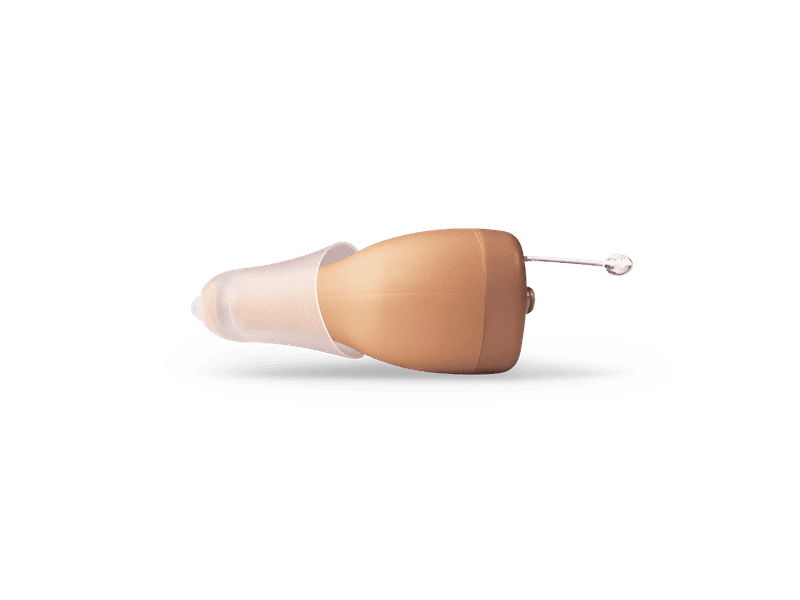
Type of hearing aid: ITC
Type of hearing loss: Mild to moderate
- Noise-canceling technology: Yes
- Battery type: Rechargeable
- Battery life: 17 hours
- Bluetooth compatible: No
- Trial period: 45 days
MDHearing Neo XS
The Neo XS is the smallest and most discreet CIC hearing aid in the brand's lineup. Due to its compact size and affordable price tag ($297), we named it the best value in our roundup of the best invisible hearing aids. It has an 18-hour battery life and an on-the-go charging case that extends that to 100 hours of hearing time. The Neo XS also earned high scores for fit and comfort.
MDHearing Neo XS
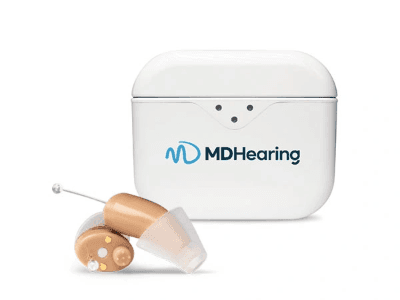
Type of hearing aid: CIC
Type of hearing loss: Mild to moderate
- Noise-canceling technology: Yes
- Battery type: Rechargeable
- Battery life: 18 hours
- Bluetooth compatible: No
- Trial period: 45 days
Other MDHearing models we’ll test soon
MDHearing Air
The MDHearing Air is tied with the Neo and Neo XS as the brand's lowest-priced BTE hearing aid ($297). It shares similar features with the Volt but lacks dual-directional microphones and has a shorter battery life (16 hours vs. 20 hours). The Air has an on-the-go charging case that extends its total charge to 60 hours. It is a discreet option for anyone seeking a basic and affordable hearing aid.
MDHearing Air
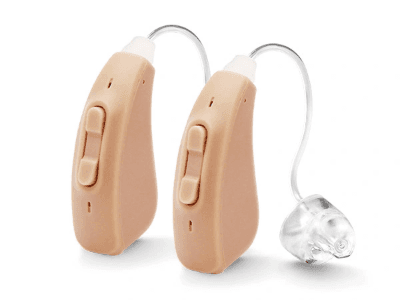
Type of hearing aid: BTE
Type of hearing loss: Mild to moderate
- Noise-canceling technology: Yes
- Battery type: Rechargeable
- Battery life: 16 hours
- Bluetooth compatible: Yes
- Trial period: 45 days
MDHearing pros and cons
There is no one-size-fits-all hearing aid. Every hearing aid on the market has its advantages and disadvantages. Here is what we like and dislike about MDHearing’s lineup:
Pros
- Among the most affordable OTC hearing aids we tried
- Offers discreet BTE and ITC models
- All devices have rechargeable batteries and long battery life, or on-the-go charging
- All hearing aids have a 45-day, risk-free trial and 100% money-back guarantee
- Lifetime support from audiologists and hearing specialists at no extra cost
Cons
- Limited styles and colors available
- Only for mild to moderate hearing loss
- Only one model has Bluetooth
- Deceptive pricing (disguising normal pricing as “sales” pricing)
Who should consider MDHearing hearing aids:
- Anyone with mild to moderate hearing loss looking for a basic, inexpensive option
- People who don’t have a smartphone or don’t enjoy using smartphone apps
- Anyone with dexterity issues that prevent them from changing batteries or other small parts
You may consider other options if you:
- Are looking for a more discreet in-the-canal (ITC) device
- Prefer more color options
- Want to pay more for better sound quality
The MDHearing customer experience
- Warranty and trial period: MDHearing offers a one-year warranty on the Air, NEO, NEO XS, and Volt 4, and a 45-day trial period on all models.
- Financing: Yes
- Phone: 800-918-3914, 7 a.m. to 6 p.m. CT, Monday to Friday
- Email: support@MDHearingAid.com, available 24/7, responses take 24–48 hours
- Contact form: https://www.mdhearingaid.com/contact-us/
Extending your MDHearing warranty
MDHearing offers two protection plans that extend the coverage of their standard warranty. The MDShield Protection Plan covers the cost of repairing or replacing the hearing aids, even if you accidentally damage them (which is not covered by the initial 1-year warranty). It does not cover loss, theft, or unauthorized repairs, and does not cover accessories. This plan costs $12 per month.
The MDShield Total Protection Plan covers all of the above and will replace lost hearing aids for $50 per device. This plan also covers accessories and an annual appointment with a licensed hearing professional. The cost for this plan is $19 a month.
If you’re not happy with your MDHearing product, you can return it for a refund within 45 days from the date of delivery. MDHearing does not charge restocking fees, but it also does not cover the cost of return shipping.
MDHearing also offers something called VIP Care. For a one-time fee of $200, this service provides access to a licensed hearing professional via video or phone. They will show you how to fit, wear, and optimize your hearing aids, and be available for follow-up appointments as needed. VIP Care also extends the one-year warranty to two years and provides you with access to a priority customer care phone line.
MDHearing costs and purchasing options
MDHearing hearing aids start between $297–$597 per pair. Most insurance plans, including Medicare Part A and Part B, do not cover the full cost of hearing aids. Medicare Advantage (Part C) may cover some of your hearing aid costs. If you have a health savings account (HSA) or a flexible spending account (FSA), you may also be able to use those for the purchase of hearing aids. Check with your insurance provider to see what’s covered. MDHearing will provide the necessary documentation to submit a claim.
MDHearing also offers financing through Affirm, which you can select at checkout. Yet some plans may come with high interest rates. To avoid surprises, we recommend checking your specific rate before committing to a financing option.
If you are a veteran or active military member, you may qualify for complete or partial hearing assistance through the U.S. Department of Veterans Affairs (VA).
Cost comparison of MDHearing hearing aids
| Comparison Features | MDHearing Air |
MDHearing Volt 4 |
MDHearing Neo |
MDHearing Neo XS |
MDHearing Neo XS Pro 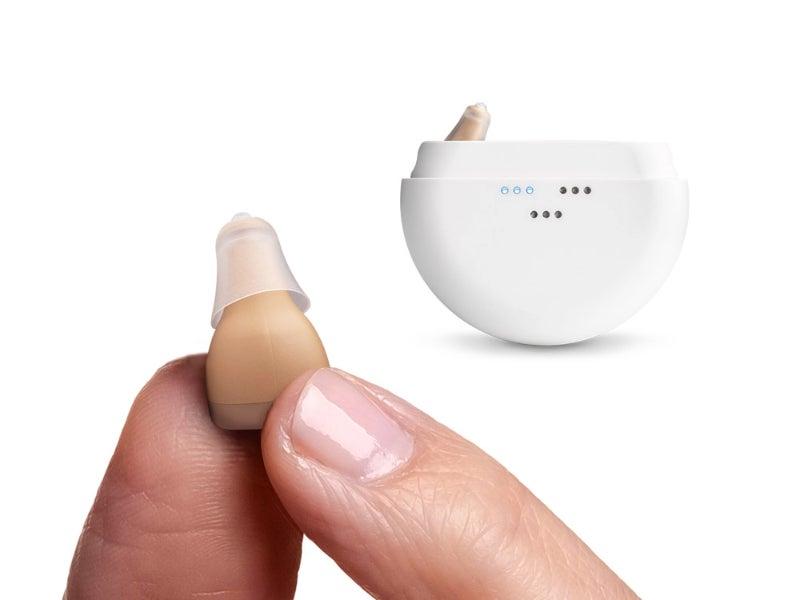 |
MDHearing Volt Max 2 |
|---|---|---|---|---|---|---|
| Cost | $297 |
$397 |
$297 |
$297 |
$597 |
$597 |
| Type | BTE |
BTE |
ITC |
CIC |
CIC |
BTE |
| Model notes: | 16-hour battery life, on-the-go charging case |
20-hour battery life, dual-directional microphones for clearer sound |
One hearing preset |
Four hearing presets, on-the-go charging |
Newest, smallest ever model |
Bluetooth streaming, app with personalized hearing test |
How to buy MDHearing hearing aids
MDHearing makes OTC hearing aids that can be purchased directly from their website without a prescription. The website offers a free online hearing test. It is generally recommended that you see an appropriate specialist if you suspect trouble with your hearing. An audiologist or hearing specialist can diagnose the exact type of hearing loss you have and which devices might be the best-rated hearing aids for you.
MDHearing setup and daily use
MDHearing makes basic hearing aids. Only one model uses an app or has Bluetooth capabilities, so most are fairly straightforward to use: Just charge them and put them in. Our testers did not run into any problems getting started. One person who tried the Volt said, “I was surprised that I got them to fit in my ear on the first try. The Volt comes with a stabilizer bar, so there's an extra wire to ensure it fits snugly and doesn't move. I anticipated that it would be more difficult to place than it was.”
Even the Neo XS, the brand's smallest model, was no trouble. “It was very easy to place correctly in the ear,” said a tester. Testers also commented that both models fit securely and were comfortable, although the stabilizer bar on the Volt may take some getting used to.
Using the devices was also pretty straightforward. The Volt, especially, has no app component, so it was all manual controls. Our testers noted that the user manual includes many pictures and clear, step-by-step troubleshooting instructions. Changing the wax guards was so simple that they could do it without needing to consult the manual.
The testers' experiences with the Neo XS were similar. “The manual is easy to read and contains lots of graphics which are helpful for guiding yourself through the process of setting up and using the hearing aids,” said one tester. The hearing aids turn on automatically when placed, and no app is required. Buttons on each device raise or lower the volume (indicated by a beep), and holding them for 3 seconds changes the program presets. The only pain point was accidentally adjusting the volume when initially placing the devices.
One thing to consider is that MDHearing hearing aids do not have an IP rating, which indicates how well they withstand water and dirt in daily use. The brand recommends regularly using a dehumidifier or dryer for the devices. If you live in a humid climate or will regularly come into contact with a lot of moisture, sweat, or dirt when wearing your hearing aids, you may want to consider a different brand with a high IP rating (68).
MDHearing accessories
MDHearing BTE hearing aids come with tubes and tips. The ITC models come with different-sized domes and several wax guards. All hearing aids come with a charger, cords, and a cleaning kit. You can also purchase a dehumidifier jar ($15) or an UltraDry UV Dryer ($99). These are recommended to regularly ensure your hearing aids don’t get moisture buildup that may affect their use.
Who should consider MDHearing
MDHearing hearing aids are made for adults who have mild to moderate hearing loss. They can be purchased without a prescription, but a hearing test is still recommended. MDHearing’s devices are among the most affordable on the market. According to our tests, they are a good budget option for those seeking a basic BTE or ITC hearing aid without paying for additional features. When deciding whether to purchase MDHearing hearing aids, consider the following questions:
- What is your budget? OTC hearing aids can range from several hundred to several thousand dollars. MDHearing offers budget-friendly hearing aids with very basic features. If you're looking for a higher-end hearing aid that remains affordable, Jabra is a brand we often recommend. Read our Jabra hearing aid review to learn more.
- How severe is your hearing loss? MDHearing OTC hearing aids are designed to treat mild to moderate hearing loss. If you have severe to profound hearing loss, we recommend visiting an audiologist to obtain prescription hearing aids.
- Do you care more about style or features? MDHearing has some discreet styles for BTE and ITC hearing aids. But most models don’t have a lot of advanced features like Bluetooth streaming or app control. And they have a limited color palette.
Frequently asked questions
How much do MDHearing hearing aids cost?
The MDHearing hearing aids in this guide range from $297–$597. The price may be affected by the options you choose.
Where can I buy MDHearing hearing aids?
MDHearing aids are only sold through the manufacturer’s website. The brand says that this is part of the reason they can offer their hearing aids for such a low cost.
Are MDHearing hearing aids legit?
Yes, MDHearing offers two styles of OTC hearing aids at a low cost and sells them directly to consumers. This may appeal to people on a fixed budget.
Questions? Email us at reviewsteam@ncoa.org.