
How to Include Adults with Low Vision in Falls Prevention Programs
5 min read

Our sense of sight is an invaluable source of information for navigating our surroundings. But for older adults, vision loss is common, affecting over a quarter of adults age 71+.1 By 2050, the number of older adults with visual loss and blindness is expected to double.2
When it comes to falls prevention, those numbers need our attention. Older adults with low vision are twice as likely to fall.3 And among older adults, low vision is associated with fear of falling, activity restriction, a 25% higher rate of recurrent falls, and increased fall-related injuries.4,5,6,7
The rising prevalence of vision loss in older adults, combined with the relationship between low vision and falls, means providers must incorporate practices and procedures to ensure older adults with low-vision can participate fully in evidence-based falls prevention programs.
Evidence-based programs with adaptations for low-vision participants
Several studies support providing falls prevention interventions to older adults with low vision. Such studies specifically recommend interventions that address fall risks from multiple angles, providing a combination of education, physical activity, medication management information, and home modification recommendations.8
A Matter of Balance (MOB) and Walk With Ease are evidence-based falls prevention programs that employ distinct approaches for preparing implementers to deliver programming to participants with blindness or vision loss.
MOB National Program Administrator Kirsten Dorsey, OTR/L, shares that their program has a high level of success for blind and low-vision participants. Dorsey describes that all MOB master trainers “have access to a low vision translation training and a toolkit to deliver MOB to people with low vision.” Additionally, MOB materials can be shared in up to 20-point font, translated into Braille, and are accessible on electronic readers.
Through funding received by the Administration for Community Living, San Antonio Lighthouse for the Blind: Vibrant Works is implementing MOB with participants who are blind or have low vision. Beverly Broom of Vibrant Works shares that she is successfully able to create MOB handouts and booklets for participants with vision loss on 11 X 17 paper. “It comes out about the size of a traditional newspaper,” she describes.
Implementors planning to engage older adults with blindness or low vision in MOB are encouraged to take MOB’s training and use MOB’s accessible program materials, rather than adapting the program on their own.
Walk with Ease similarly provides a guide that equips implementers with the knowledge needed to provide participants with a range of functional limitations and impairments, including low vision. The guide underscores the importance of including all individuals in Walk with Ease classes, as opposed to creating separate sessions for individuals with disabilities.9 The Walk with Ease guide also encourages instructors to consider personalized approaches attuned to the needs of participants and to collaborate with community partners and individuals with disabilities to design inclusive classes.
Accomodating visually impaired older adults in evidence-based falls prevention programs
Older adults with low vision who participate in falls prevention interventions presented in inaccessible formats are unlikely to derive the same benefits as their full-sighted peers.3
Therefore, it is critical that implementers employ strategies to welcome and accommodate low vision participants . Such strategies include:
- Create a welcoming recruitment and registration process: Include messaging in your participant recruitment materials that welcomes older adults who have vision loss. During the sign-up process, include questions about functional limitations and accommodations. Tip! Add an open-ended question for participants to describe their accommodation preferences rather than selecting from a menu of options.
- Use session zero: Hold a session zero, prior to the start of the program, to orient participants, including those with low vision, to available resources and optional accommodations. This can include familiarizing participants with apps that magnify text or pairing older adults who have low vision with a full-vision volunteer.
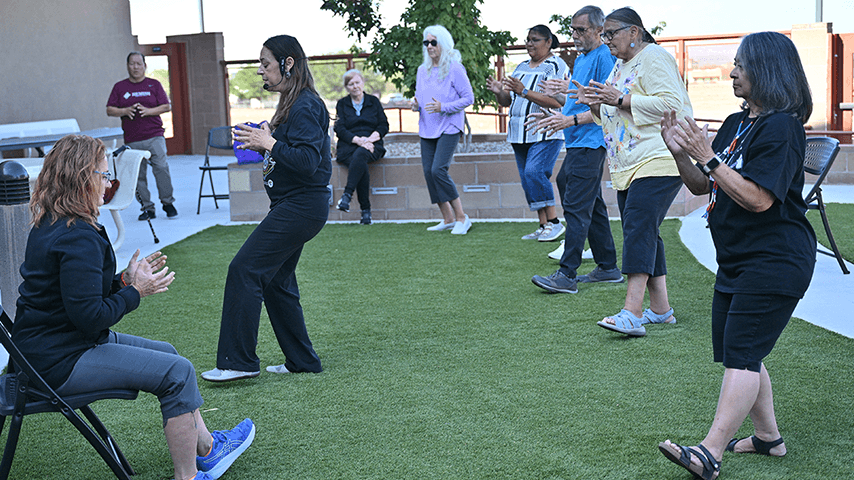
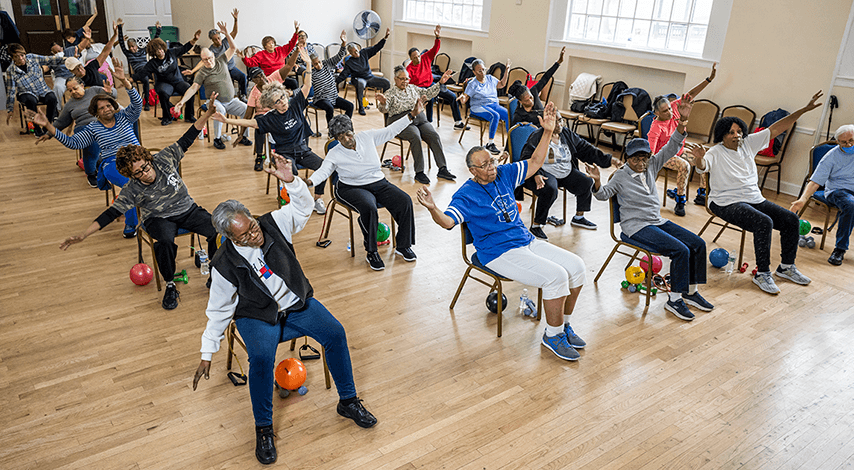
- Choose the right setting: Host your program in a familiar, well-lit setting that is convenient to access via public transit. Older adults with low vision describe concern with travelling to attend programs and prefer interventions that are offered where they live.3 For interventions involving movement, Broom also emphasized that instructors be cognizant that visually impaired participants may not be aware of fellow participants or physical obstacles. Tip! Space participants adequately from one another and remove clutter, such as backpacks, handouts, and canes, from the space.
- Format written materials: Improving text visibility and readability can increase visually impaired older adults’ understanding of written materials. Older adults with limited vision prefer large, bold, high contrast, simple fonts. Tip! Be mindful that increasing font size does not cause words to get cut-off.8
- Provide multiple delivery methods: Include multiple methods of program delivery. Consider providing audio recordings of written materials.3 During the workshop, Broom recommends including a second instructor who can provide live descriptions of movements so participants can replicate them correctly. Vivid descriptions help all participants, not only those with low vision, feel included and confident.
- Consider individual preferences: In addition to allowing for older adults with low vision to self-describe their accommodation preferences, check in with participants throughout the program to ensure changes made are helpful to the individual. Provide options for additional support and ask for suggestions to further improve.
More resources
Program implementers should also maintain knowledge of other resources that can provide older adults with additional support to stay active and independent. Resources for older adults with blindness and low vision include:
- APH Connect Center and Hotline: People with low vision can call 800-232-5463 to receive free support, practical coping strategies, and referrals.
- Vision Rehabilitation Services: Learn more about connecting older adults with life-changing vision rehabilitation services.
- Time to Be Bold: Individuals 55 and older can locate vision rehabilitation services and other vital resources.
- Vision Aware: Access free information and resources designed for low vision and blind adults, caregivers, providers, and professionals.
- Assistive Technology: Apps and products such as Be My Eyes and Seeing AI can support older adults during and outside of evidence-based falls prevention.
With the number of older adults with vision loss expected to increase to nearly 7 million by 2050, the need to provide accessible and welcoming falls prevention programming to blind and low vision older adults is critical.14 Small adjustments to improve the accessibility of evidence-based programs can ensure that all participants are positioned to stay active and independent as they age.
Sources
1. Killeen, OJ, et al. Population prevalence of vision impairment in US adults 71 years and older: the National Health and aging trends study. JAMA Ophthalmology. February 2023. Found on the internet at https://pubmed.ncbi.nlm.nih.gov/36633858/
2. Varma R, et al. JAMA Ophthalmology. Visual impairment and blindness in adults in the United States: demographic and geographic variations from 2015 to 2050. July 2016. Found on the internet at https://jamanetwork.com/journals/jamaophthalmology/fullarticle/2523780
3. Blaylock, Sarah E. et al. Accessible Fall Prevention Interventions for Older Adults With Low Vision. Topics in Geriatric Rehabilitation. October 2017. Found on the internet at https://www.researchgate.net/publication/320639733_Accessible_Fall_Prevention_Interventions_for_Older_Adults_With_Low_Vision
4. Ehrlich, JR, et al. Prevalence of Falls and Fall-Related Outcomes in Older Adults with Self-Reported Vision Impairment. Journal of the American Geriatric Society. November 2018. Found on the internet at https://pubmed.ncbi.nlm.nih.gov/30421796/
5. Wang, MY, et al. Activity Limitation due to a Fear of Falling in Older Adults with Eye Disease. Journal of the American Geriatric Society. December 2012. Found on the internet at https://iovs.arvojournals.org/article.aspx?articleid=2165366
6. Donoghue, OA, et al. Relationship between fear of falling and mobility varies with visual function among older adults. Geriatrics & Gerontology International. November 2013. Found on the internet at https://pubmed.ncbi.nlm.nih.gov/24215140/
7. Nguyen AM, et al. Physical activity restriction in age-related eye disease: a cross-sectional study exploring fear of falling as a potential mediator. BMC Geriatrics. June 2015. Found on the internet at https://pubmed.ncbi.nlm.nih.gov/26062727/
8. Blaylock, Sarah E., et al. Providing Accessible Fall Prevention Education for Older Adults With Low Vision. Topics in Geriatric Rehabilitation. July 2022. Found on the internet at https://www.researchgate.net/publication/362210108_Providing_Accessible_Fall_Prevention_Education_for_Older_Adults_With_Low_Vision
9. Arthritis Foundation. Disability Adaptation Guide for Program Leaders. Found on the internet at https://www.arthritis.org/getmedia/b1942758-b762-4f4a-9293-edb50ab49247/Disability-Adaptation-Guide_Walk-with-Ease.pdf
10. Varma, R, et al. Visual Impairment and Blindness in Adults in the United States: Demographic and Geographic Variations From 2015 to 2050. JAMA Ophthalmology. July 2016. Found on the internet at https://pubmed.ncbi.nlm.nih.gov/27197072/
This project was supported by the Administration for Community Living (ACL), U.S. Department of Health and Human Services (HHS) as part of a financial assistance award totaling $5,000,000 with 100 percent funding by ACL/HHS. The contents are those of the author(s) and do not necessarily represent the official views of, nor an endorsement, by ACL/HHS, or the U.S. Government.