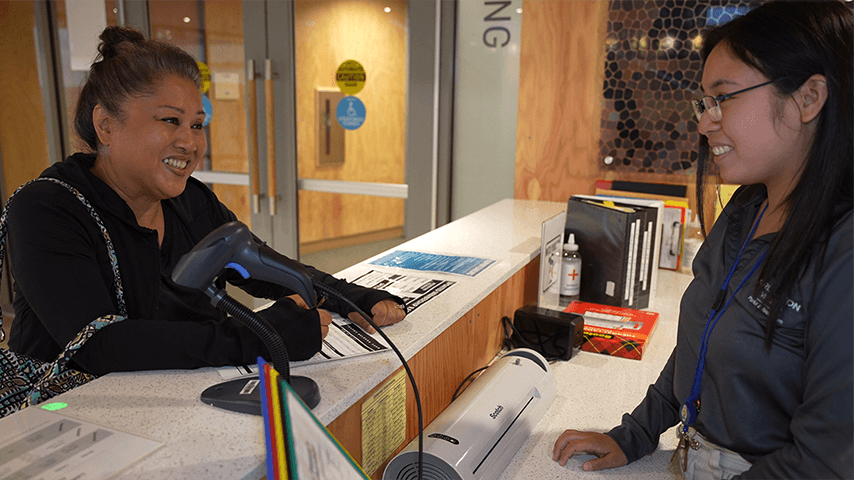

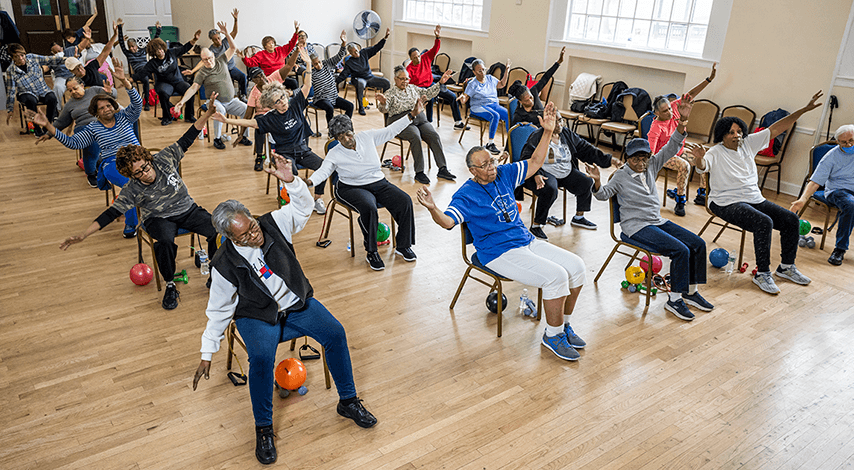
The SAIL (Stay Active and Independent for Life) program is an evidence-based exercise initiative designed to improve older adults' strength, balance, and fitness.
The basics:
- SAIL can be offered with some variety in the class structure, with a common schedule including two classes per week for 12-weeks, for a total of 24 sessions.
- Participants who attend at least 18 of the 24 sessions are considered to have completed the program, for the purposes of the Administration for Community Living falls prevention grants.
- While some participants attend one 12-week round of the class, many community members are interested in ongoing participation throughout the year to support their fitness and wellness goals.
Below are key recommendations based on current practices and lessons learned from program sites to structure ongoing SAIL classes while balancing requirements for data collection, program leader availability, and participant retention.
Data collection and tracking
Organizations funded by ACL to implement falls prevention programs are required to use Office of Management and Budget-approved data collection tools, including a pre- and post-survey. Consider the following process for data collection to support ongoing participants.
- New participants complete the required pre-survey before or during the first session of the 12-week SAIL class.
- At the end of the 12-week class, all participants complete the post-survey.
- If participants repeat a session, the original pre-survey is tracked and entered into the Healthy Aging Program Integrated Database (HAPID®). Another post-survey is conducted at the end of the repeat session.
- This process repeats for as many 12-week classes as the participant completes.
Optional functional assessments
Many organizations implementing evidence-based falls prevention programs conduct optional functional assessments as part of program implementation. Examples of functional assessments include the timed up-and-go test, chair stands, and four-stage balance test, among others.
If your site conducts functional assessments as a part of program implementation, progress can be recorded at the same time as the pre- and post-survey completion.
Functional assessments are a great way to get participants engaged and excited about their fitness progress following each 12-week round of the class. A few recommendations for completing and recording the results of functional assessments:
- Maintain paper forms with participant names and columns for each fitness test.
- Complete initial assessments in week one and use the same sheet for post-session assessments.
- Consider conducting quarterly reviews with participants about their health and progress. This is an opportunity to check in with all participants and ask about recent falls or other notable events.
- Data for 12-week rounds in HAPID® should be entered within 30 days of completing the 12-week cycle.
- While collecting data on these functional assessments is optional, you can enter this data into HAPID® if you wish to track these outcomes in conjunction with participants’ demographic and health profiles.
Managing new and repeat participants
Sites have taken different approaches to managing new and repeat participants in SAIL classes. The following options can be considered based on your site and community needs.
- Offer a brief break (typically one week) between 12-week class sessions.
- Some sites separate repeat participants from new participants, creating dedicated sections for each group.
- When mixing experience levels, encourage newer participants by showing them the progress of returning participants.
- Avoid allowing new participants to join mid-session; instead, start them at the beginning of a new 12-week cycle.
- It is recognized that some participants will return to SAIL in subsequent 12-week sessions. A participant is treated as a ‘new’ participant in each 12-week session in HAPID and toward your grant’s program targets. There is no penalty for counting a participant more than once.
- Given the wide variation in the total number of sessions grantees can deliver SAIL, when creating workshops in HAPID, you’ll be prompted to enter the total number of sessions structured for that workshop.
Program flexibility and instructor support
- Instructors need flexibility; structuring classes into 12-week segments with breaks helps prevent burnout.
- Encourage multiple instructors per site to cover absences due to illness, maternity leave, vacation, or other needs.
- Support cross-training by encouraging instructors to observe each other's classes.
- Organize an annual gathering for instructors to network and share best practices.
Retention strategies
- Maintain a visible attendance sheet to record participant progress also help individuals track their commitment and stay motivated to finish the 12-week class.
- Offer a Zoom link for remote participation during inclement weather, reducing attrition.
- Create a sense of community and accountability by allowing participants to see their progress alongside peers.
- Provide structured integration plans for new participants when many repeat participants are present.
Ongoing SAIL classes may support older adults in maintaining their independence, preventing falls, and improving overall well-being.
By implementing thoughtful strategies for data collection, participant management, instructor support, and retention, organizations can create sustainable and engaging programs that meet the needs of both new and returning participants. Flexibility, communication, and a sense of community are key to maintaining program fidelity while adapting to local contexts. As demonstrated by successful implementations like those at Sanford Medical Center, these best practices can guide organizations in delivering high-quality, year-round SAIL programming that truly makes a difference.
Many thanks to Karla Cazer and Abby Gramlick-Meuller for sharing best practices from their program implementation at Sanford Medical Center in South Dakota.
Photo copyright Rebecca Drobis for NCOA use only
This project was supported by the Administration for Community Living (ACL), U.S. Department of Health and Human Services (HHS) as part of a financial assistance award totaling $5,000,000 with 100 percent funding by ACL/HHS. The contents are those of the author(s) and do not necessarily represent the official views of, nor an endorsement, by ACL/HHS, or the U.S. Government.
How NCOA Helps Older Adults Thrive
NCOA's Center for Healthy Aging (CHA) provides training and technical assistance to help professionals support community-based health education opportunities for older adults and adults with disabilities.