
Related Topics
As soon as the caller spoke, Sherman J. sensed trouble.
The person on the phone sounded professional. They said they were from his bank. They even knew his routing number.
But, explains the 67-year-old, “I had a feeling like a pit in my stomach that something wasn’t right.”
Instead of following the caller's instructions, Sherman hung up and called his bank directly. "The bank said they never called me," he said.
The initial phone call had been a scam. His bank advised him to visit his local branch immediately, close his account, and open a new one before any money could be stolen.
It wasn’t Sherman’s first run-in with a scammer: “And I’ve had another one where at another bank, small amounts were being taken out. I just happened to be up late that night around 12:30, 1 a.m., and saw a $2.00 transaction, and another one, then they kept going.”
Unfortunately, Sherman isn't alone.
Older Americans (age 60+) continue to be disproportionately affected by financial scams, filing more than 201,000 fraud complaints in 2025 with reported losses of more than $7.7 billion—an increase of about 37% from the previous year.1
|
5 Scam Prevention Tips for Older Adults |
|
✅ Pause before you respond. |
|
✅ Verify who’s contacting you. |
|
✅ Never pay with gift cards or cryptocurrency. |
|
✅ Never share sensitive info (e.g., Social Security, Medicare numbers). |
|
✅ Use strong passwords with all your accounts. |
And since most incidents of fraud are never reported to authorities2, these figures merely scratch the surface.
“Older adults are frequent targets because scammers believe they may have savings and are more likely to trust phone calls, texts, emails, and Facebook ads that look authentic at a glance,” said Ebony White, scam prevention expert and NCOA’s Director of Economic Security & Social Safety Net Initiatives. “This is especially true when scammers pretend to be from government agencies like Medicare or Social Security. But scams affect people of every age, and anyone can be tricked under the right circumstances.”
For many older adults, the question isn't whether they'll encounter a scam; it's whether they'll spot it in time.
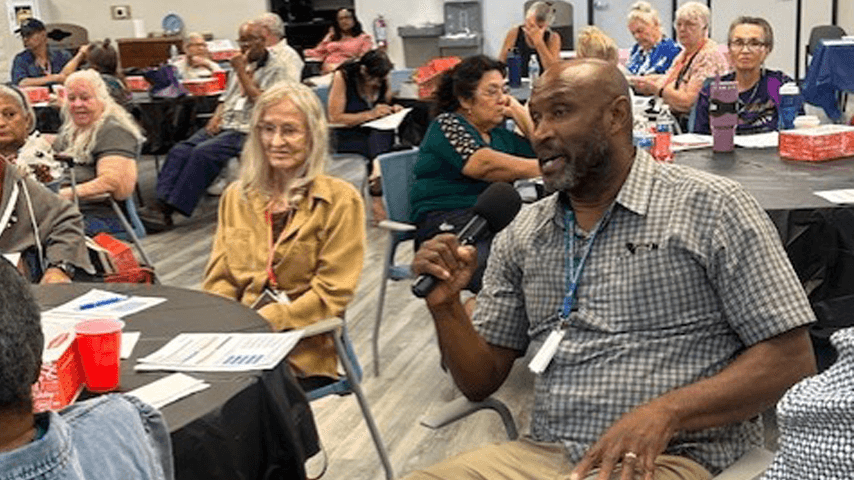
After a couple of close calls with scammers, Sherman signed up for a free “Scam Awareness Lunch & Learn” workshop held at the Desert Hot Springs Senior Center in Riverside County, California. There, he discovered more than a free meal, camaraderie, and practical advice. He found the confidence to trust his instincts.
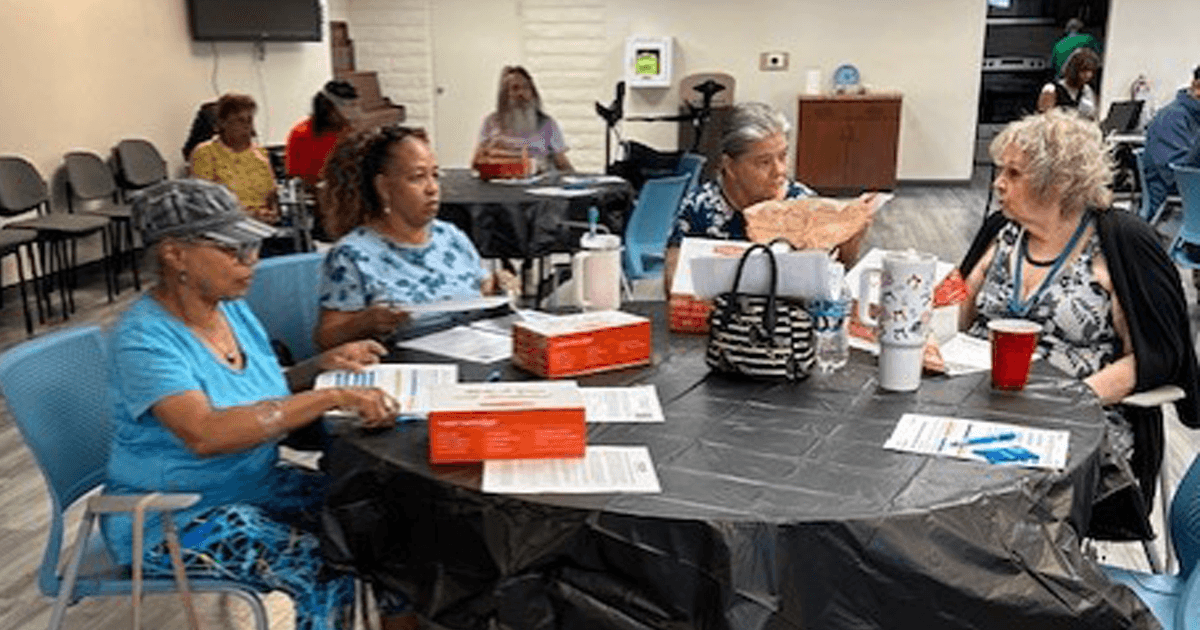
Desert Hot Springs Senior Center: Meeting older adults where they already are
Founded in 1979, the Desert Hot Springs Senior Center is a bustling hub of activity where adults age 50+ can enjoy a nourishing meal, art and exercise classes, ice cream socials, or a lively karaoke session with friends. The senior center aims to connect people with supportive services and community-based programs that can help them age well.
But healthy aging is about more than staying active and connected. It also means empowering older adults to stay safe from predatory schemes that can jeopardize their financial security, independence, and peace of mind.
Melanie Hoyt Ferrone, the center’s Senior Services Director, has seen an uptick in scams affecting her community, particularly in recent months. “Romance scams” target those who may be feeling lonely. Others receive text messages claiming they've won money or offering opportunities that seem too good to be true. Some older homeowners are being approached at their front door by “contractors” promising home repairs or solar panel installations—only to lose money after paying upfront. “They come the next day and start tearing up the roof and never come back,” Ferrone said.
With the advent of technologies like artificial intelligence (AI), financial scammers can create startlingly convincing emails, websites, text messages, photos, videos, and even voices—so it’s easier to persuade people to share personal information or send money.
You have no way of knowing what's legit or not," Ferrone explained. "How do you know if the Time Warner person is really Time Warner or if they're just putting a hack thing on your internet?"
Ferrone says this uncertainty is why scam prevention outreach is critical. “It’s just so important to get the information to them. Sometimes there’s a disconnect for the information, but maybe it’s because they don’t feel comfortable in asking,” she said.
Trusted community spaces like the Desert Hot Springs Senior Center are a critical access point for scam prevention education. That’s because they offer a safe place for older adults to share their experiences and ask questions without fear of being judged or ridiculed. This is reassuring for those who may feel embarrassed or uncomfortable talking about scams with family members.
"We are their second home. We're their local family,” Ferrone said. “They feel like they can be themselves and they’re not seen as an ‘older person’. They’re seen as a person!”
That trust is at the heart of community-based outreach. It’s why NCOA and JPMorgan Chase have partnered to bring scam prevention education directly to settings where older adults already gather and feel at ease.
Lessons that inspire safer everyday habits
As participants shared their own experiences during the “Scam Awareness Lunch & Learn” workshop, Sherman quickly realized he wasn't the only one who had encountered scammers in the wild.
Yolanda R., 80, showed up for the workshop because she had been targeted herself and wanted to learn how to better spot red flags in the future. One lesson that stood out for her was understanding the difference between scams and fraud, along with safer payment habits.
Her advice to others was basic: "Be more aware about what you click on the computer or cell phone," she said. "There is no such thing as free or quick schemes."
She also appreciated the workshop's casual, conversational feel. The Chase representative, Yolanda says, "talked to us like people and provided a personal touch."
Participant Shelia T., 68, had attended similar workshops before, yet she still discovered something new. She was surprised to learn about voice-cloning scams, where AI is used to replicate the voice of a loved one to make fraudulent calls much harder to detect.
"I did not know about picking up the phone and voice cloning," Sheila said.
Sheila’s new strategy: Let unfamiliar callers leave a voicemail if the call is important. "These people are up 24 hours a day, seven days a week being coached," she said. "Protect yourself."
Building confidence through community
And what about Sherman? After the scam prevention workshop at the Desert Hot Springs Senior Center, he had a better grasp on how to protect his money and personal information. The experience reinforced something he already knew: It’s important to trust your gut, and a little caution goes a long way.
Sherman now checks his accounts regularly. "Monitor your accounts," he said. "Stay on top of them. Keep organized." He pauses before responding to unexpected requests. And when Sherman feels that familiar pit in his stomach, he takes it as a sign to stop and double-check.
He encourages others to do the same.
Sherman’s advice echoed a message shared throughout the scam workshop: When something feels urgent, that's often the best time to slow down and take a closer look.
“Scammers know that when emotions run high, good judgment can take a back seat. They use fear or excitement to pressure you into acting before you've had time to think things through,” said Cari Gordon, Vice President and Community Manager at Chase, who led the workshop. “What we're trying to do is replace that fear with knowledge and confidence. When older adults understand how scams work, they're much more likely to pause, ask questions, and protect themselves before any money is lost.”
Ultimately, staying safe from scams isn't about having all the answers. It's about knowing where to turn when you don’t. And for many older adults, that place just might be their neighborhood senior center.
“No one can keep up with every new scam,” NCOA's Ebony White points out.
Asking questions like, ‘Does this seem legitimate?’ isn't a sign of weakness or naivety. It's one of the smartest ways to protect yourself. You don’t have to figure everything out on your own,” she said.
📣 📆 Coachella Valley residents: The Desert Hot Springs Senior Center will host another scam prevention workshop on Monday, September 28, 2026, at 11:00 a.m. PT at 11777 West Drive, Desert Hot Springs, California. To register for the workshop, call 1-760-329-0222.
Sources
1. Federal Bureau of Investigation (FBI) Internet Crime Complaint Center (IC3). Internet Crime Report 2025. Found on the internet at https://www.ic3.gov/AnnualReport/Reports/2025_IC3Report.pdf
2. Federal Trade Commission. Protecting Older Consumers 2024–2025. December 1, 2025. Found on the internet at https://www.ftc.gov/system/files/ftc_gov/pdf/P144400-OlderAdultsReportDec2025.pdf
Top 5 Financial Scams Targeting Older Adults
Financial scams targeting older adults can be devastating, leaving you in a vulnerable position and without time to recoup your losses. Learn how to identify and stop the top 10 financial scams.