As Scams Evolve, One Arizona Senior Center Helps Older Adults Stay Ahead
9 min read
Related Topics
Nell J., 75, knows the world is changing quickly. Whether it’s new smartphone apps or artificial intelligence (AI) tools that provide health reminders, there will always be something novel to explore.
“I'm trying to get on the up and up with technology,” said the Youngtown, Arizona resident at a scams prevention workshop hosted by Banner Health Olive Branch Senior Center last month.
Nell’s desire to learn more was sparked by a recent unexpected text message. An unknown sender claimed to have made a payment toward her car loan. All they needed was a bit more information to seal the deal.
For a moment, Nell was delighted. Then, a wave of uncertainty washed over her. While she doesn't consider herself well-versed in technology, she did spot one warning sign: the sender wanted her personal information.
“I knew better than to click the link,” she explained. “Things are moving fast. You don't know who to trust or who not to trust.”
Scammers have stepped up their game
Nell had good reason to be suspicious about the mysterious text message. In 2025, Americans 60 and older submitted more than 201,000 fraud complaints to the FBI, with losses from financial scams in this age group topping $7.7 billion—about 37% higher than 2024.1
One major factor in the rise of scams targeting older adults is the evolution of AI and voice cloning, which give criminals even more ways to make their lies look and sound convincing. With just a few clicks, scammers can now create highly personalized and realistic voice clips, videos, websites, emails, social media posts, and more. Fake bank alerts and spoofed calls and text messages are making fraud even harder to spot—even for older people who consider themselves tech-fluent.
Jennifer Lawless, Director of the Banner Health Olive Branch Senior Center in Sun City, Arizona, is seeing this trend play out in her community. “Our seniors are really concerned about it and worried,” she said. “And honestly, most of them will admit they have been scammed or they have been victim to some kind of online fraud.”
The center’s participants routinely share encounters that Lawless recognizes as imposter scams: “I’ve had people tell me, ‘I got a call that sounded like it was from my grandson. He was telling me in his voice that he is jail, and I’m supposed to get him money.’”
Those kinds of scams are especially sinister, says Ebony White, scam prevention expert and NCOA’s Director of Economic Security & Social Safety Net Initiatives. “The voice on the other end doesn’t belong to a stranger claiming to work for a bank or government agency,” she explained. “It sounds like someone the recipient loves and trusts. And that familiarity can make an urgent plea for money feel all too real.”
Lawless can empathize with the older adults she serves, as she’s had her own encounters with scammers. After a recent trip to Home Depot, where her husband made a purchase, she received a text claiming to be from her bank. It asked whether she had authorized a $1,500 payment at the store.
She hadn't made that purchase. Still, the timing of the text message was jarring.
“How did they know I was in Home Depot?” Lawless recalled wondering.
She checked her bank information, recognized the message as fraudulent, and deleted it. But the experience stuck with her. If criminals can deceive a person who has already learned to look for scams, what happens when someone is encountering these types of messages for the first time?
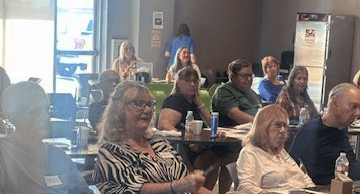
It was this concern that inspired Lawless and her team to host a scam prevention workshop at Banner Olive Branch Senior Center, sponsored by NCOA and JPMorgan Chase.
A judgment-free “home away from home”
With roots tracing back to 1988, Banner Olive Branch Senior Center prides itself on being a home away from home for the region’s older population. Staff members help older adults with needs that touch many aspects of daily life: from food, utility assistance, and applying for Medicaid to nurturing social connections. Educational classes and a computer lab offer seniors ongoing opportunities to learn and practice new skills.
Lawless describes her center as caring for the whole person and respecting every older adult who comes through the door. “We look at everyone here as if they were extended family,” she said.
Sometimes, that starts with helping a newcomer find a place to sit.
She has watched people arrive alone after moving to the area, nervous about stepping into an unfamiliar space. Staff help introduce them to others, sometimes seating them with a particularly welcoming table. Over time, those newcomers find friends and a group of their own.
“That sense of belonging matters when someone has a question, they may be afraid to ask,” said NCOA’s White. “A person who already knows the staff and feels comfortable at the center has somewhere to turn when an unexpected message or phone call doesn't seem right.”
The idea of scam prevention education sprung naturally from the questions Lawless and her staff were already fielding daily. It was clear participants needed a place to talk through their concerns and learn steps they could take to better protect themselves.
Even the tech-savvy can be caught off guard
Mary C., 76, of Glendale, Arizona, came to the workshop at Banner Olive Branch Senior Center after an especially frightening experience.
She and her husband had nearly given scammers information that could have put their financial accounts at risk. Her husband was about to provide their bank account numbers when their daughter intervened.
“Hang that phone up,” she told them.
Mary said they subsequently had their computer checked and went to their bank, where their accounts were changed. She remembers how close they came to giving away the information, and how quickly the situation unfolded.
“It was awful,” she said. “We were inches away from them getting into our banking accounts.”
What made the experience truly unsettling was that Mary and her husband had believed they could recognize a scam.
“We always thought we were pretty smart about it,” she said. “We were not.”
Mary's story shows how an encounter with a scammer can shake someone's confidence, even when they think of themselves as knowledgeable and careful.
Afterward, Mary wanted to understand how to prevent another close call. She signed up for the workshop, where she could build on what she knew and consider precautions she hadn't thought about before.

As scammers switch up their tactics, education helps older consumers keep pace, says Antonio Lara, Vice President, Community Manager in Glendale, Arizona for JPMorgan Chase. “Our goal is to make sure older adults are prepared and have the knowledge and confidence to recognize when something doesn't feel right. Stay organized, ask questions, and take the time to verify before they respond to urgent requests,” Chase's Lara said.
6 Warning Signs of a Scam & What to Do
|
Warning sign |
You should… |
|
An unexpected message asks for money or personal information. |
Contact the person or organization using a number you trust. |
|
Someone pressures you to act immediately. |
Pause. Give yourself time to check the story. |
|
A caller sounds like a family member asking for urgent help. |
Hang up and call your loved one directly. |
|
A message includes an unfamiliar link or attachment. |
Go directly to the official website instead or call the organization’s number directly. |
|
Someone demands payment by gift card, wire transfer, or cryptocurrency. |
Stop. Don’t send money. |
|
Someone asks for your password or verification code. |
Don’t share it. |
A familiar setting makes asking questions easier
Banner Health Olive Branch's Lawless sees how the conversation blooms when people start sharing their scam experiences. One person’s question can help another recognize a warning sign; a neighbor’s story can make it easier to speak up.
“It's kind of nice for people to see that it's not just them who are worried about it,” Lawless said. “It's their friends, it's their neighbors.”
That sense of connection helps ease the shame and embarrassment that can keep people from seeking help after a scam. In a familiar, welcoming space, they can ask questions and find resources without feeling judged.
“I think that with the education we're receiving and coming together in these community spaces, we can learn how to be more adaptive,” Lawless said.
She says they’re discovering that seniors can be, too—and that’s what’s most important.
“By all of us working together, we can combat fraud,” she said.
In this tech-centric era, it’s important stay curious
Nell attended the workshop at her senior center because she wanted to learn more about the deceptive tools and practices scammers are using today.
What she learned reinforced her determination to stay informed. Recognizing one scam doesn’t mean the next will be easy to spot. But Nell can keep building on the knowledge she already has.
She urges other older adults to attend scam prevention workshops offered in their area. “Things aren't the way they used to be,” Nell said. “You have to be, as much as you can, aware and on your toes.”
That desire to keep learning is far more powerful than fear. And at Banner Olive Branch Senior Center, Nell has people she can lean on as she learns to recognize new threats and protect herself.
NCOA’s Ebony White reminds older adults that being targeted by a scam isn’t a reflection of their intelligence or ability to use technology. “Scammers are becoming incredibly sophisticated, and it can happen to anyone,” she explained. “What's important is having the confidence to pause, ask questions, and know where to turn for help, like your local senior center. It’s much easier to keep up with a changing world when you have a community by your side.”
Source
1. Federal Bureau of Investigation (FBI) Internet Crime Complaint Center (IC3). Internet Crime Report 2025. Found on the internet at https://www.ic3.gov/AnnualReport/Reports/2025_IC3Report.pdf
Top 5 Financial Scams Targeting Older Adults
Financial scams targeting older adults can be devastating, leaving you in a vulnerable position and without time to recoup your losses. Learn how to identify and stop the top 10 financial scams.