


Related Topics
Whether you keep close track of every penny—or cross your fingers and hope for the best—it can be hard talking about your personal finances.
Unfortunately, this can prevent you from getting the information and help you need to build good money and debt management skills.
Good money management skills are increasingly important as we age. An analysis by NCOA and LeadingAge LTSS Center @ UMass Boston found that 80% of Americans 60 and older continue to face financial insecurity.1
In this simple guide to budgeting for older adults, we’ll walk you through why budgeting is so important, how to use a budget calendar, and ways to boost your bottom line with financial assistance programs.
Create a Budget in 4 Easy Steps
| Step | What to do | What to include |
|---|---|---|
| 1. Understand the parts of a budget | Learn which types of income and expenses belong in your monthly plan. | Income; fixed, flexible, periodic, and discretionary expenses |
| 2. Add up your income | Gather records showing all the money you receive each month. | Social Security, SSI, wages, pensions, stipends, life insurance payments, and other income |
| 3. Track your spending | Write down everything you spend for at least one week. | Bills, groceries, transportation, health care, entertainment, and small purchases |
| 4. Create your budget | Record your income and expenses on one budget sheet. Compare what comes in with what goes out. | Use NCOA's blank budgeting calendar to get started. |
Why is it so hard to talk about money?
American adults have a financial literacy rate of only around 50%.2 It’s no wonder 22% of people age 60+ reported feeling anxious when thinking about their financial situation.3
“So many of us were raised to believe that talking about money is taboo—even more so than discussing politics at the Thanksgiving table,” said Jessica Johnston, NCOA Senior Strategist for Economic Well-Being. “But that means we miss out on valuable opportunities to learn from others’ successes and mistakes—and to grow our understanding of how money management works with help from trusted family and friends.”
These missed opportunities can also be particularly harmful for older adults who live on fixed incomes.
Today’s economy means that many people are struggling to make ends meet,” Johnston continued.
“But when they suffer in silence, because they’re reluctant to talk about money, they don’t get the help or benefits they deserve,” she said.
Flora Wallace's story
Flora Wallace knows this all too well. The 74-year-old retired Chicagoan lives on her monthly Social Security check. It doesn’t stretch as far as it used to since food prices have significantly increased over the past several years. Although Wallace needs to follow a healthy diet to help manage her diabetes, she was finding it more and more difficult to buy nutritious food after paying her rent and other bills.
“When you live on a fixed income, sometimes you have the chance to buy the food you want and sometimes you don’t,” Wallace said.
Fortunately, she reached out to the Greater Chicago Food Depository, where she received help enrolling in the SNAP benefits program. Now, with this important food assistance, she finds it much easier to balance her budget.
Speaking of budgets—knowing how to set up and use one is perhaps one of the most important steps you can take to better control your money. And it's never too late to get started.
Why should older adults create a budget?
Having a budget helps you understand how much money you have coming in, where it’s going, and whether your income will comfortably cover your expenses. It can make it easier to manage a fixed income and cut down unnecessary spending. Plus, budgeting can help your retirement savings last longer.
“For many older adults, the path to financial stability begins with basic money management,” NCOA's Johnston said. “Learning how to budget can help them stay secure and independent longer, which is essential to aging with dignity, choice, and peace of mind.”
Learn more:
- Learn 5 simple ways to build your retirement confidence.
- Discover 14 steps to help you get ready for retirement.
How can I budget on a fixed income?
Get prepared to set up a budget with the tips below.
1. Before you begin, read up on NCOA’s Top 10 Budgeting Tips for Older Adults. This handy guide will help you identify key areas where you may be able to put more money back into your pocket.
2. Consider setting up a budget calendar. If you do nothing else, this simple money management tool will provide immediate visual insight into your finances. And you don’t need a fancy computer program to do it.
3. Learn about the 70/30 rule—a common budgeting formula that can help guide your spending decisions.
- Live on no more than 70% of your income
- Save 30% of your income
“When you’re on a fixed income, saving money can seem impossible,” Johnston said. “But building up a financial safety net is crucial at any age. Sticking to this guideline creates personal accountability.”
The 70/30 rule, in other words, can help guide your spending decisions: Do I need this? Or do I want it? Even if this goal seems out of reach right now, it’s a good one to shoot for as you make budgeting a regular part of your life.
4. Boost your budget with benefits programs—which can provide crucial financial assistance. If you’re a retired worker living on the average monthly Social Security benefit of $2,031.71 (as of July 2026), you may not have much left to save at the end of the month. Fortunately, there are public and private benefits programs that can help you pay for food, medicine, utilities, and other daily expenses.
Visit NCOA’s BenefitsCheckUp and enter your ZIP code to learn more and get connected to programs in your area. It's free and 100% confidential.
How do I set up a budget?
The tips below can help get you started on a path to better money management.
1. Learn about the parts of a budget. These are the numbers you will plug into your monthly plan and include:
- Income: Your Social Security, Supplemental Security Income, training wages from Senior Community Service Employment Programs, or volunteer stipends.
- Monthly fixed expenses: Your mortgage or rent; medical insurance premiums; and fixed debt payments.
- Monthly flexible expenses: Your food, utilities, and gas for your car.
- Periodic expenses: Costs for your home and car insurance, repairs and maintenance, and your property taxes.
- Discretionary expenses: Your clothing and personal care purchases; entertainment; and charitable giving.
2. Identify where your income comes from. Gather up all of your pay stubs from Social Security and other government benefits, pensions, and any money you receive from life insurance plans or other sources.
3. Learn where your income goes. For one week, keep track of everything you spend your money on. Be honest! Using a spending diary like the one below can help (notice how we've already tracked expenses and income)
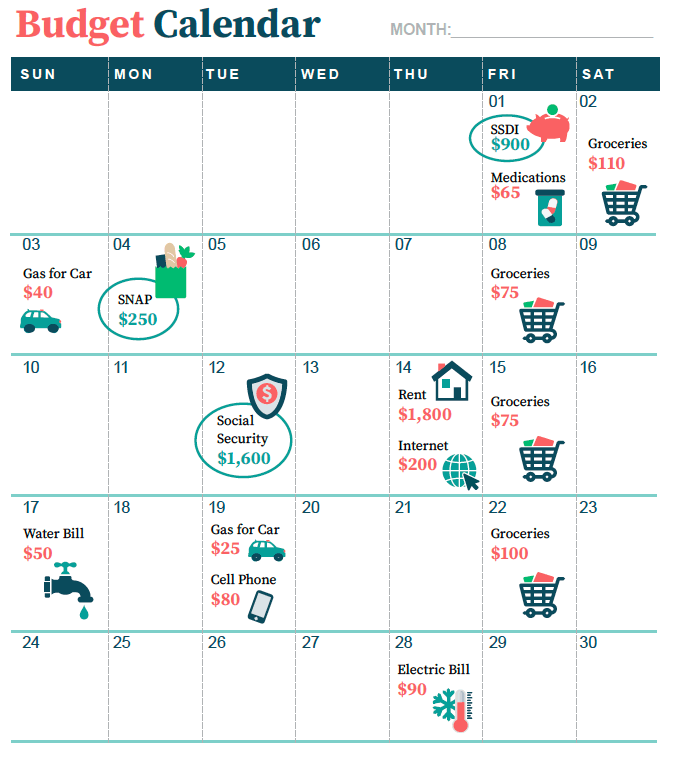
4. List everything on a simple budget sheet. Pull everything together in one place and voila! You have a working budget! Try creating yours today with NCOA's blank calendar (link to download at home).
Frequently asked questions (FAQ)
What expenses should I include in a retirement budget?
You should include your basic, essential expenses—like housing (rent or mortgage), utilities (electric, gas, water), food, transportation, health care, insurance, taxes, and debt payments in your retirement budget. Also, plan for flexible and occasional costs, like clothing, travel and entertainment, gifts, home and car repairs, and emergencies.
How do I adjust my budget for inflation?
Look at your budget at least once a year and compare your current expenses with what you previously spent. Increase estimates for costs you know have gone up, such as groceries, utilities, insurance, and health care. If your expenses are growing faster than your income, look for ways to cut spending or explore benefits programs that can help lower your costs.
How do I budget for home repairs and maintenance?
Set aside money each month in a separate home maintenance fund. Consider the age and condition of your home and plan for both routine upkeep and larger repairs—things like a roof, heating system, or major appliance. Keeping an emergency fund can also help you manage repairs that cannot wait.
The bottom line when it comes to budgeting
Of course, having a budget won’t change your money situation overnight. But it will be a powerful tool for helping you achieve toward greater financial stability. And remember, using a budget takes practice. Even if you hit some obstacles along the way, keep trying with the 70/30 rule in mind.
Sources
1. Jane Tavares, PhD et. al. The 80%: Increases in Older Americans’ Income and Household Assets Still Cannot Support Most During Financial Hardship. National Council on Aging and LeadingAge LTSS Center @UMass Boston. August 2024. Found on the internet at https://assets-us-01.kc-usercontent.com/ffacfe7d-10b6-0083-2632-604077fd4eca/108ad617-addf-4d8d-9919-5197cc08b4e9/2024_Research_80_Report.pdf
2. World Economic Forum. Can you answer these 3 questions about your finances? The majority of US adults cannot. April 24, 2024. Found on the internet at https://www.weforum.org/stories/2024/04/financial-literacy-money-education/
3. FINRA Investor Education Foundation. “Gauging the State of Financial Capability in the U.S.” Found on the internet at https://finrafoundation.org/knowledge-we-gain-share/nfcs
Work Toward Better Budgeting
Learn how to build a plan to better manage your money, including financial planning, how to earn extra income, and ways to use prepaid cards wisely.