

Related Topics
Continuous positive airway pressure (CPAP) machines provide effective, non-invasive treatment for sleep apnea: a common yet serious disorder affecting as many as 30 million people in the U.S.1
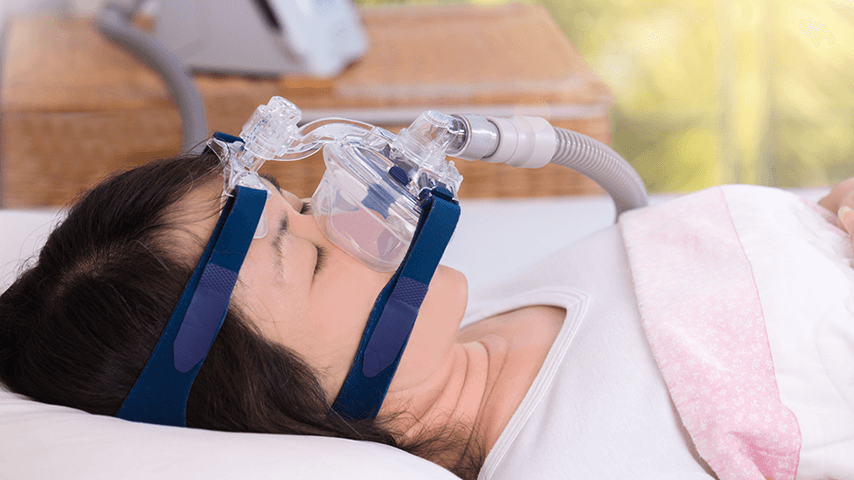
CPAP machines work by delivering a constant, forceful stream of air through a mask worn over the nose and mouth. This stream physically keeps the airway open during sleep without the need for medications or surgery.
Still, CPAP therapy can be hard to get used to. The pressurized air can be loud and uncomfortable, especially at first. CPAP ramp time can help. People who know about this feature and how to use it are more likely to stick with their sleep therapy long-term.
In this article, you’ll learn:
- What CPAP ramp time is
- How CPAP ramp time works
- The benefits of using ramp time on your CPAP machine
- How to adjust ramp time in your CPAP settings
What is CPAP ramp time?
Ramp time is a comfort feature on your CPAP machine.
To use it, you choose and set a time interval during which the machine will gradually increase (“ramp up” to) your prescribed therapeutic air pressure. Ideally, by the time this happens, you’ve fallen asleep.
Should I turn CPAP ramp time on or off?
It depends. There are several compelling benefits to using this feature—especially if you’re new to CPAP therapy and still getting accustomed to using your machine. That said, for some people, ramp time proves not to be helpful or effective. (More on this below). It’s always a good idea to ask your health care provider how best to use your machine.
Benefits of CPAP ramp time
Anyone can have sleep apnea, though it becomes more common with age.2 Left untreated, it can cause or worsen daytime sleepiness, cardiovascular (heart) disease, cognitive decline, our risk for falls, and other serious effects.2,3
CPAP therapy is the first line of defense against obstructive sleep apnea. And when it works, it works well.
Consistent CPAP use can reduce the risk of heart attack, stroke, and cognitive decline.2 It also can improve sleep and mood.4
“Still, let’s not gloss over it,” said Gretchen Dueñas-Tanbonliong, MS, MPH, RDN, Associate Director of Health and Wellness at NCOA. “CPAP machines are easy not to love.
“In addition to getting used to wearing the mask and hearing the noise, you’re having air blasted into your face—often at a very intense pressure,” she continued. “It’s understandable why people abandon their therapy before it has a chance to deliver results.”
CPAP ramp time addresses the challenges of adjusting to your prescribed therapeutic pressure. This is the force of air you need to keep your airway open while you sleep. Your doctor figures this out based on how severe your sleep apnea is; your individual anatomy and breathing patterns; and even your preferred sleeping position.
CPAP ramp time builds up to your therapeutic pressure over a time interval that you set. This makes the machine quieter and the air stream more comfortable to start. As a result, ramp time can reduce any anxiety you might feel about using the machine. It also can help you fall asleep faster and stick with your sleep therapy for the long haul.
Setting up ramp time on your CPAP machine
Each CPAP machine is different. The best source of information on how to operate and use yours will be its printed or online user’s manual.
That said, the process for setting and adjusting ramp time is fairly similar across brands and models.
Generally speaking, you will:
- Find and open the CPAP’s settings. You might do this through a touch screen on the machine itself, or through an app on your phone or tablet.
- Choose “Ramp Time.” You might find this under the general settings or in a submenu called “comfort settings.”
- Select your preferred time interval. These intervals might span a range of 5–60 minutes or more and vary by increments of 5–10 minutes.
- Put on your mask and switch on your machine. Your CPAP ramp setting will handle the rest.
As you get more used to using your machine, you may find that you can adjust your ramp time down accordingly.
How to determine your ramp time settings
Most CPAP machines include a ramp time range between 5–60 minutes, which you can set in 5-minute intervals (your CPAP may vary).
Suggested CPAP Ramp Times | ||
|
What interval should you choose?* | ||
|
If you typically fall asleep in … |
Then try ramp time at … |
Because … |
|
5 minutes or less |
5 minutes (or not al all) |
There is no benefit to the ramp. (With the caveat that you’ve already adjusted to using your machine and are able to fall asleep at full pressure) |
|
5–10 minutes |
15 minutes |
If you fall asleep quickly, a 15-minute ramp offers a nice buffer without too much time below your prescribed therapeutic pressure. |
|
10–20 minutes |
30 minutes |
Same rationale as above. |
|
20–45 minutes |
45–60 minutes |
Same rationale as above. |
*Choosing your optimal ramp time often involves trial and error, especially at first. Always work with your sleep specialist to determine the interval that’s best for you.
What ramp duration should you pick? There’s no standard answer. But there are a few clues and strategies you can use to make your best educated guess. These include:
- Taking the time to understand your needs—No matter how quickly you typically fall asleep, it probably will take you a little longer once you start using your CPAP machine—at least at first. You might want to choose the maximum available interval to start and work backward based on trial-and-error.
- Asking your health care provider—The doctor or sleep specialist who prescribed your CPAP machine knows a lot about your apnea, your sleep patterns, and your medical needs. They also know about other people’s experiences with ramp time and can suggest a setting based on all of these.
- Using your machine’s knowledge—Many CPAP machines can track and analyze your breathing, sleep duration, and other health data. Some will even suggest ramp settings based on this information. Your user’s manual can tell you where to find this feature and how to use it.
Do all CPAP machines have ramp time settings?
No. While ramp time is a common feature, it’s not universal.
When comparing CPAP machines to buy or rent, consider whether ramp time could benefit you. Your in-person or online medical equipment provider can help you navigate your choices.
If you already use a CPAP machine and it’s not equipped with a ramp time setting, you may be eligible to upgrade or trade it in. Check with your manufacturer, or the retailer where you bought or rented your CPAP, to see whether they offer such programs.
How does ramp time affect sleep?
As you’ve already read, ramp time is intended to help you fall asleep more easily. But in some cases, the opposite is true. You might wake up at the end of your ramp cycle when full air pressure kicks in.
If this happens only occasionally, it’s nothing to worry much about. You can simply re-set your ramp and wait to fall back asleep. If you always wake up at the end of the ramp cycle, however, you might try extending its duration. It’s possible you haven’t given yourself adequate time to fall deeply enough asleep.
Are there any risks or concerns related to ramp time?
Using the ramp time setting on your CPAP machine carries few risks. When issues occur, they’re generally related to comfort. Some things to be aware of include:
- Setting your initial pressure too low. This can make it hard to deeply inhale when you put your mask on. Some people report feeling “air starved” and panicked when this happens.
- Setting your initial pressure too high. On the flip side, this can make it hard to exhale when wearing your mask. In turn, you’re more likely to become frustrated and take it off.
In most cases, you can fix both issues simply by tweaking the pressure. Your health care provider can help you define a range that’s appropriate for you.
One other thing: If you often wake up during ramp time—before the end of the cycle—then using the feature is counter-productive. In order for CPAP sleep therapy to be effective, you need to be fully asleep at your prescribed air pressure. Waking up before you reach that point means you’re not reaping the intended health benefits. In this case, it may be worth abandoning the feature and working with a sleep specialist to learn other ways to adjust to your machine.
Other ways to address sleep apnea
CPAP therapy isn’t right for everyone. Whether or not it’s right for you, there are other strategies you can try instead of—or in addition to—using a CPAP machine. These include:
- Losing weight
- Quitting smoking
- Wearing a custom overnight oral appliance
- Sleeping on your side instead of your back
If you’re not used to sleeping on your side—or don’t find it comfortable—you might consider changing out your bedding. Upgrading to the best mattress for sleep apnea and the best pillow for sleep apnea could be a simple and cost-effective first step to addressing your condition.
FAQ
Do I have to use ramp time on my CPAP machine?
Not at all. This is a completely optional comfort feature designed to help you adjust to using the machine and fall asleep more easily.
What’s an ideal ramp time for a CPAP machine?
There isn’t one. Finding yours depends on the severity of your sleep apnea, how quickly you fall asleep, and other individual factors.
What is AutoRamp?
CPAP ramp time is a general, manual setting available on many machines. AutoRamp™ is a proprietary, automatic feature uniquely available on Resmed devices.
What should I do if I wake up during ramp time?
If this happens only occasionally, simply re-set your ramp and wait to fall back asleep. If it happens more often, it’s worth checking in with your health care provider.
Sources
1. Sara Berg, MS. What doctors wish patients knew about sleep apnea. American Medical Association (AMA). Nov. 2, 2025. Found on the internet at https://www.ama-assn.org/delivering-care/public-health/what-doctors-wish-patients-knew-about-sleep-apnea
2. David Brower, et al. Obstructive Sleep Apnea and Aging: A Narrative Review. Sleep Medicine Research. Sept. 29, 2025. Found on the internet at https://sleepmedres.org/journal/view.php?doi=10.17241/smr.2025.02964
3. D Stevens et al. The Impact of Obstructive Sleep Apnea on Balance, Gait, and Falls Risk: A Narrative Review of the Literature. The Journals of Gerontology Series A: Biological Sciences and Medical Sciences. Nov. 13, 2020. Found on the internet at https://pubmed.ncbi.nlm.nih.gov/32039438/
4. Cleveland Clinic. CPAP Machine. July 11, 2024. Found on the internet at https://my.clevelandclinic.org/health/treatments/22043-cpap-machine