
Related Topics
Medicare Part D provides prescription drug coverage for people enrolled in Medicare. You get Part D through a private insurance company—either as a standalone plan, or one that’s bundled into Medicare Advantage.
Importantly, no two Part D plans are the same. Out-of-pocket costs, pharmacy networks, and even their formularies (the medications they pay for) vary.
“On top of that, coverage can—and very often does—change from year to year,” said Ryan Ramsey, NCOA's Associate Director of Health Coverage and Benefits. “You can’t just assume that what you have now will always be your best option. That can make picking a Part D plan feel overwhelming.”
We’re here to help. Whether you’re choosing one for the first time or want to compare your current Part D plan to other options, this brief guide:
- Outlines the factors you should consider
- Points you to specific resources for further information
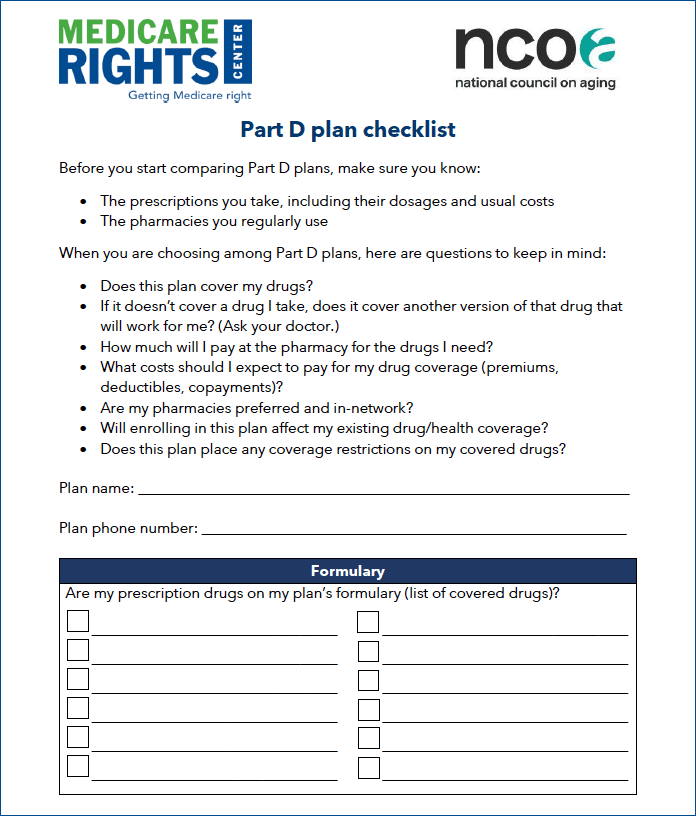
We even provide a printable checklist to help you gather all the information you’ll need in one easy-to-reference place when it’s time to compare your options.
Medicare Part D: How to choose the best plan for you
If you’re shopping around for Medicare prescription drug coverage, it’s important to think beyond cost alone. Whether or not a particular plan meets your needs also depends on:
- The medications you take
- The pharmacy you use
- The plan’s formulary (list of covered drugs)
- The plan’s network
- Any existing drug plan you may have
Medicare Part D Easy Reference Guide | |
|---|---|
|
CONSIDERATION |
WHERE TO FIND MORE INFORMATION |
|
Part D basics | |
|
Part D costs | |
|
Eligibility and enrollment |
A Complete Guide to Medicare Open Enrollment |
|
Choosing a plan provider |
Medicare Part D Prescription Drug Coverage: What Older Adults Need to Know |
|
Medications and formularies |
Medicare.gov: How do drug plans work? |
|
Pharmacy options |
Medicare.gov: What pharmacies can I use? |
Take the next step
Use this Medicare Part D plan checklist (created with the Medicare Rights Center) to help assess your plan options for coverage and costs when making decisions about which plan may be best suited to your needs.
FAQ
Which Medicare Part D plan is the best?
There’s no single right answer for everyone. That’s because Part D plans vary in cost and coverage and each person’s situation is unique. However, you can determine a right answer for you: a single-best plan that considers your specific medications, your available pharmacy networks, and where you live. Start by entering your ZIP code into the Medicare Plan Finder to find Part D options in your area along with their estimated costs.
How much is a typical Medicare Part D plan?
It depends. The average monthly premium for a standalone plan (one that’s not bundled into Medicare Advantage) is $34.50 for 2026. The maximum annual deductible is $615. And out-of-pocket costs (co-pays and co-insurance) are capped at $2,100. Some people with higher incomes pay more under IRMAA (income-related monthly adjustment amount). And some with low incomes can get the Part D Low-Income Subsidy (LIS, or “Extra Help”).
Is Medicare Part D worth it?
Only you can answer this question. If you’re currently working and have creditable prescription drug coverage through your employer, it makes sense to compare the total costs of both. If you’re eligible for Part D and don’t have other coverage options, consider what your medication needs are now and what they might be in the future. Can you afford to self-pay? And keep in mind that a late enrollment penalty may apply if you delay signing up.
How can I get help with choosing a Medicare Part D plan?
Your local State Health Insurance Assistance Program (SHIP) is a great resource. There, you’ll find unbiased and certified counselors who can help you understand Medicare basics; explore Part D plans; identify your costs and whether you can get financial assistance; and more. This service is free and available to everyone who’s eligible for Medicare, including families and caregivers. Click the link above or call 1-877-839-2675 to find a SHIP near you.
Need Help Understanding Medicare Enrollment?
Timing is critically important when it comes to enrolling in Medicare. If you think you will want Medicare at any point in your life—and you most likely will—you need to understand when you can and should enroll.