
Inogen Reviews 2026: At-Home and Air Travel-Friendly Oxygen
Inogen makes some of the lightest portable oxygen concentrators on the market. These Inogen reviews break down the specs on the Inogen Rove 4 and Inogen Rove 6.

- Inogen's portable oxygen concentrators weigh less than 5 pounds each. The brand's in-home model weighs 18 pounds, well below the industry standard of 36 pounds or more.
- Inogen's portable oxygen concentrators are priced in line with industry standards ($2,000–$4,000) and fully charge in four hours or less.
- Cost may be a drawback for the Inogen Rove 6, which starts at $2,795 and costs more than $600 to add the extended 12-hour battery.
We recommend products and services that offer real value to our readers. It's important to us that our reviews of portable oxygen concentrators are accurate, helpful, and trustworthy. So our team spent more than 1,000 hours researching and comparing options.
To choose what to recommend, we:
- Researched 15+ brands and 30 models on our own
- Spoke with experts in geriatric care and respiratory medicine
- Mystery-shopped manufacturers and retailers to check product claims and see what the buying experience is like
- Surveyed 300 oxygen machine users and caregivers to learn what matters most in real life
- Reviewed medical and academic research on how well portable oxygen concentrators work and how safe they are
- Looked at verified customer reviews on trusted sites like the Better Business Bureau and Trustpilot
Our review process is based on clinical evidence and expert input. So you can feel confident you’re getting reliable, up-to-date guidance. Learn more about our oxygen machine review methodology.
Many portable oxygen companies name chronic obstructive pulmonary disease (COPD) as the main condition requiring the use of oxygen therapy. But there are multiple reasons doctors might prescribe supplemental oxygen. "Many patients consider oxygen to be a treatment for breathlessness," says Suman Paul, a respiratory physician based in Liverpool, England. "But [oxygen therapy] is meant to correct the drop in oxygen levels in their blood."
When we surveyed people who use portable oxygen concentrators, the top reasons respondents receive oxygen therapy are sleep apnea, severe asthma, and COVID-19 complications.¹ Our respondents are in good company: Research shows that 1.5 million U.S. adults use supplemental oxygen to manage a range of respiratory disorders.²
These Inogen reviews explore the perks of an Inogen system, cost, battery life, and any downsides to using Inogen for your supplemental oxygen needs.
Comparing Inogen portable oxygen concentrators as of 2026
| Comparison Features | |||
|---|---|---|---|
| Flow type | Continuous |
Pulse dose |
Pulse dose |
| Flow settings | 1-5 |
1-4 |
4-6 |
| Max oxygen output | 5,000 mL/min |
840 mL/min |
1,000–1,499 mL/min |
| Noise level | 45 dBA |
<40 dBA |
~40 dBA |
| FAA-approved | No |
Yes |
Yes |
| Bluetooth capabilities | No |
Yes |
Yes |
| Warranty or protection plan | Yes |
Yes |
Yes |
| Free trial | Yes |
Yes |
Yes |
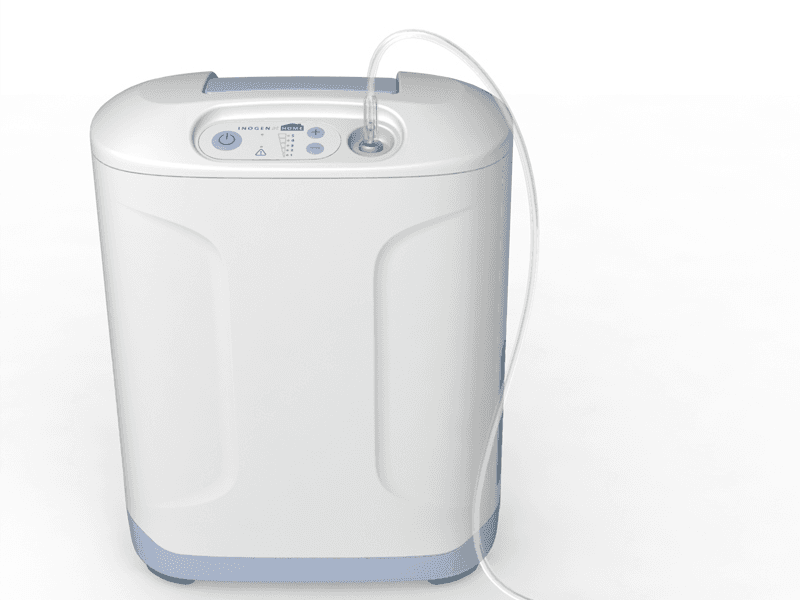
Understanding Inogen portable oxygen concentrator models
Inogen Rove 4: Best for Air Travel
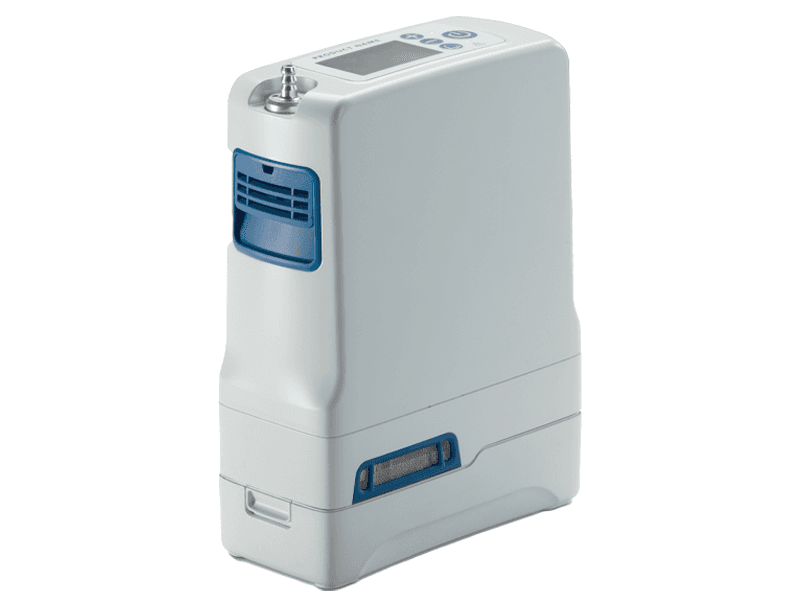
The Inogen One G4, now called the Rove 4, earned Best for Air Travel in our roundup of the best portable oxygen concentrators because it is FAA-approved and weighs less than 3 pounds.
- Can be used while charging on a plane
- Lightweight design
- Bluetooth capable
- Cost: $2,695
- Weight: 3.3 pounds
- Dimensions: 5.91 × 2.68 × 7.2 inches
- Battery life: 5 hours on a double battery
- Battery charging time: 3 hours (single battery), 5 hours (double battery)
- Delivery/flow type: Pulse dose
- Range of flow settings: 4
- Noise level: 40 dBA
The Inogen Rove 4 comes with the following supplies:
- Portable oxygen concentrator unit
- Wall (AC) charger/power cord
- One rechargeable battery
- Custom carrying bag
- User manual
You can purchase additional accessories for your Rove 4, including a hip bag, extra particle filters and batteries, or a DC power cable. You can also buy an external battery charger to charge while you're away from an AC or DC power source.
Pros
- Backlit screen
- Accessible power button
- Batteries come with indicator gauges
Cons
- 3-hour battery life
- Limited maximum oxygen output
- Only four pulse dose settings
What’s different about the Inogen Rove 4
Unlike some other portable oxygen concentrators on the market, you can use the Rove 4 while it charges. It is also among the lightest POCs available. The features that tend to make a portable oxygen concentrator heavy—compressors, extended batteries—are not present on the Inogen Rove 4. But that light weight comes with trade-offs. The Rove 4 has fewer pulse dose settings than many competitors and can output a maximum of 840 mL/min of oxygen.
Inogen Rove 6: Long Battery Life
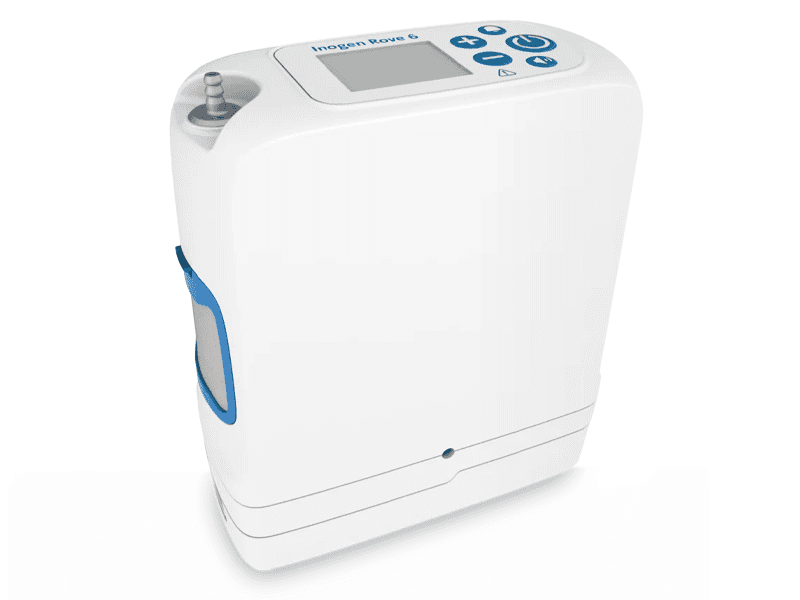
With two more pulse settings, the Inogen Rove 6 improves on many features of the Rove 4. The Rove 6 is also FAA-approved and delivers six hours of battery life on a standard battery (compared to the Rove 4's three hours) while still weighing less than 5 pounds.
One of the top complaints our survey respondents identified was monitoring battery levels when away from home.¹ The Rove 6's longer battery life addresses that concern directly, especially with the optional 12-hour extended battery.
- Designed for travel
- Backwards compatible with other Inogen batteries
- Bluetooth capable
- Cost: $2,795
- Weight: 4.8 pounds
- Dimensions: 7.18 × 3.27 × 8.14 inches
- Battery life: 6 hours (standard battery) 12 hours (with extended battery)
- Battery charging time: 3–4 hours
- Delivery/flow type: Pulse dose
- Range of flow settings: 6
- Noise level: 39 dBA
The Inogen Rove 6 comes with the following supplies:
- Portable oxygen concentrator unit
- Wall (AC) charger/power cord
- Car (DC) charger/power cord
- One rechargeable battery
- Custom carrying bag
- User manual
You can purchase additional accessories for your Rove 6, including the 12-hour extended battery, an external battery charger, and a cart to help transport your device.
Pros
- FAA-approved
- Lightweight
- May last up to eight years
Cons
- Extended battery sold separately
- Filters require weekly cleaning
- Larger battery makes it heavier
What’s different about the Inogen Rove 6
We named the Inogen Rove 6 Best Overall in our Best Portable Oxygen Concentrators review because of its portability. It charges in three to four hours, its largest battery option allows it to run for 12 hours, and the unit weighs just over 5 pounds, depending on which battery you use. You can carry the Rove 6 in its included shoulder bag, or purchase a hip bag or backpack separately.
How much do Inogen portable oxygen concentrators cost?
Cost was the most important factor in a portable oxygen concentrator purchase, according to our survey respondents.¹ Inogen portable oxygen concentrator models start at $1,695 for the At Home. The Rove 6 without the extended battery starts at $2,795. Those prices are in line with the oxygen concentrator industry overall, though the Rove 6 is slightly pricier than other pulse-dose machines with six flow settings.
| Oxygen concentrator | Price |
| Inogen At Home | From $1,695 |
| Inogen Rove 4 | From $2,695 |
| Inogen Rove 6 | From $2,795 |
Inogen offers a risk-free 30-day trial and a three-year warranty on all its devices. Note that "risk-free" does not mean free. If you return the device in original condition, Inogen issues store credit, not a refund.
Check with your insurance provider or Medicare plan to see if they will cover your Inogen device. Inogen says it will work directly with your doctor, Medicare, and your insurance company to help you get one of its portable oxygen concentrators. If you fly frequently, keep in mind that Medicare does not cover oxygen for air travel. But Medicare may cover the Inogen At Home for in-home use.
Who should use Inogen
With its light weight and long battery life, Inogen may be a good fit for people who do not want to or cannot carry a bulky machine while out and about. Its extended battery option suits active lifestyles well. If you fly frequently, both of Inogen's portable oxygen concentrators are FAA-approved.
Inogen's portable oxygen concentrators may also be a good fit if you already monitor your health at home, such as tracking your blood pressure. The Inogen Rove 4 and Rove 6 are pulse-dose devices, meaning you may need to adjust your pulse dose setting depending on how much oxygen you need at a given time.
One way to make sure your pulse dose oxygen is working properly is to measure your blood oxygen levels with a pulse oximeter. You can read our Oxiline pulse oximeter review to learn more about these devices and how we review them.
Who should not use Inogen
Inogen's Rove series may not be the best fit if you are looking for a more affordable option, as its pricing is on the higher end for pulse-dose machines. You should also avoid the Rove models if your doctor has prescribed continuous flow oxygen. If your oxygen needs cannot be met by pulse-dose delivery (short bursts of oxygen delivered when you inhale, vs. continuous flow oxygen) you will need to use the Inogen At Home instead.
Inogen customer reviews
The Better Business Bureau (BBB) accredits Inogen with an A+. Through BBB, Inogen has a customer rating of 1.15 out of 5 stars, based on 40 customer reviews.3
Inogen's BBB customer rating is low, but customer reviews do not factor into the BBB accreditation rating. That rating is determined by criteria such as whether the company responds to complaints in a timely way. Based on BBB feedback, Inogen's customer service issues tend to arise when any portion of expenses comes out of pocket rather than through insurance.
Trustpilot gives Inogen a rating of 3.9 out of 5 stars, based on more than 4,000 reviews.⁴
“The rove 6 POC is a lifesaver, not too heavy; great when shopping or just taking a walk. . . ”
PHILOMINE, VERIFIED CUSTOMER REVIEW (TRUSTPILOT.COM)
“Battery life is only 2-3 hours not plugged in, and unit is a lot heavier than I expected. . . The carrying case supplied is very loose fitting around machine and the cutout for the charging port is too high above the port. Also wish unit and replacement batteries were cheaper. Otherwise the unit functions as described. Better than carrying around oxygen tanks.”
GERALD, VERIFIED CUSTOMER REVIEW (TRUSTPILOT.COM)
“This Rove 6 is a very well-designed little workhorse. We have flown to Hawaii with it twice, and used it exclusively for a month each time with absolutely no issues. The batteries don't last quite as long as stated and it makes a bit too much noise for attending the symphony, but is fine for restaurants and musicals. The customer service phone answers promptly and are knowledgeable. We are grateful to have it.”
M, VERIFIED CUSTOMER REVIEW (TRUSTPILOT.COM)
“Inogen Rove 6 is beautiful, but with only 1.267 liters per minute. . . absolutely worthless to someone who needs 3 or 4 LPM.” *
SETH, VERIFIED CUSTOMER REVIEW (TRUSTPILOT.COM)
It is worth noting that the Inogen Rove series does not offer continuous flow oxygen. If you need 3 or more liters per minute on a continuous basis, the Inogen At Home, which delivers up to 5 liters per minute, may be the better option.
Frequently asked questions
Does Medicare cover Inogen portable oxygen concentrators?
Medicare does not cover oxygen for air travel, but that does not mean it will not cover any portable oxygen concentrators. Because most portable oxygen concentrators are built with travel in mind, you will need to work closely with your Medicare plan to understand your coverage options.
Are Inogen oxygen concentrators easy to move around?
Inogen has some of the lightest portable oxygen concentrators on the market. At less than 5 pounds each, Inogen's portable oxygen concentrators are built to make travel and everyday use more manageable.
Can you travel with an Inogen concentrator?
Inogen's portable oxygen concentrators are FAA-approved for air travel. Before any trip, plan for access to DC or AC power to keep your device charged and functional.
How long does the Inogen Rove 6 last?
With the extended battery, purchased separately, the Rove 6 can last up to 12 hours on one of the lower pulse dose settings.
How long does the Inogen One G4 last?
The Inogen One G4, now called the Inogen Rove 4, can last up to three hours on its standard battery and five hours on its extended battery.
Questions? Email us at reviewsteam@ncoa.org.