
Stair Lift Buying Guide: Types, Features, and Installation Costs
12 min read
Related Topics
Do you live in a home with more than one level? Buying a stair lift may be a smart investment.
"Most of us want to maintain our independence and grow older right where we are,” said Dorothea Vafiadis, Senior Director of NCOA’s Center for Healthy Aging. “Practically speaking, that means many of us will need to change our living space to help prevent falls and make it easier and safer to get around."
Indoors and outdoors, curved and straight, stairlifts do just that. With a variety of models and features to choose from, these assistive devices can help keep us safe and empower our independence for years to come.
Still: it can be hard to know where to start. Our comprehensive stair lift guide covers what you need to know before you shop. Continue reading to learn more
What is a stair lift?
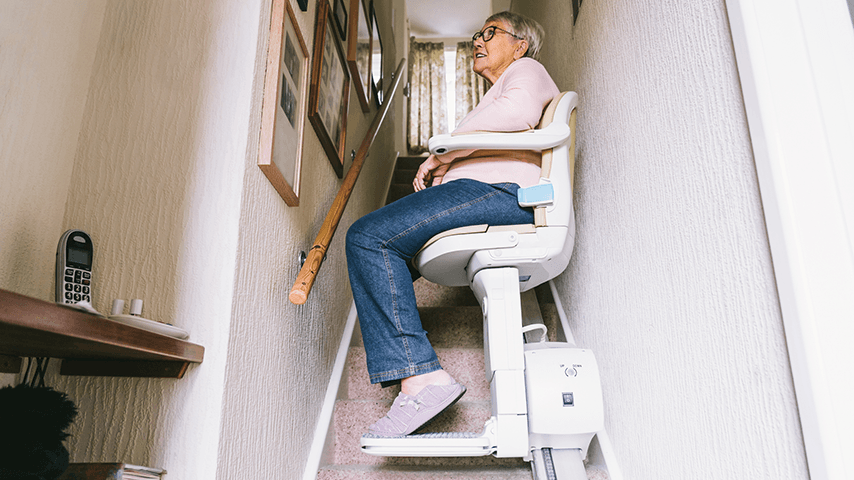
A stair lift is exactly what it sounds like: a piece of equipment that carries you up and down the stairs.
There are two main parts:
- A wall- or tread-mounted rail that runs alongside or above the steps
- A motorized chair that connects to the rail
The best stair lifts are made to accommodate people of all sizes and staircases of all types. No matter your home configuration, there’s likely one that will work. Keep in mind, however, that costs can vary widely depending on the brand, features, and even where in the country you live (more on this in “How Much is a Stair Lift,” below).
Stair lift benefits
I stair lift may be an important piece in our "aging-in-place" kit.
This is especially true for those of us facing mobility challenges, decreased vision, or balance issues, Vafiadis explained. These things if not monitored carefully, can be a risk of a fall. It’s important that older adults regularly get their vision checked and engage in regular activities to improve their balance and strength, with proven programs that reduce the risk of falling, such as Tai Chi.
Avoding potential falls risk is important. Fear of falling can limit full enjoyment of our homes and an interfere with our ability to get to important spaces like the kitchen, bathroom, or bedroom.
Buying and installing a stair lift may:
- Allow more freedom of movement between levels
- Assist in getting into and out of the house
- Reduce risk of falling on the stairs
- Prevent having to move or pay for expensive home renovations
Perhaps the best part? Much like medical alert systems and walk-in tubs, a stair lift supports continued independence at home while providing greater peace of mind: for us, our caregivers, and our families.
What types of stair lifts are there?
Today’s stair lifts can meet a variety of needs. In order to quickly understand your options, here’s a helpful visual aid:
| Staircase Location | ||
| Staircase layout | Indoors | Outdoors |
| Straight | √ | √ |
| Curved | √ | √ |
Keep in mind that the type of stair lift refers specifically to the rail system, not the seat that goes with it (which you will have the opportunity to customize).
Straight
Straight stair lifts are the simplest. Typically, they consist of a one-piece rail manufactured for a standard, single flight of steps. These stair lifts run vertically up and down.
Of the available options, straight stair lifts tend to be the least expensive. The rails are mass produced, can easily be cut to size, and are simple to install. Of course, costs can rise if your stair lift will be outdoors or if you add extra features (more on these below).
Curved
Curved stair lifts accommodate staircases with more than one flight. The rails are either custom-made or modular and they bend around any landings for continuous transport.
Because they are more complicated to manufacture and install, curved stair lifts are more expensive. Your cost will depend on the number of bends (which correspond to the number of landings you have), premium labor charges, and whether the lift is inside or outside.
Outdoor
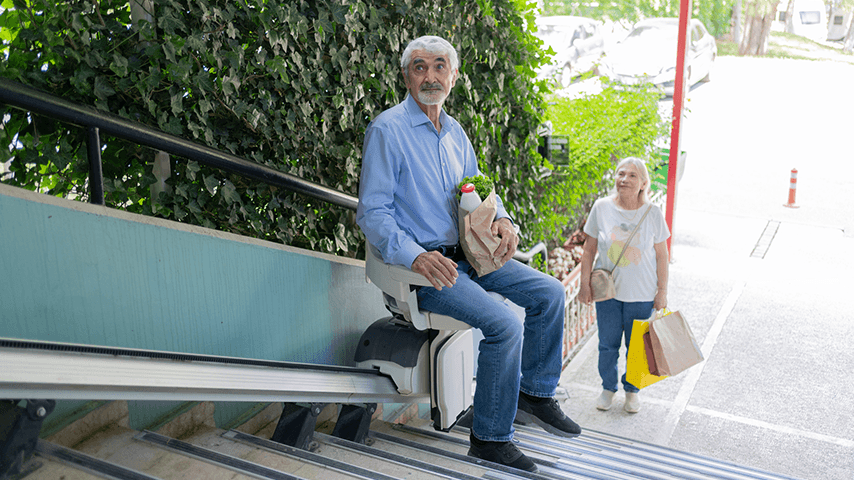
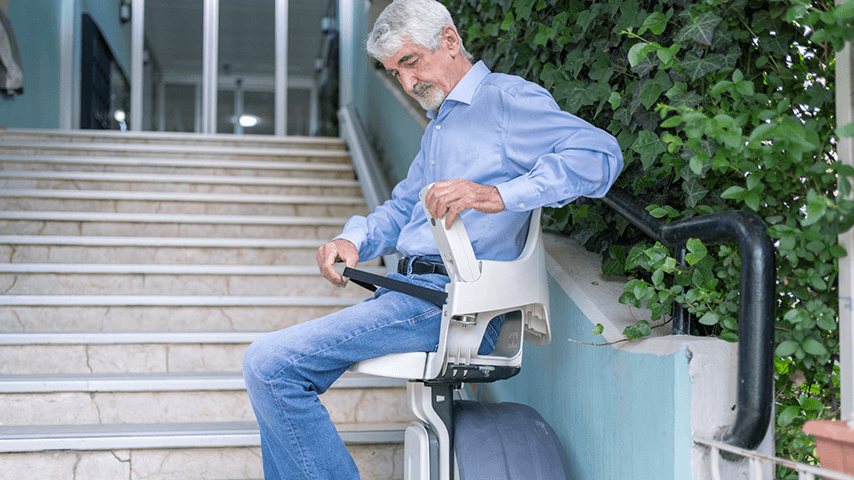
Outdoor stair lifts can either be straight or curved. They include specific features to ensure they can withstand and operate safely in all kinds of weather: from hot to cold, sun to snow.
Outdoor stair lifts typically carry the highest price tag. The materials themselves are more expensive to produce, and the baseline safety and weatherproofing features cost more, too. These lifts often require custom installation, which adds to overall expense.
What are the components and features of a stair lift?
Now that you know about the types of rails, it’s time to take a look at everything else.
Each stair lift comes with a baseline set of components and features that ensure it does what it promises: carry you up and down the stairs. As with most consumer products—from cars to refrigerators, phones to thermostats—you have the opportunity to upgrade and/or customize them depending on your needs and preferences.
Standard stair lift components
At a minimum, every stair lift system includes a:
- Track. The track (another name for the rail) guides the lift up and down the stairs. Baseline tracks typically are made of aluminum or steel and sit at least 6” away from the wall or banister.
- Chair. The chair carries you from one point to the other. Most standard models include a basic seat and backrest; manual folding armrests; manual folding footrests; and a seat belt.
- Power source. Most stair lifts rely on a battery-powered motor and require a standard 120-volt electrical outlet to operate. Baseline models include two battery charging stations at the top and bottom of the track.
- Control panel. The control panel turns the motor on and off, directs the chair up and down, and activates other optional features (such as a power swivel seat). It’s built into the chair unit for easy access.
Optional stairlift features and enhancements
Depending on your needs and budget, you’ll have many opportunities to upgrade and customize your chair lift. Your choices generally fall into three categories:
Safety and comfort
These extras make it easier to navigate and use your stair lift—and can improve your enjoyment, too. They may include:
- Swivel seat (manual or automatic)—These seats rotate to face the direction that’s safest for you to enter and exit the chair (some provide tilt-assist, too). You also can turn them around curved rails.
- Automatic arm- and footrests—You can raise and lower these features without having to bend over (and risk falling out of the chair) or wrestle them out of the way.
- Folding rail (manual or automatic)—Eliminate any potential for tripping over the track when you’re not using the stair lift. (Generally only available for straight rails).
- Additional weight capacity—Most standard stair lifts accommodate 300 pounds. Upgraded heavy-duty models can safely hold up to 600 pounds (or more in some cases).
- Remote control—“Call and send” the chair up and down the rail whenever you need it, from where you are—helpful in homes where more than one person will use the stair lift.
Aesthetics
These upgrades reflect your personal style and help your stair lift blend into your home’s décor. They may include:
- Seat fabric and color choice—Standard seats come in a narrow range of materials and hues (think: white or tan vinyl). Choose upholstery, patterns, and colors you like.
- Rail options—Depending on the manufacturer, you may have the opportunity to upgrade your rail’s color, finish, and—in some cases—profile.
Weatherproofing and durability
Often, you can upgrade some of the standard safety and comfort features included with every outdoor chair lift. For example:
- Rider protection—Why cover just the chair when you have to endure the elements, too? A canopy that attaches to your seat can keep you dry in the rain and cool in the sun.
- UV protection—Keep your upholstery and paint from fading, cracking, and peeling in the sun with optional ultraviolet-resistant materials.
How expensive are these extras? It depends on how advanced the functionality is, how luxe the materials are, and whether or not the upgrades you choose require structural modifications to your staircase. Ask to see a detailed pricing sheet when shopping around; reputable stair lift dealers will help you understand the costs and how they impact your budget.
How do I choose a stair lift for my home?
Choosing the right stair lift boils down to four things: your needs, your budget, your brand preference, and where and how you’ll buy.
Buying a stair lift: a guide to the process
Once you’ve decided to get a stair lift, buying one is pretty straightforward. For most people, the process follows a predictable set of steps:
- Evaluate your home. First things first: survey your living space and determine what you need: an indoor or outdoor model, curved or straight. Many stair lift dealers offer free in-home consultations where they precisely measure your staircase, walk you through equipment choices and upgrades, and write up a no-obligation price quote.
- Consider your budget. How much can you afford to spend on your stair lift? If money is tight, can you forego certain “nice to have” upgrades to lower the price tag? Would you consider buying a used stair lift instead of a new one? If you have more than one floor, is it possible to install several straight rails (which are less expensive) instead of a curved system?
- Research brands. There are dozens of makes, models, and manufacturers out there—and not all stair lifts meet the same quality standards. Spend some time reading online reviews of the best stair lifts and check local dealers against the Better Business Bureau database. Ask any friends, family, and neighbors who use a stair lift about their experiences, too.
- Visit showrooms. If you have the mobility and transportation to visit a few local dealers, it’s generally worth your time. You can see (and test out) the equipment, ask real-time questions, and compare quality and prices. Often, you’ll benefit from seamless installation from a certified technician, too—which eliminates the stress of finding someone on your own.
- Seal the deal. Once you’re certain of your choice, it’s time to sign the sales agreement and pay for (or put a deposit on) your stair lift. Many manufacturers offer low- or no-interest payment plans for equipment, installation, or both; your sales representative can walk you through the application and terms if you’re interested in this option.
- Schedule delivery and installation. Your salesperson will work with you to choose a day and time for a dealer-certified technician to install your stair lift—usually within a few days to a few weeks, depending on manufacturer lead times. (If you purchased your stair lift online or from a private party, you’ll need to arrange for delivery or transport yourself and find an independent installation professional to do the work).
Stair lift safety, costs, and other considerations
Is a stair lift safe? Absolutely—with two important caveats. First and foremost, the person (or people) who will be using it should be able to get into and out of the seat without trouble. They also will need to buckle the safety belt and operate the lift’s power mechanism.
“These things do require some physical and cognitive acuity,” NCOA’s Vafiadis explained. “In many cases, the companies that sell and install stair lifts provide in-home consultations to help determine whether or not it’s a workable solution.”
You also might consider consulting a physical or occupational therapist for a professional assessment of your home’s fall risk, as they can identify hazards like poor lighting or slippery floors, she added. “If you’re in any doubt, having an objective professional opinion and a tailored home assessment can help you make a smart decision about eliminating dangerous areas, or whether or not it’s a good idea to invest in a stair lift.”
Second, your stair lift must be installed properly in order to be safe. If you or someone you know is good with tools, you may be tempted to do this yourself. Still, it’s worth considering the potential pitfalls—and risks.
Are your wall studs and stair stringers (structural beams) sturdy enough to support the lift? Do you have enough electrical outlets in the right place to power it? What happens if the answer is “no?”
“The point of a stair lift is to avoid injury and make living at home easier,” Vafiadis said. “Sometimes that means making a bigger up-front investment—by hiring a professional installer—for peace of mind down the road.” Plus, she pointed out, your time is money, too. A job that might take you several days or more to complete may only take an expert a few hours.
Here’s how that investment breaks down.
How much is a stair lift?
You can plan to spend between $2,500–$15,000 for the equipment and installation.
Your specific price tag will depend on things like brand, features, staircase type, regional labor rates, and other factors. (We cover, in-depth, the costs of buying, installing, and maintaining a stair lift—as well as ways to save money—in Stair Lift Costs: A Complete Guide.)
What does service and maintenance look like for a stair lift?
Once your stair lift is up and running, you’ll want to keep it that way. Regular maintenance helps protect your investment and ensures your stair lift’s ongoing safety.
Beyond the simple things you can do yourself—like charging the batteries and cleaning the rails—you might consider an annual service plan. These plans, which typically cost between $100–$300 per year, include a professional inspection of your stair lift’s:
- Rails
- Motor
- Gear box
- Controller
Some plans may include replacement parts and labor, too. It pays to ask about this—as well as standard and extended warranty coverage and options—before buying a stair lift.
FAQ
How much weight can a stair lift support?
Most standard stair lifts will hold 300 pounds. This includes your body weight and anything you’re carrying—like groceries, laundry, or maybe even your pet. If you need additional support, most manufacturers offer upgraded, heavy-duty models that can accommodate up to 600 pounds.
Will a stairlift work when the power goes out?
Yes. Most reputable brands include a battery-powered backup system to get you through an electrical outage. Typically, this backup system is set to last for a certain number of trips (say, between 10–20) rather than a length of time—which more reliably ensures a working lift when you need it.
What is the lifespan of a stairlift?
A new stair lift can last around 10 years. Used and/or reconditioned units may not last as long. In both cases, taking good care of your stair lift—and getting regular service—can improve its longevity. Many manufacturers offer annual maintenance plans and extended warranties to help protect your investment.
How long does it take to install a stair lift?
Once all the components are ready, most professionals can complete the job in 1–2 days. Keep in mind that straight stair lifts are much easier and quicker to install than curved ones; and indoor stair lifts are simpler than outdoor ones. Any unexpected structural or electrical problems will add to the time and cost.
Find a Device You Can Trust
We tested medical alert systems and found which ones feature fast response times and a long battery life.