

Related Topics
One of the most powerful ways to share information about your programs and services is through participant stories and testimonials. Collecting and sharing testimonials provides a chance for other older adults in your community to hear from their peers about what it’s like to participate in a program or event at your organization and hopefully encourage them to join the next time.
While simple feedback like, “it was a great class” or “I would recommend this to a friend” is helpful, going a bit deeper and hearing more about a participant’s experience can create more compelling stories that will spark others’ interests.
It can be useful to provide multiple opportunities for participants to share their feedback. A survey at the end of a class, a comment box at your senior center, or a form in your newsletters are all possibilities. If you recognize that a participant really enjoyed a class or event, consider reaching out to them and requesting a testimonial.
Participant testimonials can be collected in a variety of ways, such as
-
Through a survey
-
An interview over the phone
-
By videoconference
-
In person
You can also use available online programs such as StoryCorps or Photovoice Kit. Be sure to tell the participant how you are going to use their testimonial and why you are collecting it. Create a release form and make sure all participants sign it—and explain to them what the form outlines/how you will use their testimonial.
The stories they share may help someone else realize that the program you are offering is a good fit for them.
Always start with a goal in mind
The first thing you’ll want to do is decide why you are collecting testimonials. The following types of testimonials each help highlight a different result:
-
Impact story: show a measurable impact from program participation (e.g., was able to identify falls risks at my house and make home modifications)
-
Personal story: a lived experience that others can relate too. This could be used to help recruits other older adults to your programs or get them to attend your events
-
Value (beyond impact): explains what makes the program so effective (e.g., it was fun and in a convenient location; I made new friends)
-
Partnership: highlight the strength of working together. This testimonial could be two grantee organizations collaborating on a program, rather than a testimonial from a program participant)
Asking effective questions for specific responses
Open-ended prompts can help encourage more detailed responses so that you don’t end up with only ‘yes or no” answers. Consider the following sample questions when requesting a participant testimonial:
-
What attracted you or made you want to join when you heard about the program?
-
What happened during the first class? What made you want to stay and complete the whole program?
-
What did you like the best about the program? What is one key lesson or takeaway?
-
What are you doing differently as a result of taking the class? How has the class changed your life?
-
What do you think it was about [program name] that helped you feel more comfortable about [a goal of the class]?
-
Why would you recommend the class to a friend or family member?
It may also be helpful to find out more about the person and ask what other community activities they are involved in, or what a typical day looks like for them.
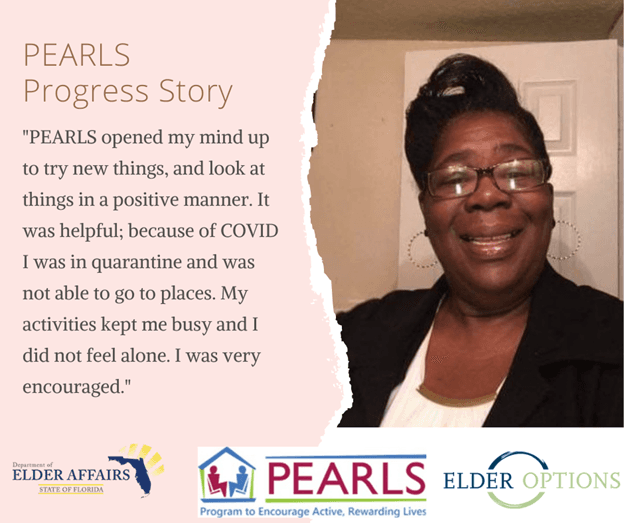
Credit: Elder Options
Why adding a photo to your testimonial helps
If the testimonial is in writing, consider taking or asking the participant for a photo. Be sure you have a signed consent form allowing your organization to use their image.
Here are some quick tips for taking better pictures on your smartphone:
-
Photo quality is best when you use the camera on the back of the smartphone instead of the “selfie” camera.
-
Wipe off the lens to make sure there are no fingerprint smudges.
-
Fill the frame with the subject and get closer if you need to.
-
Be sure that the subject has light on their face; for example, sitting facing a window.
-
You can also take your participant testimonials a step further by recording a short video. Hearing a participant tell their story can be even more impactful. According to Forbes.com, people are more likely to retain what they hear in a video message compared to reading a story. If your budget is small, you can record a short video on a smartphone.
Some tips to consider when recording video:
-
Keep it short! 30-90 second videos are best.
-
Remind people to speak like they are talking to a friend.
-
Record videos vertically and horizontally (vertical video is better for some social media platforms; horizontal is better for websites and YouTube).
-
Film in quiet areas with good lighting and nice backgrounds.
-
Tools like Auphonic can remove background noise easily and offer up to 2 hours of free production each month.
-
Position the speaker at eye level, and make sure there is space above their heads.
-
Ring lights and phone stands can also help.
See an example of a video testimonial from the Mid-America Regional Council (MARC) in Missouri.
Final-WellnessPromo
How to make collecting participant testimonials more fun
If collecting participant testimonials is difficult, consider adding a social time after the last session of a class. In addition to allowing more time for the participants to connect, it can also be an opportunity to collect feedback about the class. Participants could even interview each other about their experiences.
Now that you have a powerful testimonial in hand, it is time to get it out there. The testimonial can be shared on social media, in promotional materials, with policymakers, or even in a press release to announce an upcoming program.
For additional tips on how to collect better stories, check out this article on 10 Tips to Harness the Power of Stories.
This project was supported, in part by grant number 90CSSG0048 and 90FPSG0051 from the U.S. Administration for Community Living, Department of Health and Human Services, Washington, D.C. 20201. Grantees undertaking projects under government sponsorship are encouraged to express freely their findings and conclusions. Points of view or opinions do not, therefore, necessarily represent official Administration for Community Living policy.