
Caire Oxygen Concentrator Reviews
Learn more about the different CAIRE oxygen concentrator models with our in-depth review.

- There are multiple CAIRE oxygen concentrators options: lightweight portable, continuous flow portable, and stationary home oxygen concentrator models.
- CAIRE oxygen concentrator prices range from $895–$3,000+
- CAIRE designs portable oxygen concentrators with ergonomics in mind.
We recommend products and services that offer real value to our readers. It's important to us that our reviews of portable oxygen concentrators are accurate, helpful, and trustworthy. So our team spent more than 1,000 hours researching and comparing options.
To choose what to recommend, we:
- Researched 15+ brands and 30 models on our own
- Spoke with experts in geriatric care and respiratory medicine
- Mystery-shopped manufacturers and retailers to check product claims and see what the buying experience is like
- Surveyed 300 oxygen machine users and caregivers to learn what matters most in real life
- Reviewed medical and academic research on how well portable oxygen concentrators work and how safe they are
- Looked at verified customer reviews on trusted sites like the Better Business Bureau and Trustpilot
Our review process is based on clinical evidence and expert input. So you can feel confident you’re getting reliable, up-to-date guidance. Learn more about our oxygen machine review methodology.
CAIRE is a global oxygen supply manufacturer that makes both stationary and portable oxygen concentrators, providing oxygen therapy to people whose blood oxygen levels are low. In the United States alone, nearly 1.5 million adults are on supplemental oxygen.1
Supplemental oxygen may help manage a variety of sometimes overlapping conditions, like chronic obstructive pulmonary disease (COPD), asthma, heart failure, COVID-19, and sleep apnea. These are the top five most common conditions that contributed to the purchase of an oxygen concentrator, according to the results of our survey of 300 people who have bought one.2
Since conditions that affect blood oxygen levels are so varied, portable oxygen is not a one-size-fits-all solution. The right portable oxygen (PO2) concentrator for you depends on what your doctor prescribes, how mobile you want to be, and your budget. Our CAIRE oxygen concentrator review breaks down cost, weight, and other specifications to help you decide if CAIRE is the best portable oxygen concentrator for your needs and lifestyle.
Why we like CAIRE portable oxygen concentrators
CAIRE has been in business for close to 40 years, offering a range of home and portable oxygen solutions. It's the only oxygen provider we found that offers portable oxygen concentrators with ergonomic curves to better fit the human body.
Portable oxygen concentrators are designed to hang off a shoulder strap in carry bags roughly the size of a lunchbox. CAIRE designed the curved body so the concentrator sits more securely against the hip rather than bouncing with each step, a meaningful detail for anyone wearing a PO2 concentrator throughout the day.
Comparing CAIRE portable oxygen concentrators
| Comparison Features | |||
|---|---|---|---|
| Flow type | Pulse dose |
Both |
Continuous |
| Flow settings | 5 |
9 |
N/A |
| Max oxygen output | 1,000–1,499 mL/min |
3,000 mL/min |
5,000 mL/min |
| Noise level | 39.9 dBA |
40 dBA |
50 dBA |
| FAA-approved | Yes |
Yes |
No |
| Bluetooth capabilities | Yes |
Yes |
Yes |
Understanding CAIRE portable oxygen concentrator models
CAIRE FreeStyle Comfort: Best Lightweight CAIRE Oxygen Concentrator
The FreeStyle Comfort is built around wearability. It is curved to fit the body, outfitted with a large, readable display, and weighs five pounds by itself, or eight pounds with the extended battery.
CAIRE FreeStyle Comfort
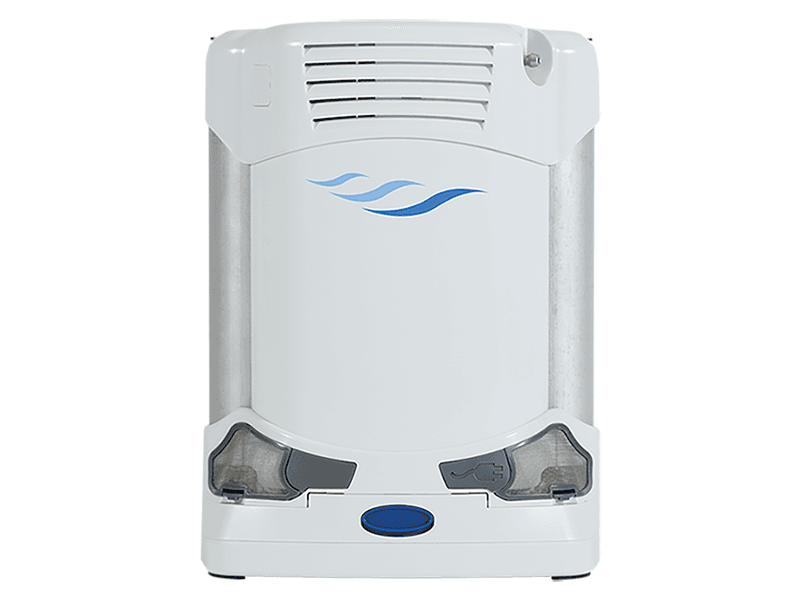
- Curved design fits against the body when worn on a shoulder strap
- Batteries include indicator lights to show remaining charge
- Wireless telehealth sends data to your care team via the myCAIRE app
- Cost: $2,000–$3,000
- Weight: 5 lbs.
- Dimensions: 10 x 7.3 x 3.1 inches
- Battery life: 4–8 hours
- Battery charging time: 3–6 hours
- Delivery/flow type: Pulse dose
- Range of flow settings: Five
- Noise level: 39.9 dBA
The CAIRE FreeStyle Comfort comes with the following supplies:
- Carrying bag
- Battery pack
- AC (wall) charger/power cord
Additional accessories available for purchase include a backpack, an 8-hour extended battery, and an AC charging setup.
Pros
- Quieter than a refrigerator
- FAA-approved
- Backlit display
Cons
- Cannot be used while charging in the car
- Included battery lasts only four hours
- Extended battery sold separately
- Not available to buy online direct from CAIRE
What’s different about the CAIRE FreeStyle Comfort
Like many portable oxygen concentrators, the CAIRE FreeStyle Comfort is FAA-approved. But its curved body sets it apart from other devices in the category. "When you're on any oxygen you want to make sure when you're using it — at rest, when you're sitting down, when you're exerting yourself, when you're walking to the bathroom, when you're walking around a store, or at night — you want to make sure that it fits comfortably," said Alexis Smith, doctor of osteopathic medicine at Novant Health in Huntersville, North Carolina.
When we asked our survey respondents what they wished they had known before buying a portable oxygen concentrator, one said they wished they had known "it was still obtrusive," and another said they wished they had known "how massive it was."² For people with similar concerns about size, the FreeStyle Comfort may be worth considering. CAIRE designed it to conform to the hip when worn on a shoulder strap, and at five pounds with a standard battery, it is one of the lighter portable oxygen concentrators on the market.
Because the FreeStyle Comfort offers several pulse-dose settings, you may need to adjust your flow settings at home without your doctor present. The myCAIRE telehealth app will share that flow rate data with your care team. When adjusting oxygen at home, you will need to use a pulse oximeter to check your blood oxygen levels and confirm the device is delivering the right amount.
CAIRE Eclipse 5: Best Stationary-Portable Hybrid
While the FreeStyle Comfort is built for mobility, CAIRE designed the Eclipse 5 for use both at home and on the go. The Eclipse 5 can deliver both pulse-dose oxygen and continuous flow up to three liters per minute (LPM), making it suitable for people on a higher oxygen prescription.
CAIRE Eclipse 5
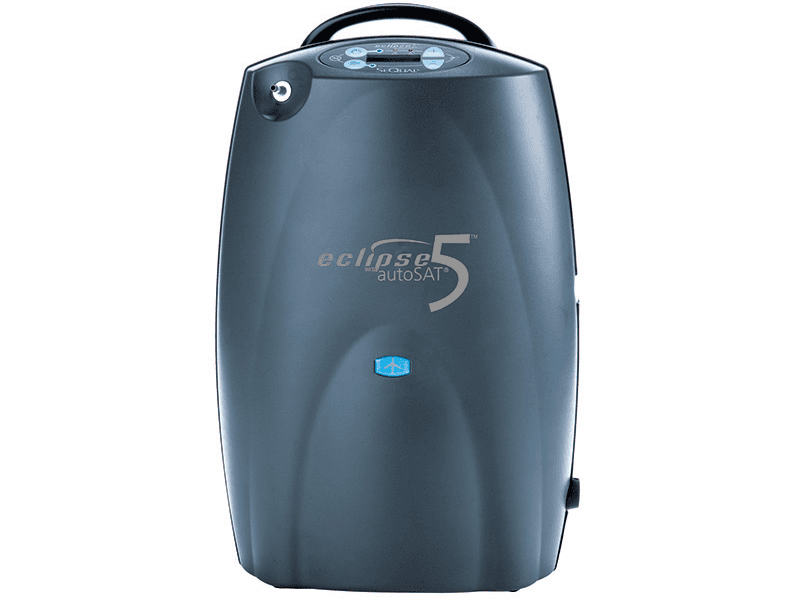
- Hand cart converts between portable and stationary use
- Nine pulse dose settings
- Continuous flow up to 3 LPM
- Cost: Starts at $3,200
- Weight: 18.7 lbs
- Dimensions: 19 x 12.3 x 7.1 in
- Battery life: 2 hours
- Battery charging time: 5 hours
- Delivery/flow type: Continuous and pulse dose
- Range of flow settings: 9
- Noise level: 40 dBA
The Eclipse 5 comes with the following supplies:
- Power cartridge (battery)
- AC power supply
- DC power supply
- Removable cart
- Accessory bag
- Nasal cannula
- Spare intake filter
Pros
- Can be used while charging from a wall outlet
- FAA-approved
- Concentrates more oxygen than many other portables
- Can use while charging in the car
Cons
- Cart requires extra assembly
- Bulky
- Battery recharging takes up to five hours
- Removing the power cartridge might be difficult for people with limited hand dexterity
What’s different about the Eclipse 5
The Eclipse 5 bridges the gap between the other CAIRE models: It is portable like the FreeStyle Comfort, but can deliver continuous flow oxygen like the stationary Companion 5. That ability to offer continuous flow opens it up to a much wider range of users, because some oxygen prescriptions require more oxygen than a pulse-dose-only device can deliver.
Ginger Villanueva, BSRC, RRT, RRT-NPS, manager of respiratory therapy and pulmonary diagnostics at Sentara Health in Norfolk, Virginia, noted a common misconception about portable oxygen concentrators. “People think they will do higher liter flows successfully, when they don’t really,” she said, adding portable oxygen concentrators may not be able to deliver the volume for certain high oxygen prescriptions.
Stationary, continuous flow oxygen, like the CAIRE Companion 5, is known for higher liter flows. Many portable oxygen concentrators only offer pulse-dose oxygen, which is what sets the Eclipse 5 apart. The Eclipse 5 can produce pulse-dose oxygen at nine settings and can concentrate up to 3 LPM of continuous flow oxygen.
The trade-off for that range of output is its size. The Eclipse 5 weighs more than 18 pounds, its power cartridge is large, about the size of a paperback book, and the hand cart required to transport it is bulky. All of this makes the Eclipse 5 the best option for someone with high oxygen needs that lighter devices like the FreeStyle Comfort or Inogen portable oxygen concentrators cannot meet.
The Eclipse 5’s biggest drawbacks are its weight and long recharge time. When asked what they wished they had known before purchasing a portable oxygen concentrator, our survey respondents mentioned recharge time and short battery life as top concerns. Weight was also frequently noted as a concern.2
CAIRE Companion 5: Most Practical CAIRE Oxygen Concentrator for Daily Home Therapy
Roughly the size of a carry-on suitcase, the Companion 5 is CAIRE's home oxygen offering. It is not portable, but delivers a continuous flow of oxygen up to 5 LPM.
CAIRE Companion 5
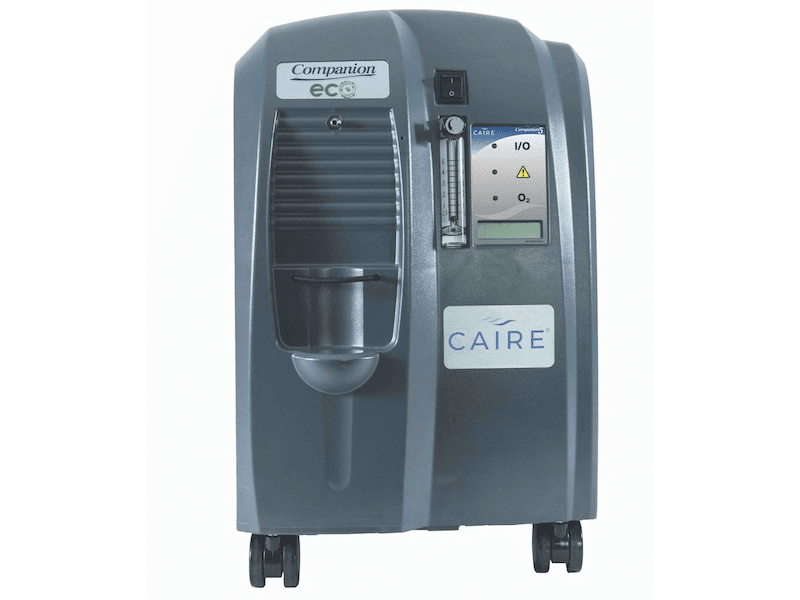
- Simple, straightforward operation
- Delivers up to 5 liters per minute
- Lower power draw than comparable devices
- Cost: $895
- Weight: 36 lbs
- Dimensions: 21.5 x 13.5 x 12.5 inches
- Battery life: N/A
- Battery charging time: N/A
- Delivery/flow type: Continuous flow
- Range of flow settings: N/A
- Noise level: 50 dBA
The Companion 5 comes with the following supplies:
- Humidifier adapter tube
Pros
- Can support up to 50 feet of tubing
- Power switch accessible for people with limited dexterity
- Requires routine durable medical equipment (DME) maintenance only every two years
Cons
- Stationary only
- Humidifier bottle sold separately
What’s different about the Companion 5
Unlike the FreeStyle Comfort and the Eclipse 5, the Companion 5 has no batteries. It runs on wall power only, drawing around 285 watts on setting two, comparable to the lower end of a standard home refrigerator, which draws between 300–800 watts.5
Because the Companion 5 relies entirely on wall power, it is important to have a plan for power outages. "Make sure you're in contact with your power company to make sure that if you have a storm, they know that you need the power turned on quickly," said Dr. Smith. "Your doctor can help write letters to support and advocate for you...to make sure that if [you] lose power, you have a backup plan and you don't lose your oxygen."
Noise levels of CAIRE oxygen concentrators
These devices are measured in A-weighted decibels (dBA), which reflect how loud a device sounds to the human ear.
A quieter machine means less disruption in daily life, whether you are having a conversation, watching television, or trying to sleep. CAIRE states that its portable oxygen concentrators produce sound that is “more than a whisper but less than a refrigerator.”
How much do CAIRE portable oxygen concentrators cost?
The CAIRE Companion 5 is the most affordable option in the CAIRE lineup, retailing at around $895. The portable oxygen concentrators start at $2,000 and increase from there.
| Comparison Features | CAIRE FreeStyle Comfort |
CAIRE Eclipse 5 |
CAIRE Companion 5 |
|---|---|---|---|
| Cost* | $2,000–$3,000 |
$3,200 |
$895 |
| Warranty or protection plan | Yes |
Yes |
Yes |
| Free trial | No |
No |
Yes |
Health care providers and case managers can often work with your insurance and Medicare to make sure you’re able to get the oxygen you need. Medicare will not cover air travel oxygen, but may cover your CAIRE Companion 5 for in-home use. You can also explore programs through BenefitsCheckUp to see if you qualify for help with medical equipment costs. Portable oxygen concentrators are more expensive, and you may have to pay out of pocket for a more advanced portable unit that your insurance may not cover.
To lower costs, depending on your condition, you may be able to rent a portable oxygen concentrator. Use caution when purchasing oxygen concentrators through third-party retailers, as these purchases may not come from verified medical equipment suppliers and could affect your warranty or prescription compliance. Because supplemental oxygen requires a prescription, your doctor can direct you to a durable medical equipment (DME) provider and preferred retailers.
CAIRE offers a free trial only on the Companion 5. Returns are not available for CAIRE's portable oxygen concentrators.
Who should use a CAIRE portable oxygen concentrator
If your doctor has prescribed less than 2 liters per minute of oxygen and you are able to carry up to 8 pounds or use a hand cart for transport, a CAIRE portable oxygen concentrator may meet your needs. CAIRE's portable oxygen concentrators are also well-suited to people with active lifestyles, since both portable models can be charged in the car.
Who should not use a CAIRE portable oxygen concentrator
If your doctor has prescribed more than two liters per minute of oxygen, a portable oxygen concentrator may not deliver enough. In that case, a stationary oxygen concentrator like the CAIRE Companion 5 may be a better option. Likewise, if you spend most of your time at home or are working within a tighter budget, a stationary model may be more practical.
CAIRE customer reviews
AirSep, a division of CAIRE, is not accredited by the Better Business Bureau (BBB) and neither is CAIRE, so they do not have a customer rating on the site. The BBB has given AirSep an A+ rating, which represents how likely BBB thinks AirSep is to interact with people who use CAIRE devices.
CAIRE does not have its own verified Trustpilot page. Customers have used the Oxygen Concentrator Store's Trustpilot page to leave reviews of their CAIRE devices.
“For me the pulse settings are good when I am sitting or not exerting, and the 3 liters is good when I am exerting, walking or lifting (usually into or out of a vehicle). Note: 1) if lifting the Caire Eclipse 5 while mounted on the cart - lift by the cart not the concentrator handle.”
Jerry, Verified Customer Review (TRUSTPILOT.COM)
“The Caire oxygen concentrator is an excellent machine. The strongest portable concentrator I found. The pulse mode is more efficient than others I have tried. I can use it as low as 5 in pulse mode, when that was not sufficiently on my old unit. I wish it were lighter, but it is more portable than a tank. I can use while traveling and charging.”
Richard, Verified Customer Review (TRUSTPILOT.COM)
“They sold me a Caire SeQual Eclipse 5 oxygen concentrator, even though I had been asking about other models. I have read the User's Guide and the machine has a lot of cool features, but also a lot of issues with complexity. If you leave the device plugged into your car after you have turned off the engine it can drain the car's battery even if the machine is off. If you plug the machine into the car before turning on the engine of the car, you might not be able to start the machine at all even after you start the car. If the machine starts up at maximum flow, it can damage the electronics in your car … I have the technical background to probably be able to effectively use this device, but if I had been the salesperson I would have directed the customer to something more user friendly.”
Eric, Verified Customer Review (TRUSTPILOT.COM)
Frequently asked questions
What is the difference between Inogen and Caire?
Both Inogen and CAIRE offer lightweight portable oxygen concentrators with Bluetooth connectivity. Inogen is built to be lighter — both of its portable models weigh less than 5 pounds, while CAIRE places greater emphasis on ergonomics, including curved designs and hand cart options. Of the two, CAIRE offers the portable concentrator with the highest oxygen output: the Eclipse 5 can produce up to 3,000 ml/min, or 3 LPM.
Do I need a prescription to buy a Caire portable oxygen concentrator?
Yes. In the United States, supplemental oxygen requires a prescription. Your doctor can direct you to a durable medical equipment provider and preferred retailers.
Can I use a Caire concentrator on a plane?
Yes. Both the CAIRE FreeStyle Comfort and the CAIRE Eclipse 5 are FAA-approved for use on commercial flights. You cannot be seated in an exit row with a portable oxygen concentrator, and you should contact the airline before your flight so the airline is aware of your needs.
What are the different types of Caire concentrators?
CAIRE offers three oxygen concentrators for oxygen therapy: the FreeStyle Comfort, the Eclipse 5, and the Companion 5. The Eclipse 5 and Companion 5 offer continuous flow oxygen, while the FreeStyle Comfort offers pulse-dose oxygen only.
Questions? Reach out to reviewsteam@ncoa.org.