

Related Topics
Vitamin and supplement labels can be intimidating if you don't know what to look for. This guide breaks down what each part of the label means, so you know what you're buying.
Use this guide to:
- Compare products
- Spot key ingredients
- Identify potential allergens.
But this article can't replace your doctor's insight. Before you buy a new supplement, be sure to talk with your health care provider.
Supplement Label Red Flags At a Glance
| Quick Fix | As with most things in life, there's no such thing as a quick fix |
| Newest Scientific Breakthrough | Tends to be tied to false health claims |
| Used for Thousands of Years | Is either misleading or a fancy way to say "salt" or "honey" |
| All-Natural | Natural ingredients are not necessarily safe (arsenic is natural) |
How to read a supplement facts label
The front of a supplement label often looks like a cereal box, with bold claims meant to grab your attention. To know what's really inside, read the full label, not just the marketing on the front.
The United States Pharmacopeial Convention (USP) sets standards for supplement strength and purity. These standards are FDA-enforced.1
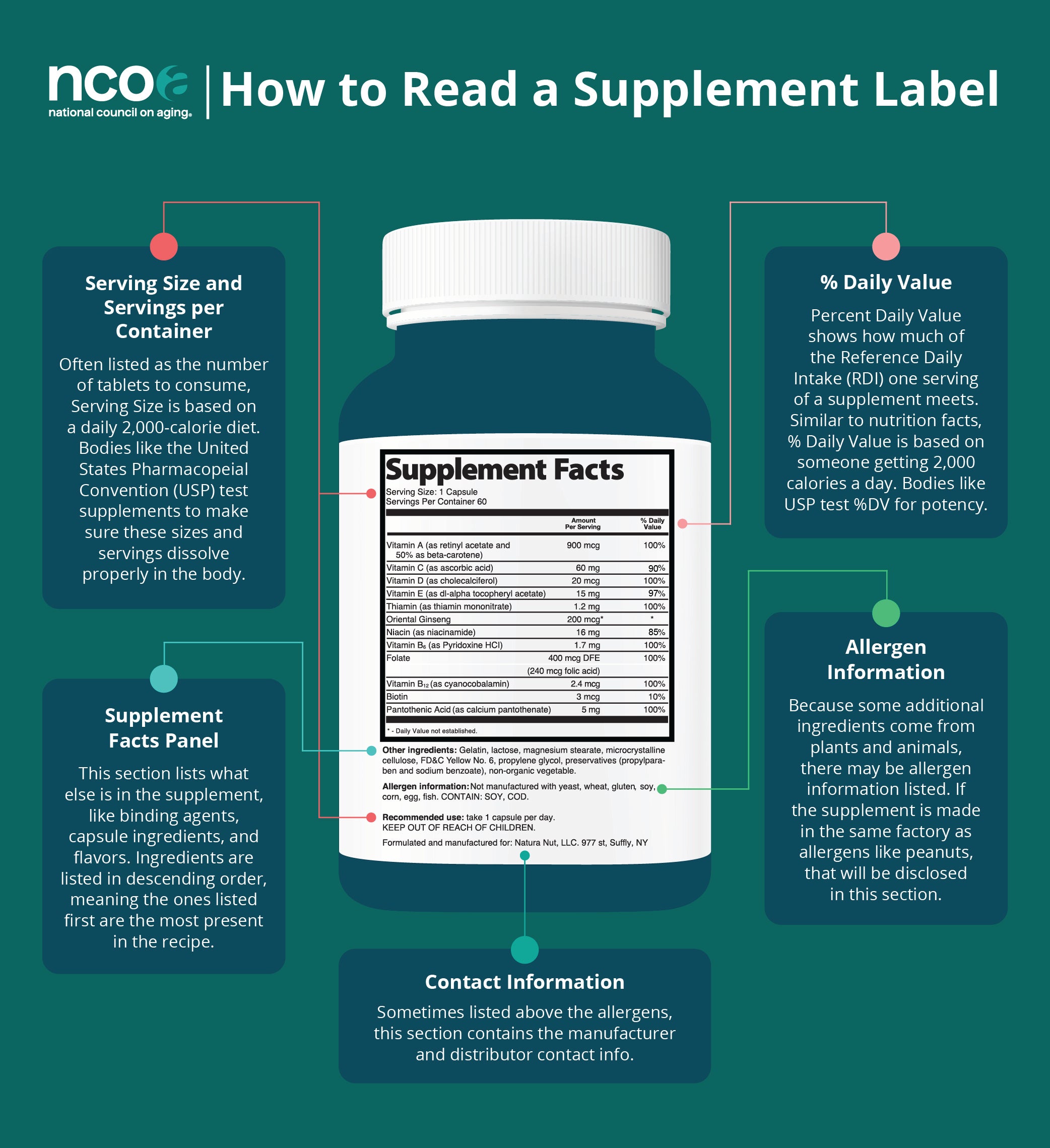
1. Check the serving size
A supplement's serving size tells you how much counts as one dose. USP testing confirms each serving breaks down properly in the body. Taking more than the recommended serving can make it harder for your body to absorb the nutrients. In some cases, it may even cause more serious negative effects, depending on the vitamin or mineral.2
2. Find the servings per container
This number tells you how many daily doses of the supplement are in the bottle or jar. For example, let's say a zinc supplement's serving size is one tablet. If the bottle holds 100 tablets, it has 100 servings. If a serving size is two tablets, then that same bottle holds 50 servings.
3. Review the dietary ingredients
This section lists any additives, fillers, and preservatives that are in the supplement. Why are those things in there to begin with? Manufacturers add these to bind ingredients together and extend shelf life.3 Additives can alter the taste, texture, color, or consistency of the supplement. Finding a supplement completely free of them might be difficult. Instead, try to avoid supplements with long lists of additives.
Dietary ingredients are listed in descending order. This means the ingredients listed first are the most present. Additives that show up high on the list mean your supplement is less pure.
4. Look at the amount per serving
“Amount per serving” shows how much of each main ingredient you get in one dose. It does not include fillers or additives. This is expressed as a percentage called “% Daily Value,” or %DV. %DV tells you how much of a nutrient is present in a single serving, compared to how much you need daily.
Similar to the nutrition facts on the back of your snacks, the “% Daily Value” is based on a 2,000-calorie-a-day intake.5 Your multivitamin or supplement may say it contains 80% of the Daily Value for magnesium. That means the serving has 80% of the magnesium you need for the day if your diet is 2,000 calories.
A single-ingredient supplement may be simple. For instance, a zinc pill may contain 100% zinc. Multivitamin lists are longer. A multivitamin may offer 50% of your daily value of zinc, and 20% of calcium in one dose.
|
% Daily Value is based on the nutrition needs of someone on a 2,000-calorie diet.5 |
Why do some supplements contain more than 100% daily value?
Some supplements have more than 100% Daily Value. Aside from covering potential nutrition shortfalls found in the average American diet,6 other reasons why manufacturers produce these types of formulations may include the fact that some population subgroups have greater nutrition needs or have limited ability to absorb certain nutrients. Pregnancy, for example, increases women’s needs for folate, iron, iodine, and choline. On the other hand, some older adults may require high doses of B12 to compensate for decreased absorption of this vitamin that comes with age.
Note that when it comes to determining whether high amounts of certain nutrients are safe, there’s an important distinction to be made between % Daily Value (DV) and what is called the tolerable upper intake level (UL). The DV tells you the amount of a nutrient that’s in a standard serving of a food or supplement in relation to your needs. The UL is the highest average daily intake unlikely to pose a risk for most people. For some nutrients, taking substantially more than the DV can approach or exceed the UL.
So a supplement containing, say, 500% DV of vitamin C (450 mg) isn't automatically dangerous because it is still below the adult UL of 2,000 mg from all dietary sources. Moreover, once the body’s tissues become saturated with vitamin C, absorption decreases and any excess amount will be excreted in urine.
On the other hand, a supplement containing 500% DV of vitamin A (4,500 mcg/day of preformed Vitamin A, or retinol) deserves more attention because it exceeds the adult UL of 3,000 mcg retinol/day. Because vitamin A is fat-soluble, any amount not immediately needed by the body is absorbed and stored in fat tissue or the liver. If too much is stored, it can become toxic. It can cause problems such as vision changes, bone pain, dry skin, nausea and vomiting, and sensitivity to bright light like sunlight.
Where can you find allergen information?
Allergen information is listed near the bottom of the supplement label. Look below "Other Ingredients" and the manufacturer's contact information. You should find a "CAUTION" section listing allergens. This area typically also offers guidance on consulting a physician before taking the supplement.
Some protein derivatives, such as soy lecithin, gluten binders, casein, and marine collagen, can cause allergic reactions. If a label doesn't list allergen information, you can search for it in the Dietary Supplement Label Database. This database is run by the National Institutes of Health and the Office of Dietary Supplements.
What supplement measurement units are there?
According to the FDA, units of measure for supplements include:5
- Grams (g)
- International units (IU)
- Micrograms (mcg)
- Micrograms of dietary folate equivalents (mcg DFE)
- Micrograms of retinol activity equivalents (mcg RAE)
- Milligrams (mg)
- Milligrams of niacin equivalents (mg NE)
Common ingredients in supplements
Sometimes there will be non-mineral and non-vitamin ingredients in your supplements. These additives can act as binding agents or alter the supplement's taste, texture, and color. You can find them on the supplement label under “Other Ingredients.”
For example, an orange-flavored vitamin C gummy might contain gelatin to give it its gummy texture. It might also contain other additives to make the gummy orange-colored and flavored.
Common "other ingredients" in supplements include:
- Cellulose: Often used as a binding agent in tablets, cellulose is a biopolymer in plant cell walls.8
- Gelatin or plant-based capsule materials: Gelatin can make supplements easier to swallow. These materials help keep powder and dry ingredients together.9
- Magnesium stearate: This additive is most often used as a binder or a thickening agent.10
- Maltodextrin: Some laboratories call this “the molecular taxi service." Maltodextrin is a modified starch that may make supplements easier to swallow and help the body absorb them faster. Maltodextrin is also a sugar substitute.11
- Potassium sorbate: An antimicrobial preservative. It doesn’t affect the taste of a supplement, and it dissolves in water.12
- Preservatives: Sometimes preservatives are natural, like citric acid. Other times, preservatives are synthetic, like sodium benzoate. These extend the shelf life of the supplements. Other preservatives in supplements include glycols and sulfites.
- Sorbitol: A sugar substitute. It's also used to prolong the supplement's shelf life.13
- Starch: Starch is a natural carb that’s often used in supplements as filler or to stabilize and bind.
Red flags to avoid in supplements
Review the entire ingredient list to see which additives the supplement contains. You should also pay attention to the suffixes of additives listed under “Other Ingredients.” The United States Anti-Doping Agency put together a watchlist of suffixes. These may imply the presence of stimulants in the ingredient list.
Be cautious of marketing language that sounds urgent or makes exaggerated claims. On the front of the label, watch for phrases like:
- “Quick fix”
- “Newest scientific breakthrough”
- “Used for thousands of years”
- “All-natural”
The last one may technically be true. Some fillers are natural. But they’re still fillers. Cellulose and starch are natural. But you still want to avoid supplements with an overabundance of additives.
What does third-party tested mean?
If a supplement is not approved by the FDA, it should be tested by a third party. This requires an organization with no ties to the manufacturer to check a supplement. The goal is to ensure the ingredients listed on the label are present and accurate. A third-party tester looks for toxic levels of ingredients, such as heavy metals, and for bacteria.
The United States Pharmacopeial Convention (USP) is a third-party tester for dietary supplements. Informed Choice and NSF are organizations that conduct more testing. They ensure a supplement is free of illegal substances or those banned from sports competitions.14
Frequently asked questions
How are supplement facts and nutrition facts labels different?
Allergens are more prominently listed in nutrition facts than on supplement facts. This is because food allergies are a more significant public health concern, according to the FDA. Both labels list Daily Values and serving sizes based on a 2,000-calorie daily diet. Both labels will also list additives in descending order. This highlights which ingredients and extras show up in the largest quantities. Plant origins must be listed for supplement facts, but not nutrition facts.4
What should older adults look for on supplement labels?
Older adults should look for calcium amounts, vitamin D, and potassium on a supplement label. These minerals are important for bone health and nervous system function. Older adults with food allergies should pay attention to the allergen section of the label. They can further research the supplement on the Dietary Supplement Label Database.
Why do some supplement ingredients have no daily value?
This means the amount of the ingredient is too small relative to the 2,000-calorie diet to be listed on the label. For example, a supplement with 5 mg of zinc has less than 1% of the recommended daily value. That doesn’t mean there is zero zinc in the supplement, just that the percentage is too small to merit a DV value.4
What is a proprietary blend?
“Proprietary blends” are undisclosed recipes. They are manufacturers’ exceptions to the FDA mandate that all ingredients must be listed on a supplement label. This might also be called a “matrix,” “complex,” or “proprietary formulation.”15
Sources
1. Food and Drug Administration. Dietary Supplement Labeling Guide: Chapter IV. Nutrition Labeling. 2005. Found on the internet at https://www.fda.gov/food/dietary-supplements-guidance-documents-regulatory-information/dietary-supplement-labeling-guide-chapter-iv-nutrition-labeling#4-2
2. United States Pharmacopeial Convention. Medical Technology Assessment Directory: A Pilot Reference To Organizations, Assessments, and Information Resources. 1988. Found on the internet at https://www.ncbi.nlm.nih.gov/books/NBK218324/
3. Loef M., et al. Copper and iron in Alzheimer's disease: a systematic review and its dietary implications. Br J Nutr. January 2012. Found on the internet at https://pubmed.ncbi.nlm.nih.gov/21767446/
4. United States Food and Drug Administration. Questions and Answers on Dietary Supplements. Feb. 21, 2024. Found on the internet at https://www.fda.gov/food/information-consumers-using-dietary-supplements/questions-and-answers-dietary-supplements
5. United States Food and Drug Administration. Daily Value on the Nutrition and Supplement Facts Labels. March 5, 2024. Found on the internet at https://www.fda.gov/food/nutrition-facts-label/daily-value-nutrition-and-supplement-facts-labels
6. National Institutes of Health. Daily Values. Found on the internet at https://ods.od.nih.gov/HealthInformation/dailyvalues.aspx
7. Drake V. Micronutrient Inadequacies in the US Population: an Overview. Linus Pauling Institute | Oregon State University. November 2017. Found on the internet at https://lpi.oregonstate.edu/mic/micronutrient-inadequacies/overview#toc-authors-and-reviewers
8. Dominguez-Robles J., et al. Lignin and Cellulose Blends as Pharmaceutical Excipient for Tablet Manufacturing via Direct Compression. Biomolecules. August 2019. Found on the internet at https://pmc.ncbi.nlm.nih.gov/articles/PMC6770814/
9. Prakash A. Are Your Capsules Vegetarian or Nonvegetarian: An Ethical and Scientific Justification. Indian Journal of Pharmacology. September–October 2017. Found on the internet at https://pmc.ncbi.nlm.nih.gov/articles/PMC5830853/
10. Hobbs C., et al. Magnesium Stearate, a Widely-Used Food Additive, Exhibits a Lack of in vitro and in vivo Genotoxic Potential. Toxicology Reports. October 2017. Found on the internet at https://pmc.ncbi.nlm.nih.gov/articles/PMC5655391/#sec0045
11. Hofman D., et al. Nutrition, Health, and Regulatory Aspects of Digestible Maltodextrins. Critical Review Food Science Nutrition. February 2015. Found on the internet at https://pmc.ncbi.nlm.nih.gov/articles/PMC4940893/#s0006
12. Yuling D., et al. Potassium Sorbate Induces Developmental and Microbiome Changes in Drosophila Melanogaster with Attenuated Trans-Generational Toxicity. Frontiers in Microbiology. March 2026. Found on the internet at https://pmc.ncbi.nlm.nih.gov/articles/PMC13050859/
13. Fernandes F., et al. Effect of Natural Preservatives on the Nutritional Profile, Chemical Composition, Bioactivity and Stability of a Nutraceutical Preparation of Aloe arborescens. Antioxidants. March 2020. Found on the internet at https://pmc.ncbi.nlm.nih.gov/articles/PMC7222173/
13. Corazza G.R., et al. Sorbitol Malabsorption in Normal Volunteers and in Patients with Celiac Disease. Gut. January 1988. Found on the internet at https://pmc.ncbi.nlm.nih.gov/articles/PMC1433267/
14. Department of Defense: Operation Supplement Safety. Why is Third-Party Certification Important for Dietary Supplements? May 29, 2024. Found on the internet at https://www.opss.org/article/why-third-party-certification-important-dietary-supplements
15. Department of Defense: Operation Supplement Safety. Proprietary Blends. March 28, 2018. Found on the internet at https://www.opss.org/article/proprietary-blends-what-does-mean