
Best Portable Oxygen Concentrators of 2026
Portable oxygen concentrators help you take your oxygen therapy wherever you need to go.
- The best portable oxygen concentrator overall is the Inogen Rove 6.
- Portable oxygen concentrators often cost around $2,000–$4,000.
- You need a prescription to buy a portable oxygen concentrator.
- The best portable oxygen concentrators are lightweight and have long battery life.
We recommend products and services that offer real value to our readers. It's important to us that our reviews of portable oxygen concentrators are accurate, helpful, and trustworthy. So our team spent more than 1,000 hours researching and comparing options.
To choose what to recommend, we:
- Researched 15+ brands and 30 models on our own
- Spoke with experts in geriatric care and respiratory medicine
- Mystery-shopped manufacturers and retailers to check product claims and see what the buying experience is like
- Surveyed 300 oxygen machine users and caregivers to learn what matters most in real life
- Reviewed medical and academic research on how well portable oxygen concentrators work and how safe they are
- Looked at verified customer reviews on trusted sites like the Better Business Bureau and Trustpilot
Our review process is based on clinical evidence and expert input. So you can feel confident you’re getting reliable, up-to-date guidance. Learn more about our oxygen machine review methodology.
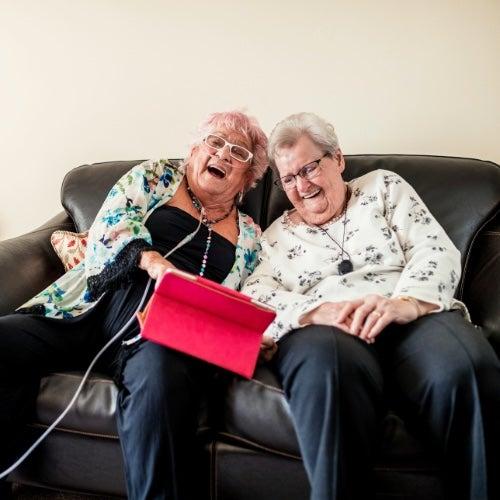
Staying social is important for people trying to be proactive about their health needs. And portable supplemental oxygen can help the more than 1.5 million U.S. adults who need oxygen maintain independence and social connection.1 Unlike their stationary home oxygen counterparts, portable oxygen concentrators (PO2s) are discreet and built to be mobile. When you think “portable oxygen,” you might picture the clunky metal tanks of the past. While those do still exist, today's portable oxygen concentrators are far more convenient and look like hip carry-on luggage or small, soft-sided coolers.
This roundup of the best portable oxygen concentrators aims to help you choose the best option for your situation based on user testing and reviews. This review explains what these devices can do and ranks the best portable oxygen concentrators by top features such as battery life, flow, durability, and cost.
Our picks for the best portable oxygen concentrators of 2026:
- Inogen Rove 6: Best Overall
- CAIRE Freestyle Comfort: Best Value
- O2 Concepts Oxlife Liberty 2: Best Continuous and Pulse Flow
- Inogen One G4: Best for Air Travel
- CAIRE Eclipse 5: Highest Oxygen Output
- Invacare Platinum: Most Durable
Comparing the best portable oxygen concentrators of 2026
| Comparison Features | ||||||
|---|---|---|---|---|---|---|
| Our rating | 9.9 |
9.8 |
9.8 |
9.5 |
9.9 |
9.8 |
| Best for | Overall |
Value |
Continuous and Pulse Flow |
Travel |
Oxygen Output |
Durability |
| Max oxygen output | 1,000-1,499 ml/min |
1,000-1,499 ml/min |
2,000-2,499 ml/min |
500-999 ml/min |
>2,500 ml/min |
1,000-1,499 ml/min |
| Battery life | Over 6 hours |
Over 6 hours |
4-4.9 hours |
2-2.9 hours |
5-6 hours |
4-4.9 hours |
| Weight | 3.9-4.1 lbs. |
5-7 lbs. |
8-15 lbs. |
<3 lbs |
>15 lbs |
3.1-4.9 lbs. |
Our reviews of the best portable oxygen concentrators
Inogen Rove 6: Best Overall Portable Oxygen Concentrator
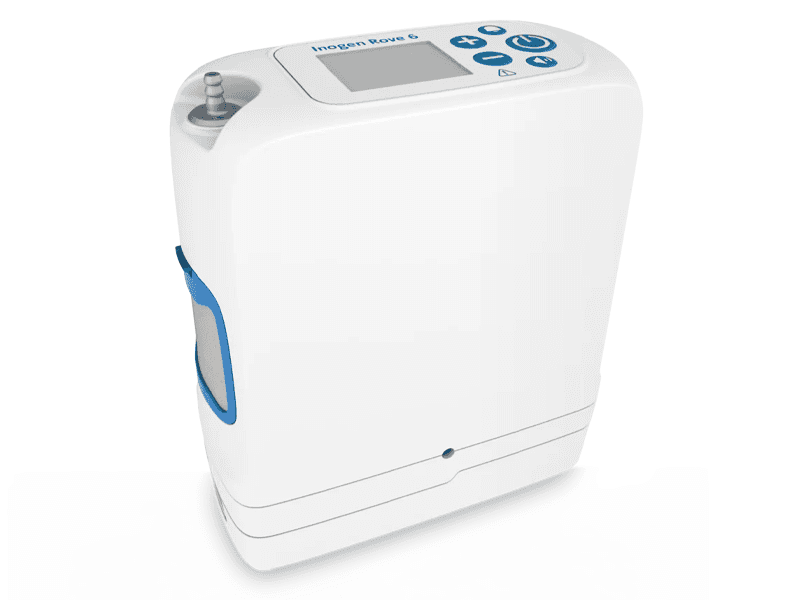
We chose the Inogen Rove 6 as our Best Overall portable oxygen concentrator. We like this model because it's the lightest and has the longest battery life of all the devices we tested.
- Handy Bluetooth app for monitoring battery
- Comes with a cloth carry bag and a car charger
- Lighter weight makes it well-suited for travel
- Weight: Less than five pounds
- Power source: AC/DC
- Battery life: 6 hours
- Flow type: Pulse dose
- Maximum oxygen output: 1260 ml/min
Pros
- Lightweight
- FAA-approved
- Fairly quiet
- Can last up to 8 years
- Compatible with previous-model Inogen batteries
Cons
- Moderately expensive
- Backpack not included
- Filters must be cleaned weekly (standard on all the models in our roundup)
Why we chose the Inogen Rove 6 as the Best Overall
At just shy of five pounds, the Inogen Rove 6 is one of the lightest portable oxygen concentrators on the market. Its ability to weigh this little, even after you factor in its brick-sized battery, is impressive.
Battery life was one of the most important features people mentioned during our 2025 survey of 300 people with respiratory devices.2 The Rove 6 has more than 6 hours of battery life, which is on the longer side of the models we researched. Most of the PO2 concentrators on this list run on 3–4 hours of battery life.
You can also continue to use the Inogen Rove 6 while it charges. Since the Rove 6 takes about 3 hours to charge, being able to use the device while it charges is important. The Inogen Rove 6 package includes a DC power charger so you can charge it in your car (as well as a standard AC wall charger for home charging). As an added bonus, the Rove 6 is also compatible with Inogen G5 batteries.
Some portable oxygen concentrators offer both continuous flow oxygen and pulse doses, meaning you can choose between little air puffs and a continuous blast of air. The Inogen Rove 6 offers pulse dosing across a standard range of four to six pulse flow settings.
For an additional cost, you can get a backpack to tote your Rove 6. Otherwise, this PO2 concentrator comes with a faux leather shoulder-strap bag.
CAIRE Freestyle Comfort: Best Value Portable Oxygen Concentrator
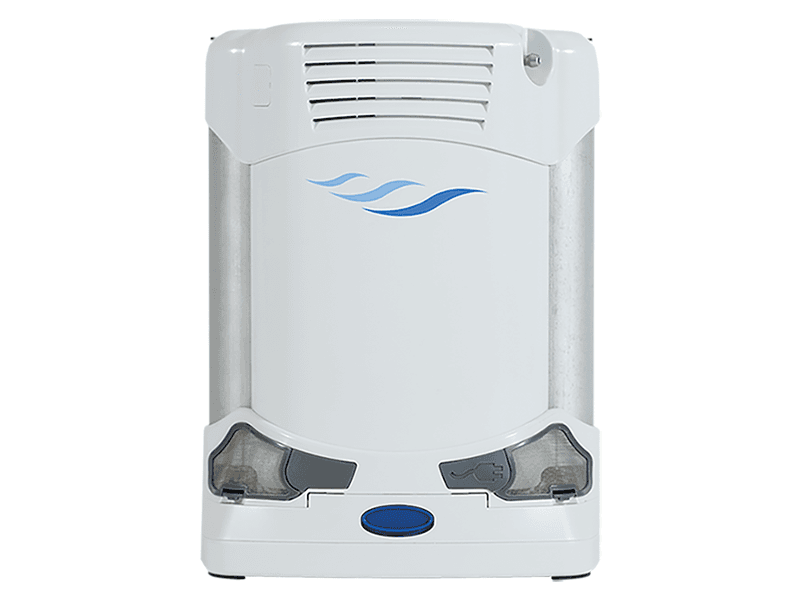
CAIRE Freestyle Comfort earned the title of Best Value because it’s the most affordable PO2 concentrator model. It also features a six-hour battery life and can be worn three ways: on your shoulder with or without the carry bag, or on your back.
- Curved design to better conform to users' bodies
- Batteries come with helpful test buttons
- Remotely sends stats to loved ones and doctors
- Weight: 5 lbs.
- Power source: AC/DC
- Battery life: 4-8 hours
- Flow type: Pulse dose
- Maximum oxygen output: 1,00-1,499 ml/min
Pros
- Quiet
- Large display
- Glow-in-the-dark buttons
- FAA-approved
Cons
- Pulse dose only
- Can’t use it while charging in the car
- 8-hour battery pack costs extra
Why we chose the CAIRE Freestyle Comfort as the Best Value
The Freestyle Comfort offers many features that contribute to its “Best Value” superlative. With a slightly lower price than the Inogen Rove 6, the CAIRE Freestyle Comfort can fit both a 4-hour battery and an 8-hour battery, the latter of which you can purchase at additional cost.
At less than 40 dBA (A-weighted decibels, which are the most widely used decibels to describe how humans perceive sound volume), the CAIRE Freestyle Comfort is fairly quiet. According to CAIRE’s website, your fridge is likely louder. Out of all the portable oxygen compressors in this review, the Freestyle Comfort is the only PO2 concentrator with a curved design. CAIRE opted for the ergonomic curve to better hug your hip when the device hangs off your shoulder. There’s less need for the curve if you choose to wear the Freestyle Comfort on your back.
The Freestyle Comfort comes with the MyCAIRE wireless telehealth service, which it uses to share flow-rate data with family and health care providers. You can use your Freestyle Comfort while it’s charging on the wall, but not when it’s charging in the car. When charging in the car with the included DC charger, you have to let the Freestyle Comfort charge fully before using it again.
O2 Concepts OxLife Liberty2: Best Continuous and Pulse Flow
To be portable, many PO2 concentrators don’t provide continuous oxygen. The technology required to create continuous flow (larger compressors, more or denser batteries) makes the portable oxygen concentrator heavier and, well, less portable. Of the portable oxygen concentrators we looked at that offer continuous flow, the OxLife Liberty 2 was the lightest, earning it the title of Best Continuous and Pulse Flow.
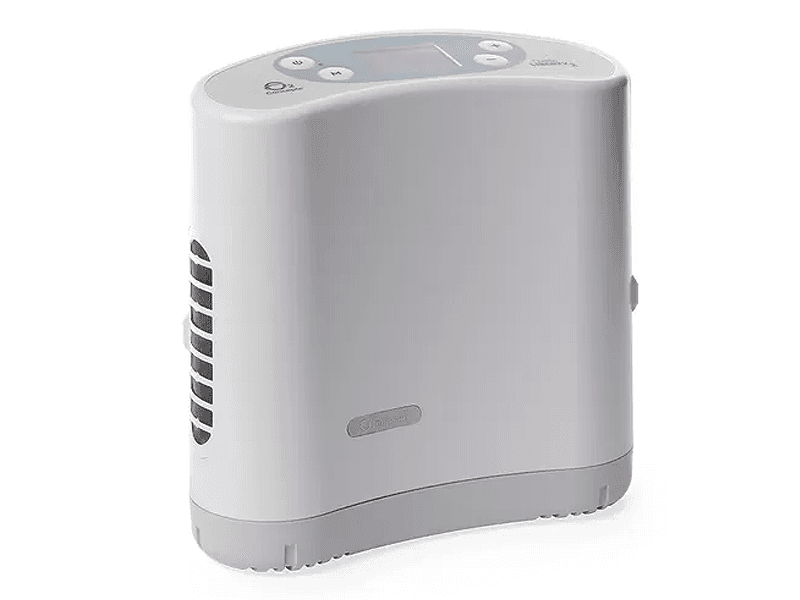
- Ergonomic curve sits better on your hip
- Impressive 10 pulse mode settings
- Batteries come with helpful charge indicator buttons
- Weight: 8–15 lbs
- Power source: AC/DC
- Battery life: 4–4.9 hours
- Flow type: Continuous and Pulse Flow
- Maximum oxygen output: 2,000–2,499 ml/min
Pros
- Comes with a carry bag and an accessory bag
- FAA-approved
- Remote troubleshooting via Oxlife DNA Technology
Cons
- Needs a battery replacement every two years
- Counterintuitive battery charging icon that fills from the top down may be confusing
- You must use the cables that come with it
- You must clean filters weekly, which is standard
Why we chose the Oxlife Liberty 2 as the Best Continuous and Pulse Flow
At 2,000–2,499 ml/min, the Oxlife Liberty 2 has the second-highest oxygen output on this list. This is in part due to continuous-flow portable oxygen concentrators producing more oxygen than pulse-flow portable oxygen concentrators. A continuous-flow system tends to add weight to the machine, so we were impressed that the Liberty 2 comes in under 15 pounds.
Where most PO2 concentrators in this review have six pulse flow settings, the Oxlife Liberty 2 offers what O2 Concepts says is “the industry’s largest pulse flow settings,” or a total of 10. The Liberty 2 connects to Verizon’s Oxlife-specific network, so your health care provider can remotely monitor your PO2 concentrator’s performance and help troubleshoot issues.
Inogen One G4: Best for Air Travel
At 3.3 pounds, the Inogen One G4 is one of the lightest portable oxygen concentrators on the market, and definitely the lightest on this list. While all PO2s in this review are FAA-approved, the Inogen One G4 is not only a lighter lift but also runs for 5 hours on its extended battery, making it the best for air travel.
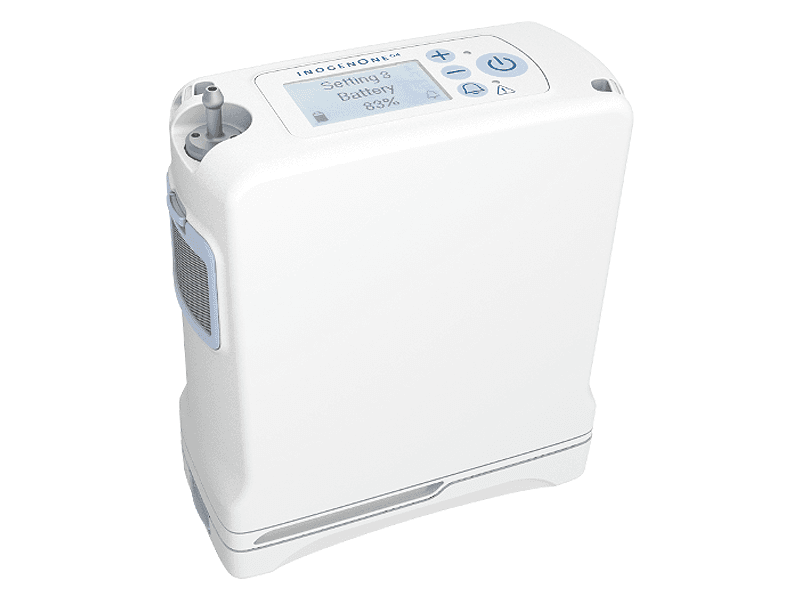
- Bluetooth app for monitoring battery
- Super light
- Can be used while charging on plane
- Weight: 3.3 lbs
- Power source: AC/DC power
- Battery life: 3–5 hours
- Flow type: Pulse dose
- Maximum oxygen output: 500–999 ml/min
Pros
- The extended battery lasts 5 hours on the lowest flow setting
- Carry bag included
- Costs the same as an average PO2 concentrator
Cons
- The standard battery barely lasts 3 hours
- Limited flow settings
- Hip bag costs $70 extra
Why we chose the Inogen One G4 as the Best for Air Travel
Like all oxygen concentrators, the G4 charges when plugged into a DC wall outlet. Many planes use DC outlets for passengers. As long as you’re seated by an outlet (you can work with the airline to ensure this), you’ll be able to charge your G4 while using it on the plane. This convenience and the light weight make the G4 a strong choice for air travel. Depending on the length of your flight, your Inogen One G4 may make the trip without charging—on the lowest flow setting, the G4 can last five hours on its extended battery.
CAIRE Eclipse 5: Highest Oxygen Output
At more than 2,500 ml/min, the CAIRE Eclipse 5 creates the most oxygen out of all the machines on this list. So we awarded it Highest Oxygen Output. The Eclipse 5 earned this honor because it offers continuous-flow and pulse-dose oxygen.
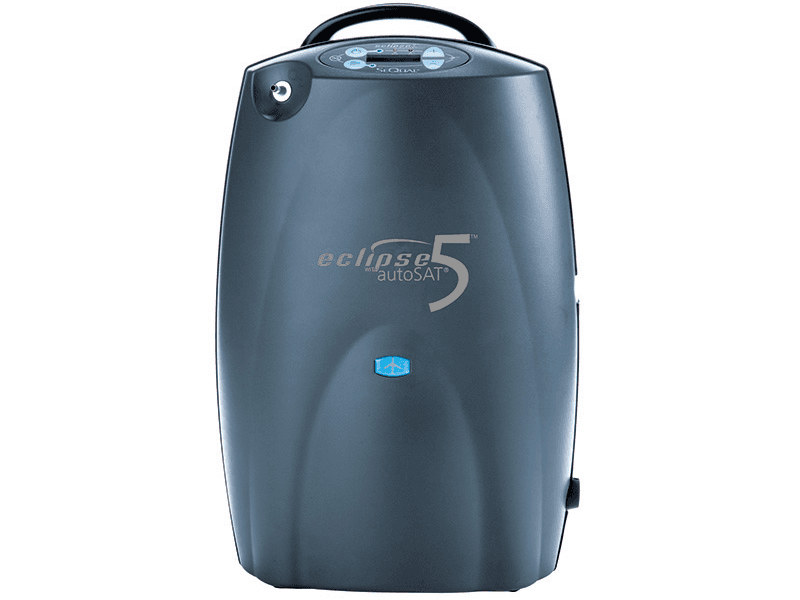
- Can deliver more than 2,500 ml/min
- Has wheels for increased mobility
- Cart is removable
- Weight: 15+ lbs.
- Power source: AC/DC
- Battery life: 5–6 hours
- Flow type: Continuous and pulse dose
- Maximum oxygen output: 2,500+ ml/min
Pros
- Offers continuous flow
- FAA-approved
- Up to 9 pulse dose settings
Cons
- Heavy
- Not discreet
Why we chose the CAIRE Eclipse 5 as the Highest Oxygen Output
The Caire Eclipse 5 is one of two portable oxygen concentrators on this list to earn a near-perfect score, losing the Best Overall crown to the Inogen Rove 6 only because it’s slightly heavier. The Eclipse 5 weighs about 18 pounds because it offers both pulse dose oxygen and continuous flow, and continuous flow requires larger batteries and compressors.
Unlike the other portable oxygen concentrators on this list, the Eclipse 5 does not come with a shoulder bag. Instead, the Eclipse 5 comes with wheels and a handle like hard-sided carry-on luggage.
Invacare Platinum: Most Durable
We chose the Invacare Platinum as our Most Durable because it’s the only portable oxygen concentrator we looked at that’s water-resistant. The Invacare Platinum is advertised as “designed to endure the trials of daily life,” and can handle about 10 minutes of direct rain.
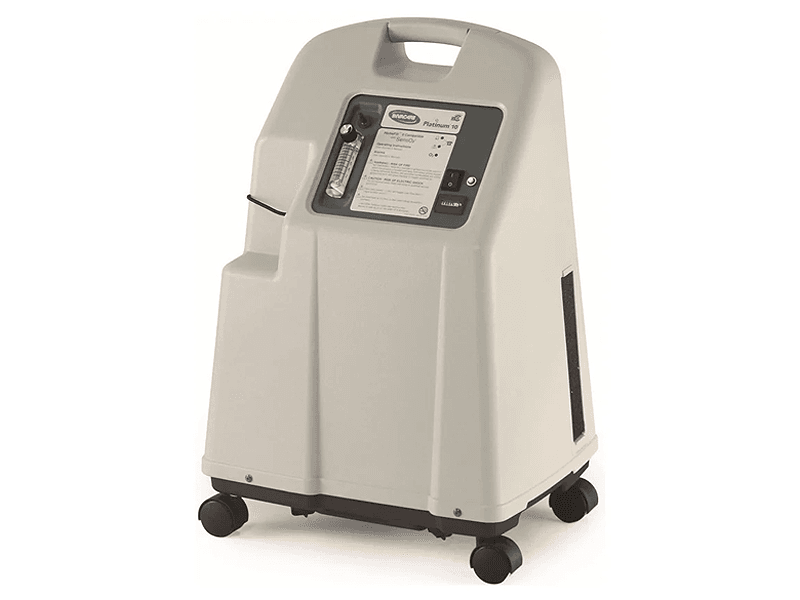
- Water-resistant
- Built with shock-absorbing foam for protection
- FAA-approved
- Weight: 5–8 lbs.
- Power source:
- Battery life: 4–8 hours
- Flow type: Pulse dose
- Maximum oxygen output: 1,000–1,499 ml/min
Pros
- Durable
- Large, simple buttons
- Can use it while charging in the car
Cons
- Can overheat, according to user reviews
- Second battery sold separately
- Intake filter needs weekly maintenance, which is standard for portable oxygen concentrators
Why we chose the Invacare Platinum as the Most Durable
Durability is important for a portable oxygen concentrator. Over half of our survey respondents stated oxygen therapy allowed them to spend more time outside or traveling. So an oxygen concentrator that can handle being on the move is important.
The Invacare Platinum compressor is surrounded by foam to withstand shock, and the whole unit has reinforced bumpers. Depending on whether you're using one battery or a second one to extend its battery life, your Invacare Platinum could weigh up to seven pounds at maximum, which makes it fairly portable.
What we look for when testing portable oxygen concentrators
We identified several important factors during our research, testing, and review of portable oxygen concentrators. These include:
Oxygen flow type
Continuous flow, as the name implies, is a steady stream of oxygen. This is the baseline oxygen type that stationary oxygen concentrators deliver. Any time someone needs oxygen support while they sleep, that oxygen will be continuous flow, not pulse dose. To deliver large amounts of oxygen in a continuous stream, the oxygen concentrator uses compressors. Stationary oxygen concentrators are so much bigger than their portable counterparts because of their larger compressors. Pulse dose oxygen doesn’t need as large a compressor, which is why so many portable oxygen concentrators offer pulse-dose oxygen only. On our list, only the CAIRE Eclipse 5 and the O2 Concepts Oxlife Liberty 2 offer continuous flow.
Battery life
You’re only mobile for as long as your battery can power your portable oxygen concentrator. For most of the oxygen concentrators on this list, battery life is between 3–5 hours. The CAIRE Freestyle Comfort is the exception—it comes with an 8-hour battery and offers a ~16-hour battery for additional purchase.
Many models let you continue using the concentrator while it charges from the wall (or any AC power source). But not every portable oxygen concentrator model can remain in use while charging in the car. This means you need to have enough battery power to get home. There's also a trade-off with longer-lasting batteries: the ones that last the longest tend to weigh more, which makes them more difficult to haul around.
Many portable oxygen concentrators on the market advertise their maximum battery life, but sometimes that maximum requires two batteries, and your initial purchase comes with only one. For example, the Invacare can last you eight hours—if you load it with two batteries. And the CAIRE FreeStyle Comfort can last you eight hours, but only if you buy the 8-hour bonus battery. To enjoy the most freedom with your portable oxygen concentrator, you may need to purchase an additional battery.
Weight and portability
“How heavy it is is really, really important to patients,” says Alexis Smith, DO, at Novant Health, focusing on pulmonary and critical care. “The heavier an oxygen concentrator is, the less likely patients are going to use it, and the less likely they’re going to be able to do what they need to do with it.” Since the whole point of portable oxygen is to help people continue to live their lives to the fullest, being able to carry your oxygen concentrator is crucial.
Many portable oxygen concentrators come with a shoulder strap so you can carry them like a messenger bag. Some can be worn as a backpack. A lighter, portable oxygen concentrator, such as the Invacare Platinum or the Inogen Rove 6 or One G4, can make your routine easier. Note that these lighter models, weighing four pounds or less, often have limited pulse dose ranges.
Noise level
Compressors, like the one in your refrigerator, make noise. Due to their larger compressors, stationary oxygen concentrators are louder than portable oxygen concentrators. The volume oxygen concentrators operate at is measured in A-weighted decibels (dBA)—a measure of how humans perceive sound volume. All of the concentrators on this list are 40 dBA or quieter, except the O2 Concepts Oxlife Liberty 2, whose ability to offer continuous oxygen in addition to pulse dose means it runs louder than 40 dBA.
Warranty and customer support
Many portable oxygen concentrators have three-year manufacturer warranties. The FDA pays close attention to which manufacturers can create oxygen concentrators and how, so it’s not a surprise that the manufacturers offer the same warranty timeframe across the board. Every portable oxygen concentrator on this list scored a perfect 10 for customer service.
Maintenance and ease of use
The level of maintenance depends on the type of portable oxygen concentrator you buy. For example, pretty much every portable oxygen concentrator on this list needs its intake filters cleaned weekly, and most, but not all, need you to give the filters a gentle sponge bath with dish soap. Follow the instructions that come with your concentrator for more details on model-specific care. Avoid using alcohol products to clean your portable oxygen concentrator, as these can damage the unit’s casing.
Who should use a portable oxygen concentrator
Many conditions can make someone a good candidate for a portable oxygen concentrator, and many people can have overlapping conditions that make oxygen therapy a part of their routine. You might need portable oxygen if you have chronic obstructive pulmonary disease (COPD), asthma, or sleep apnea.
“Whenever we prescribe oxygen, we’re doing it because the oxygen in a patient’s bloodstream is low, and that can be for a multitude of reasons,” says Dr. Smith. “People often think it’s a lung problem, but it can be a muscle problem, it can be a heart problem, it can be neuro. There can be lots of different factors that contribute, and it can be all of the above—it doesn’t have to be just one isolated problem.”
Stationary oxygen is great for when you’re sleeping or reading or generally staying put, and portable oxygen concentrators are best for when you’re on the go, either around your home (cooking, cleaning, walking to the bathroom) or beyond. Travel, of course, will also require a portable oxygen concentrator.
Are portable oxygen concentrators safe to buy online?
Portable oxygen concentrators are safe to buy online if you buy them from a place your health care provider recommends. And since you need a prescription, you will have ample opportunities to discuss purchasing one with your health care provider.
Not sure if the oxygen concentrator you’re about to buy is a scam? Check for:
- Whether the website you’re using sells other types of durable medical equipment. Legitimate durable medical equipment (DME) companies and home oxygen vendors will also sell tubing, hospital beds, and walkers.
- Reviews for that company on Trustpilot or the BBB. These will reveal how trustworthy the vendor is.
- FDA approvals ensure that oxygen concentrators perform up to standard.
As with anything priced suspiciously low, a highly affordable portable oxygen concentrator might be a scam. Certified portable oxygen concentrators approved by your doctor will cost $2,000 or more. It’s best to purchase your concentrator from a verified medical online retailer or from a local durable medical equipment company, not from Amazon.
Traveling with a portable oxygen concentrator
All the models on this list are FAA-approved, but TSA will still be involved when you fly with oxygen. When traveling by air with oxygen, you must alert the airline so they can get a headcount of how many passengers have oxygen. Many airlines require those traveling with oxygen to complete forms signed by the user and their health care provider.3
The biggest thing to remember with any kind of travel is battery life. If your travel leg lasts longer than your battery, you’ll need to ensure access to an AC power source so you can charge your portable oxygen concentrator while it's in use. Since most of the devices on this list can be used while charging at an AC outlet, you should be safe to travel anywhere you have reliable access to a wall outlet, including planes, trains, and cruise ships.
Among the models on this list, the Inogen Rove 6 and the CAIRE Freestyle Comfort are both under 8 pounds and have a 6-hour battery life, making them a good choice for travel.
Air Travel Checklist
Before heading off on a trip, you’ll need to alert your health care provider. With enough notice, Dr. Smith says your health care provider can create an oxygen test to simulate where you’re going (and even simulate flying at altitude) so they can help you dial into the right oxygen output for your travel and destination.
Before flying with oxygen:
- Reach out to your doctor for a simulation
- Get a prescription and doctor’s letter
- Notify airline 48–72 hours ahead*
- Confirm battery and weight allowances with the airline
- Request a seat with a power port if possible
- Pack extra supplies, chargers, and a backup plan
*This not only lets the flight crew know how many passengers will have oxygen, but also can help TSA provide you with an escort. A cart escort to your gate will lower your exertion and conserve oxygen.
Buying vs. renting a portable oxygen concentrator
If your health care provider has told you that oxygen is a temporary need based on your diagnosis, you might prefer to rent a portable oxygen concentrator. This might also be a good option if you're partial to your stationary oxygen and need a portable oxygen concentrator only for a specific trip or event.
Verified oxygen retailers, such as the Oxygen Concentrator Store, offer rental programs, as do many DME providers. Be cautious of renting a concentrator from a fishy company.
Since most portable oxygen concentrators cost around $3,000, owning one becomes a better investment than renting if your rental costs exceed the price of a brand-new unit. For example, renting the CAIRE Eclipse 5 costs $315 per week. The Eclipse 5 retails for $4,000, so you can rent it for about 12 weeks before your rental costs reach $4,095, surpassing the sticker price of a brand-new machine.
Frequently asked questions
Do I need a prescription for a portable oxygen concentrator?
Yes. Your health care provider determines how much and what kind of oxygen you need (pulse dose vs. continuous flow), and you can then use your prescription to find a portable oxygen concentrator that can fulfill that need.
Are all portable oxygen concentrators FAA-approved?
All of the portable oxygen concentrators on this list are FAA-approved. But you still need to contact the airline you intend to fly with and let them know you’ll be bringing your oxygen.
What’s the best model of portable oxygen concentrator for overnight use?
Stationary oxygen concentrators, not portable ones, are best for overnight use. But if you have to use a portable oxygen concentrator overnight, choose one that delivers continuous flow. You might need to leave it plugged into the wall all night to avoid draining the battery.
Does Medicare or insurance cover portable oxygen concentrators?
If you’re eligible, Medicare will help cover (but not fully cover) a portable oxygen concentrator in some instances. Medicare will not cover oxygen related to air travel. Oxygen companies may be happy to work with your insurance provider to confirm your eligibility. Your portable oxygen concentrator should be reimbursable through FSA or HSA funds.
Can I travel internationally with a portable oxygen concentrator?
Yes, but you’ll need to make sure that you have the right adapters to charge your concentrator in your destination country. You’ll also need to make sure your boat or plane seats you near a 120V AC outlet so you can charge your PO2 concentrator en route.
Questions? Email us at reviewsteam@ncoa.org.