
NCOA's 2025 Annual Report
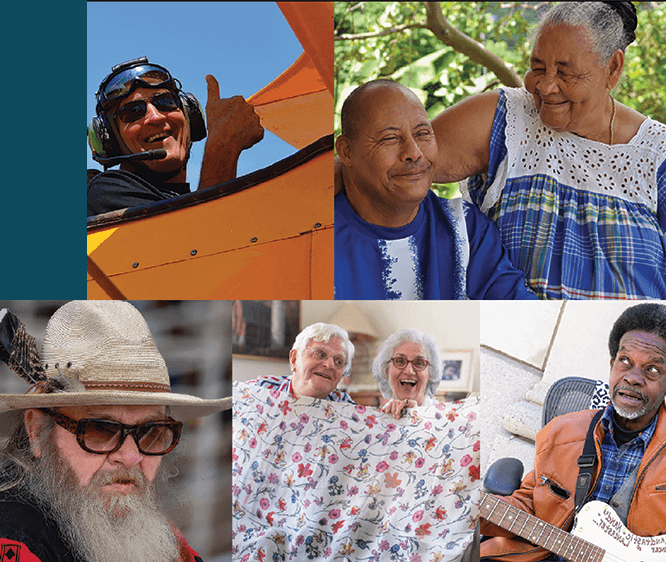
NCOA is the national voice for every person’s right to age well. Working with thousands of national and local partners, we provide resources, tools, best practices, and advocacy to ensure every person can age with health and econonomic well-being. Founded in 1950, we are the oldest national organization focused on older adults.
Every year, NCOA releases an Annual Report that describes the programs, accomplishments, societal impact, and progress. Learn about the work we do, the people we serve, and why aging well matters now more than ever by reading the highlights below and downloading the fiscal year 2025 report.
Health
Chronic Disease
NCOA’s National Chronic Disease Self-Management Education (CDSME) Resource Center works to increase access to, and use of, CDSME and other evidence-based programs to help older adults and adults with disabilities live longer, healthier lives. In FY25:
- The center supported 22 CDSME grantees to expand access to programs and integrate them into state and community health systems. These efforts were funded through the U.S. Administration for Community Living (ACL) Prevention and Public Health Fund.
- Over 12,900 participants attended 980 CDSME workshops nationwide during FY25. Since NCOA started collecting data from grantees, the NCOA Center for Healthy Aging team has supported grantees to reach over 532,000 participants through over 47,700 workshops, making use of the nation’s largest database for these programs.
- The center launched a communications toolkit with templates, supported the 2025 evidence-based review council to designate newly recognized evidence-based programs, and facilitated a “skills-lab” series of peer-to-peer learning opportunities.
- The center promoted sustainability by launching a revised Cost Calculator Tool, to help grantees better understand their total costs and break-even points . Existing and new grantees were engaged in strategic sustainability planning through the Program Sustainability Assessment Tool, resulting in individualized scorecards and next steps for action plans. And grantees received one-on-one specialized sustainability guidance through individual consultations with subject matter experts.
Falls Prevention
NCOA’s National Falls Prevention Resource Center supports the implementation, dissemination, and sustainability of evidence-based falls prevention programs and strategies across the nation to reduce the incidence of falls among older adults and adults with disabilities. The center educates consumers and professionals about the risks of falls and how to prevent them and serves as a national clearinghouse of tools and best practices. NCOA also leads the Falls Free® Initiative, which includes national organizations and state coalitions on falls prevention charged with promoting effective strategies to prevent falls and fall-related injuries. In FY25:
- Falls Prevention Awareness Week 2024 engaged 34 states, reaching 9.1 million people nationally through educational campaigns and events. Grassroots activities reached 773,921 older adults and included activities such as education campaigns and events, fall risk screenings, advocacy efforts, and traditional media campaigns. Media releases reached 3.7 million people, and social media posted on platforms including Facebook, X, YouTube, and LinkedIn reached 4.7 million people.
- The center partnered with 23 grantees to implement and sustain evidence-based falls prevention workshops, resulting in 1,505 workshops with over 17,860 participants. Since collecting data through the National Falls Prevention Resource Center, the Center for Healthy Aging team has supported grantees in reaching over 280,000 participants through 21,140 workshops.
- In April 2025, NCOA launched the State Falls Prevention Coalition project, funding 18 grantees for an 18-month period to expand falls prevention activities a t a statewide level. Additional funding from ACL enabled the center to add tw o Falls Prevention Fellows to develop innovative capstone projects addressing real-world problems and reducing falls risks.
Senior Centers
NCOA continued to strengthen its national leadership by engaging a broad network of community-based organizations (CBOs) while providing focused leadership and support for senior centers as essential community hubs through the specialized work of the National Institute of Senior Centers (NISC).
Key FY25 accomplishments included:
- Engaging CBOs and senior centers in advocacy and program innovation, bringing community insights into federal and state policy discussions while supporting organizations in piloting and implementing initiatives in areas such as digital inclusion, fraud prevention, economic security, and healthy aging.
- Strengthening professional development, with NISC offering targeted training and a dedicated senior center track at Age+Action to support the growth of senior center leaders and staff.
- Expanding networking and peer engagement, with NISC supporting more than 3,000 affiliate member organizations and convening a Leadership Collaborative representing 34 states to provide ongoing peer networking, insight, and communication across the senior center and CBO network, as well as supporting the development of online peer affinity groups.
- Providing national visibility and outreach tools, including an enhanced National Senior Center Month toolkit that supported local engagement and highlighted the contributions of senior centers within the wider CBO ecosystem.
- Recognizing innovation and excellence, with NISC’s Programs of Excellence Awards, honoring 15 senior centers at Age+Action, showcasing their models through a webinar series, and adding them to NCOA’s clearinghouse to support replication across CBOs.
Economic Well-Being
Benefits Access
NCOA helps older adults and adults with disabilities enroll in programs that pay for health care, prescriptions, food, utilities, and other daily expenses. In FY25:
- NCOA continued support for 90 community-based organizations to serve as Benefits Enrollment Centers. These organizations help low-income people with Medicare access all the benefits they may be missing. The BECs helped over 82,250 people submit more than 117,023 applications for benefits estimated to be worth over $450 million. The FY25 figures reflect a transition year in the program. A gap between grant cycles, the closure of a large multi-state partner, and a strategic shift to prioritize hard-to-reach communities all contributed to a year-over-year change in outputs.
- NCOA’s Center for Economic Well-Being provided resources and technical support to states and territories that receive Medicare Improvements for Patients and Providers Act (MIPPA) funding to help low-income individuals apply for Medicare subsidies. MIPPA grantees assisted with submitting over 110,000 applications for the Extra Help/Low Income Subsidy (LIS) and Medicare Savings Programs (MSP).
- As part of the Senior SNAP Enrollment Initiative funded by the Walmart Foundation, 20 community organizations screened over 38,000 clients and completed over 5,400 applications for low-income older adults applying for the Supplemental Nutrition
Direct Care Workforce
With continued funding from the ACL, NCOA advanced its work to support states in addressing the growing shortage of skilled direct care workers. Through the Direct Care Workforce Strategies Center, NCOA partners with cross-state teams to set and achieve milestones to grow and strengthen the home-and community-based services workforce through targeted technical assistance, structured peer learning, and the development and dissemination of innovative tools and resources that elevate strategies ready for broader adoption. In FY25, the center:
- Delivered technical assistance to 20 states—Through Peer Learning Collaboratives and Intensive Technical Assistance the Strategies Center helped states drive systems change by advancing cross-agency workforce strategies, building career pathways, and putting in place the infrastructure needed to strengthen recruitment and retention within the HCBS direct care workforce.
- Launched Year 3 technical assistance in May 2025, selecting 18 states and one territory for the 2025–2026 TA cycle. Approximately half of the year 1 state teams returned for continued engagement, nearly doubling the program’s reach and suppo rting a total of 27 states over two years, reflecting sustained investment in direct care workforce systems change.
- Hosted six national webinars reaching over 1,500 attendees on topics including workforce data infrastructure, recruitment marketing campaigns, state workforce investment systems, and peer learning collaborative innovations—and all recordings and resources were made available through the DCW Resource Hub.
- Continued to engage a 26-member Advisory Committee representing direct care workers, people with disabilities, family caregivers, and national experts to shape and inform the TA strategy around three thematic areas: Joining the Workfor ce, Well-being at Work, and Career Progression.
Mature Workers
NCOA is a national sponsor of the Senior Community Service Employment Program (SCSEP), funded through the U.S. Department of Labor. In FY25:
- SCSEP served 4,056 participants who provided 2.32 million hours of community service.
- The program placed 409 trained participants in jobs.
Scam and Fraud Prevention
With funding from Bank of America Charitable Foundation, NCOA updated and published Steps to Avoiding Scams: Savvy Saving Seniors Financial Education Module, a toolkit to help professionals educate older adults about popular scams, tips for avoiding them, and next steps for those targeted by financial fraud. In addition to hosting a virtual training open to the public with 89 participants, NCOA selected three organizations to receive training on the curriculum and implement two trainings per site.
Public Policy
NCOA is a national voice for older adults and the organizations that serve them. Our goal is to protect and strengthen major public programs, particularly those that support disadvantaged and vulnerable older adults. In FY25, NCOA:
- Led the advocacy efforts to continue authorization and funding for low-income beneficiary outreach and enrollment efforts, which helps older adults afford out of pocket Medicare costs like prescription drug co-pays and plan premiums. Mobilizing nearly 100 national organizations in outreach to Congress, the program was extended in September 2024, December 2024, and March 2025.
- Protected and restored investments in aging services that support healthy aging and financial security, including falls prevention, the Medicare State Health Insurance Assistance Program (SHIP), and the Senior Community Service Employment Program (SCSEP).
- Leveraged insights and expertise gained from working with the Aging Services Network across the country to shape the bipartisan reauthorization of the Older Americans Act reintroduced in the Senate in 2025.
- Led state-based advocacy efforts to modernize the Center for Medicare & Medicaid Services (CMS) regulatory definition of obesity prohibiting Medicare Part D coverage of obesity medications. NCOA brought the voices of medical professionals and those with lived experience to Congress and the Domestic Policy Council at the White House, resulting in CMS issuing a proposed rule to reflect that obesity is a chronic disease, which would extend Medicare access to obesity treatment for millions of Americans.
Research
NCOA conducts research to inform decisions that improve aging well by identifying barriers and generating evidence to support effective policies and programs. In FY25, the Research and Evaluation team led the following research activities:
- NCOA advanced the Innovation Lab, an ACL-supported implementation research project to identify essential interventions or components of evidence-based falls prevention programs that are linked to outcomes related to falls risk reduction or fewer falls. The goal of the project is to conduct research, demonstrations, and evaluations to further develop the evidence base on the essential elements of falls risk interventions for older adults and people with disabilities. Key accomplishments include completing and releasing the request for proposals, awarding 18 grantees, and launching the grantee project period.
- Through funding from ACL, NCOA conducted a return on investment analysis of both the CDSME and Falls Prevention programs. This analysis used a robust methodology to analyze program effectiveness and translate outcomes into economic terms. The results of this analysis reveal compelling evidence that falls prevention programs yield significant health improvements and substantial economic benefits.
- In collaboration with our partners at the University of Massachusetts, Boston, NCOA published a study in the journal The Gerontologist that investigated the association between caregiving and health cost burden by measuring condition-specific expenses in a nationally representative sample of older caregivers and non-caregivers.
Events and Education
NCOA hosts the annual Age+Action Conference to spark connections and energize aging services professionals to serve older Americans across the country. In FY25, the conference:
- Brought together over 726 attendees from 53 U.S. states and territories.
- Offered 73 sessions on topics ranging from healthy aging to innovative senior center programs to bolstering economic well-being.
- Featured a Hill Day with 115 advocates educating their lawmakers about what it takes to age well.
NCOA hosted the 8th annual Older Adult Mental Health Awareness Day Symposium on May 1, 2025, during Mental Health Awareness Month:
- NCOA partnered with ACL, the Health Resources Services Administration, and the Substance Abuse and Mental Health Services Administration for this all-day virtual event.
- The Symposium draws aging services professionals from across the nation, raising awareness to better address older adult mental health and substance use disorders.
- Participants leave with actionable tools and resources to better meet the needs of their communities. Hosted by NCOA since 2021, almost 19,000 professionals have attended the symposium.
Financial Highlights
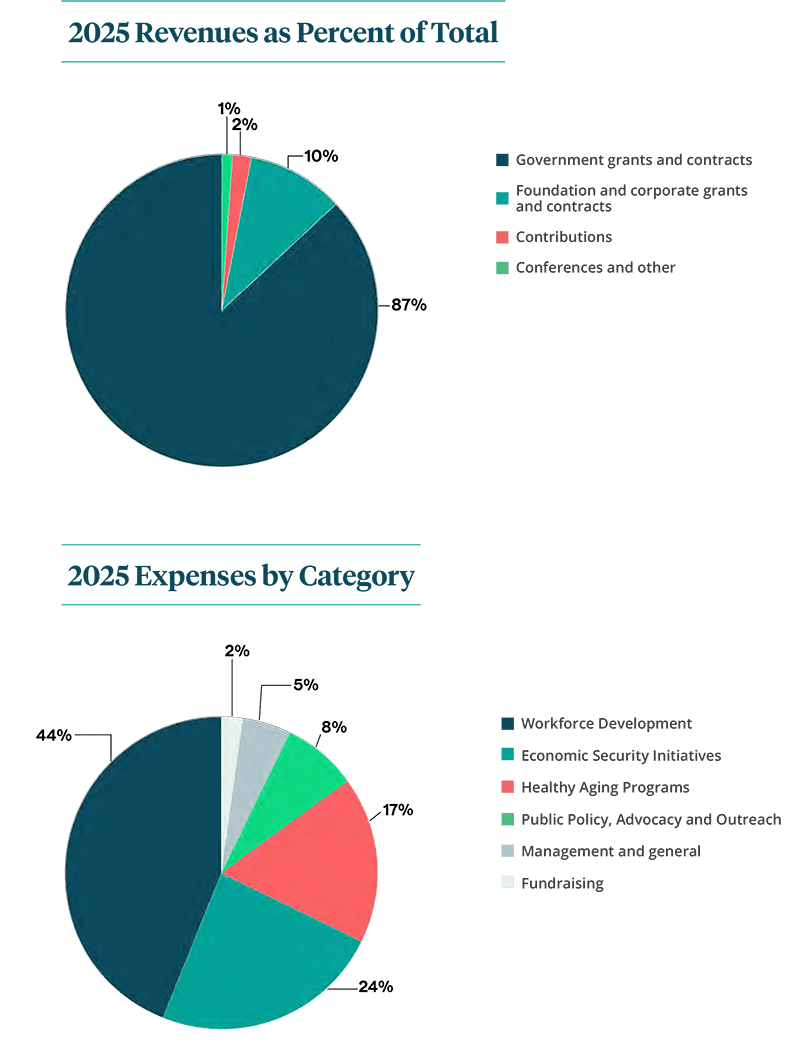
The following charts present the highlights of the revenue and expenditure distributions by categories for FY25. Full Audited Financial Statements for FY25 and for prior years are available on NCOA’s website.
Download the annual and financial reports
Ways to Give to NCOA
Your generosity brings us a little closer toward a just and caring society in which each of us, as we age, lives with dignity, purpose, and security. Learn more about the ways you can give to NCOA.