
Tips to Maximize Community Member Participation in Falls Prevention Coalitions
5 min read
Related Topics
Integrating community members who have been directly affected by falls into falls prevention coalitions can strengthen the relevance, credibility, and effectiveness of coalition efforts. Community members with lived falls experience, such as older adults and caregivers, offer critical contributions to coalitions. They contribute firsthand knowledge and unique perspectives, enabling coalitions to lead responsive initiatives to reduce falls.
To fully realize these benefits, coalitions must prioritize community members’ active, meaningful, and sustained involvement. By using tailored strategies that support participation and retention, coalitions can amplify community voices and strengthen the overall impact of their work.
The following strategies can help coalitions sustain meaningful engagement of community members impacted by falls in their coalition’s work.
Get personal
Use a personalized approach to recruit and engage community members with lived experience. This is an important first step for retention that enables coalitions to learn about the interests and expertise of their members.
- Set up a one-on-one meeting with new members to learn what motivates them to improve falls prevention efforts in their state.
- Ask about both personal and professional experiences.
- Pair newly recruited community members with an established coalition member “buddy” who can serve as a friendly face and a resource for questions.
Create opportunities for input
Community members may initially feel hesitant to share their perspective during meetings, especially in coalitions that primarily consist of professionals. Coalitions should intentionally create welcoming opportunities for participation, such as beginning meetings with an ice breaker or inviting feedback through chat functions or email. When community members do contribute, make sure that their input is welcomed and encouraged.
Tip! Invite community members to share their personal experiences with falls and falls prevention services and encourage other professional members to talk about their relevant personal experiences with older adult falls to establish an environment where relevant personal sharing is valued and respected.
Encourage full participation
The impact of community members is directly tied to the extent of their involvement. Older adults and caregivers should be encouraged to fully participate in all aspects of coalition work, including leading meetings, serving on leadership committees, chairing workgroups, and speaking at events. Coalitions should avoid assigning predefined roles to community members (such as limiting participation to “advisory-only”) and instead focus on engaging older adults and caregivers in meaningful ways that match their interests.
Resist over-professionalization
Coalitions comprised primarily of professionals are likely to rely on processes and procedures that are unfamiliar to community members. Processes that are overly formal or technical can make community members feel unwelcome and create unintentional barriers to participation. Coalitions should foster a culture in which professionalism does not inhibit inclusivity.
- Avoid jargon and instead, use plain language. When terms or acronyms cannot be avoided, define them clearly each time they are used.
- Include a “no rank in this room” norm in your community agreement. In practice, this might mean that during introductions, members share their name, but leave out their title and the name of their organization to prevent valuing one member’s experience over another's.
- Orient community members to coalition norms and processes. Community members (as well as members from professional backgrounds) may benefit from gaining a foundational understanding of your coalition’s functioning. Introduce your mission statement and action plan and invite conversation and questions.
- Develop and share by-laws that do not assume prior experience with coalitions or organizational processes.
- Offer education and technical support as needed. For example, orient members to virtual meeting platforms or discuss the purpose of meeting minutes. Encourage questions and provide meaningful responses.
Modify as you go
Keep communication lines open—integrating new members into the coalition is an ongoing process. Solicit input from members with lived experience to assess what is going well and what can be improved. Be prepared to revise coalition processes and structure to create a welcoming environment for all members.
- Reach out to older adults and caregivers after meetings or events to get their feedback. Was the meeting beneficial to them? Do they have unanswered questions? How can meetings be more engaging or more productive?
- If your coalition has had difficulty retaining community members in the past, consider asking a neutral or third-party person to initiate a meeting to find out why they did not continue in the coalition.
- Educate all coalition members on the importance of modifying processes to ensure the coalition is welcoming of a range of perspectives and backgrounds.
Creating impactful solutions
Adopting strategies that prioritize relationship-building and ongoing support and equally value personal and professional backgrounds enables coalitions to meaningfully integrate the lived experiences of community members into all aspects of their coalition’s work. When coalitions engage older adults and caregivers with firsthand experience of falls as invaluable members of their coalitions, they are better positioned to create impactful solutions that prevent falls and fall-related injuries.
Check out these resources to learn more about effective practices for keeping community members with lived experience engaged in your falls prevention coalition:
- Engaging People Most Affected by the Problem from the University of Kansas Community Toolbox
- Engaging Lived Experience Toolkit developed by the People with Lived Experience Workgroup and Community Champions from 100 Million Healthier Lives
- Engaging Community Residents with Lived Experience: Common Concerns & What to do About Them published by 100 Million Healthier Lives
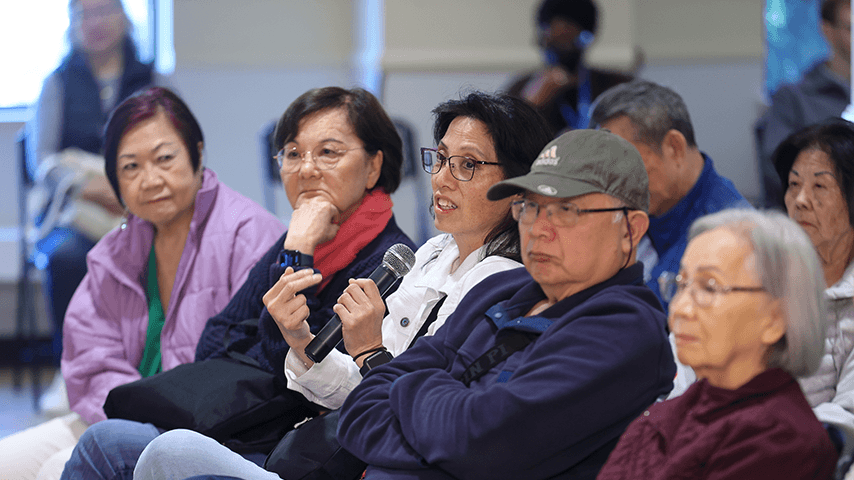
Photo by Mat Hayward/Getty Images for National Council on Aging
This project is supported by the Administration for Community Living (ACL), U.S. Department of Health and Human Services (HHS) as part of a financial assistance award totaling $2,5000,000 with 100 percent funding by ACL/HHS. The contents are those of the author(s) and do not necessarily represent the official views of, nor an endorsement, by ACL/HHS, or the U.S. Government.