
Integrated Care for People with Medicare and Medicaid
3 min read

Roughly 13.6 million Americans have both Medicare and Medicaid coverage.1 These individuals, often called dual eligibles or "duals," have access to special health plans that can make their coverage easier to manage and may provide additional benefits.
Medicare covers most preventive and primary care services, as well as prescription drugs. Medicaid is responsible for the coverage of long-term services and supports (LTSS), some behavioral health services, and pays for Medicare premiums and cost-sharing.
Dual-eligible beneficiaries often face complex decisions about how to receive their Medicare and Medicaid coverage. Some choose to keep the programs separate to maximize provider choice, while others enroll in an integrated plan that coordinates benefits and services through a single organization.
Use our integrated care toolkit
NCOA has partnered with the Medicare Rights Center to develop this toolkit for counselors who work with dual eligibles, and beneficiaries themselves. This toolkit was created following interviews and focus groups with counselors, and will be updated and enhanced with additional materials on an ongoing basis.
| Resource | Audience | Link |
| Chart of integrated care models | Professionals | |
| Primer that reviews the current landscape of integrated care plan models and recent legislative changes to how they are implemented | Professionals | |
| FAQ about integrated care, Medicare & Medicaid | Professionals, Consumers | |
| PowerPoint training deck | Professionals | PPT |
| Comparison chart of Original Medicare, PACE, & integrated D-SNPs | Professionals, Consumers | |
| Comparison chart of Original Medicare, D-SNPs, & integrated D-SNPs | Professionals, Consumers | |
| Questions to ask when weighing coverage choices | Consumers | |
| Default enrollment into D-SNPs fact sheet | Professionals |
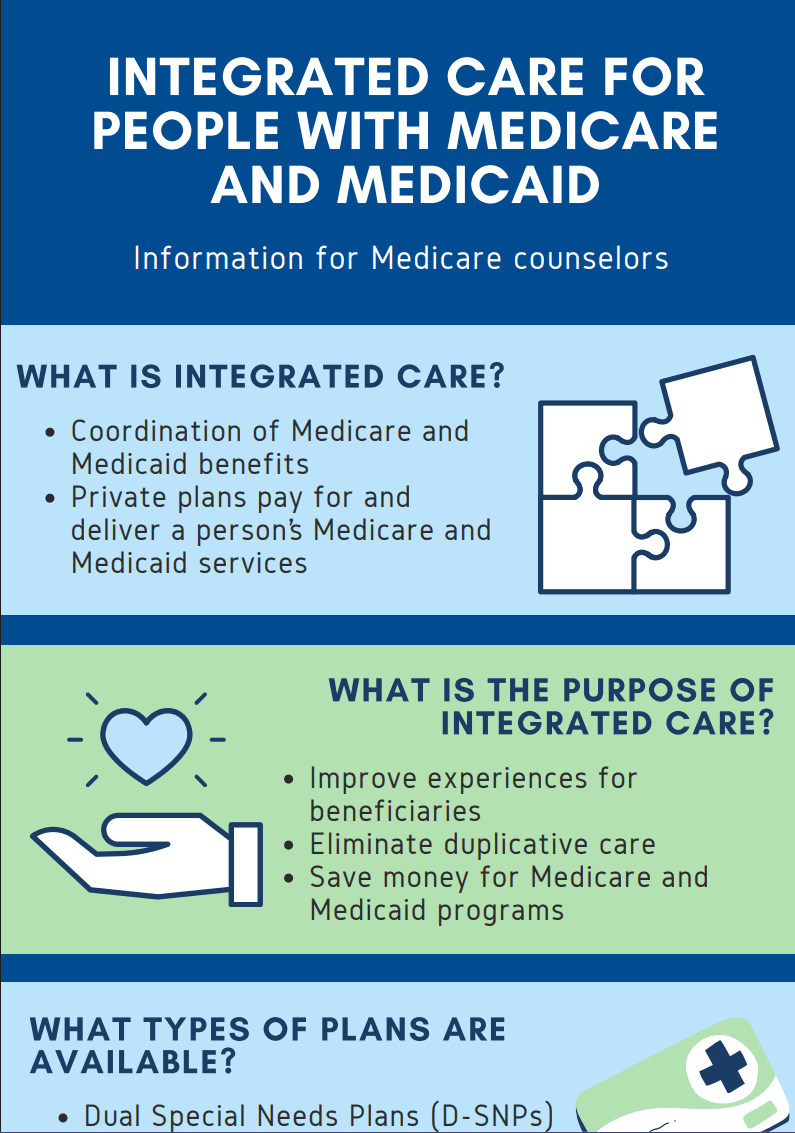
Infographic
Download this infographic to use as a quick shorthand guide.
Dual eligibles and ACOs
If you are counseling clients who opt to receive Original Medicare and not enroll in an integrated care plan, you may still wish to educate them about Accountable Care Organizations (ACOs). ACOs are groups of doctors, hospitals, and other providers that work together to provide care for people in regular Medicare, and are rewarded for providing high-quality care. Learn more about ACOs (information in English and Spanish).
Source
1. Medicare Payment Advisory Commission (MedPAC) and Medicaid and CHIP Payment and Access Commission (MACPAC). Data Book: Beneficiaries Dually Eligible for Medicare and Medicaid. December 2, 2025. Found on the internet at https://www.medpac.gov/document/december-2025-medpac-and-macpac-data-book-beneficiaries-dually-eligible-for-medicare-and-medicaid/