

Related Topics
The Age-Friendly Health Systems movement now encompasses more than 5,500 hospitals and health care systems, including VA medical centers, community care centers, and long-term care facilities.1 These care settings have embraced the implementation of core geriatric strategies focusing on the Age-Friendly 4Ms Framework—What Matters Most: Medication, Mobility, and Mentation (thinking, memory, reasoning, and perception). The goal: help older adults get care that better aligns with their unique health priorities and needs.
What Matters Most is the key to decision-making about medications, mobility, and mentation and is the first step in offering age-friendly care. Yet What Matters Most can sometimes be difficult to define for older adults as well as their doctors and other health care professionals. Patient Priorities Care and My Health Priorities are solutions to clearly defining goals and priorities of older adults and aligning care to address them.
What is Patient Priorities Care?
Patient Priorities Care (PPC) is intended to help ensure that health care for older adults is truly aligned with what matters most to them. It aims to improve health outcomes for patients everywhere—based on what that means to each individual—and providing health professionals with the tools to make that happen. Over 10 year s ago, it was developed by a national group of clinicians, older adults, caregivers and health system leaders under the direction of individuals at Yale University School of Medicine, UTHealth Houston Institute on Aging, and Baylor College of Medicine.
PPC improves communication among patients, clinicians, and care partners by ensuring everyone is focused on the same outcomes, especially in the common situation of uncertainty, tradeoffs, or when there are multiple care choices and no best answer.
This approach has been shown to reduce perceived treatment burden, decrease unwanted care, such as medications being stopped, fewer self-management tasks added, and fewer diagnostic tests ordered, and increase wanted care.2
The PPC website offers tools and resources for implementing PPC and published articles about PPC.
What is My Health Priorities?
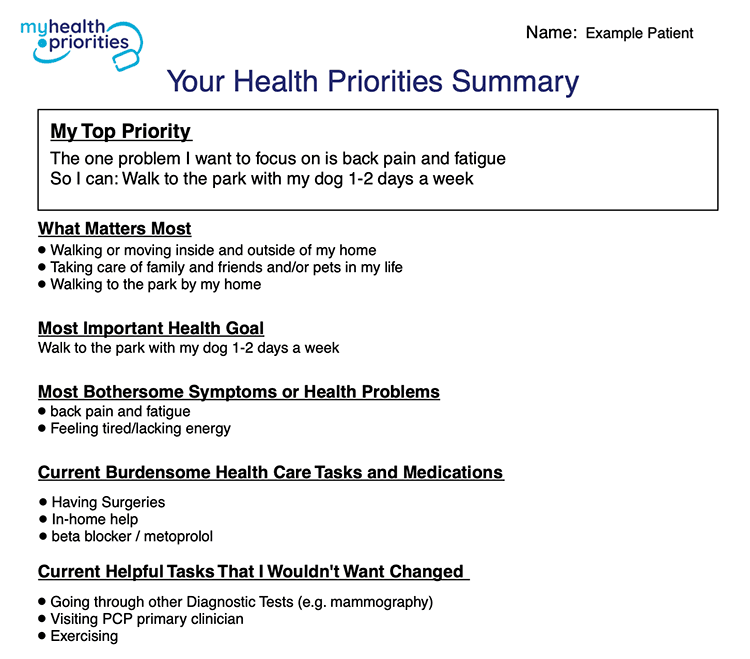
A critical part of PPC is identifying health priorities for older adults, which can be accomplished through the use of My Health Priorities, a free online self-assessment tool that guides older adults and care partners through steps to identify priorities. The steps included on the assessment are:
- Identify what matters most
- Identify a health goal
- Identify bothersome symptoms or health problems
- Clarify top priority to focus on
- Identify burdensome medications and health related tasks
After completing the assessment, My Health Priorities provides a print-out to share and discuss with doctors, other health care professionals, and family, such as the example shown below.
How can senior centers and other community-based organizations support PPC and My Health Priorities?
All older adults deserve to have access to care that aligns with what matters to them, their needs, and priorities. Community-based organizations can play an important role in educating older adults about the age-friendly health care movement and helping them define what matters most to them.
To assist in this role, a Community Toolkit has been developed as part of PPC for senior centers, area agencies on aging, and other community organizations to offer presentations and discussions on why it is important to identify priorities and what matters most related to health, health care, and social supports. This approach can be a key part of person-centered planning by allowing older adults to feel heard and motivated. PPC can also better address priorities as they relate to social needs and how community services and programs are delivered. A potential benefit is more effective care planning and delivery of health care and social support services, such as those delivered by senior centers and other community-based organizations.
The toolkit includes a guide for community-based organizations to conduct presentations and discussions with older adults and/or care partners on My Health Priorities. The Guide covers the what, why, and how of PPC and My Health Priorities, a case example, and how older adults can best communicate about what matters most to them with their health care team. A PowerPoint slide deck is included in the toolkit to be used in conducting these community presentations.
Learn more
Be part of the Age-Friendly Movement and watch NCOA's webinar on PPC and My Health Priorities to learn how you can use the Community Toolkit to help your clients identify what matters most to them and enhance your approach to person-centered care (Click the green "Register" button to access the recording).
Sources
1. Institute for Healthcare Improvement. Age-Friendly Health Systems Recognition. Found on the internet at https://www.ihi.org/partner/initiatives/age-friendly-health-systems/recognition
2. Mary E. Tinetti, et al. Association of Patient Priorities–Aligned Decision-Making With Patient Outcomes and Ambulatory Health Care Burden Among Older Adults With Multiple Chronic Conditions: A Nonrandomized Clinical Trial. JAMA Internal Medicine. December 2019. Found on the internet at https://jamanetwork.com/journals/jamainternalmedicine/fullarticle/2752365
How NCOA Helps Older Adults Thrive
NCOA's Center for Healthy Aging (CHA) provides training and technical assistance to help professionals support community-based health education opportunities for older adults and adults with disabilities.