

Empowering People Experiencing Homelessness: Using Evidence-Based Programs to Address Access Barriers
Housing is important for everyone's health and safety, influencing access to resources, stability, and overall well-being. Yet housing has become increasingly unaffordable for many, due to rising rental and home prices nationwide. This is putting significant financial strain on individuals and families, particularly those with lower or fixed incomes.
Older adults are more likely to spend over half their income on housing and live on a fixed income supported by government programs, such as Social Security.1 At the same time, the cost of groceries and other essentials has significantly increased. For many older adults, managing these rising costs while maintaining stable housing and addressing chronic health conditions has become especially challenging.
Adults age 50 and older are the fastest-growing group of individuals experiencing homelessness, with numbers expected to triple by 2030.1 Homelessness in later life is often triggered by traumatic events such as the death of a spouse, divorce, job loss, eviction, or the onset of health issues. As a sorth of double whammy, experiencing homelessness increases the risk for chronic conditions like diabetes and respiratory illnesses.2 And once individuals over 55 become homeless, they often remain without stable housing, with many resorting to living in conditions that are unsafe.1
How can evidence-based programs help peoople expriencing homelessness?
Evidence-based programs can provide older adults experiencing homelessness with the resources and support they need to improve their health, regain stability, and build a better quality of life. However, challenges such as limited access to resources, transportation, and stigma must be addressed to effectively support this population.
Consider the following challenges and use the strategies discussed to plan how your organization can enhance the accessibility of your evidence-based programming.
Access to resources and services
When individuals are focused on meeting basic needs such as food, shelter, and safety, there is little opportunity for them to engage in essential evidence-based health promotion programs to manage their chronic conditions. Offering food, water, or other necessities during these programs can help address survival needs, making it more likely that people will attend and participate.
Offering incentives, such as gift cards, hygiene kits, or other essential items, can also encourage participation.4 To ensure that your programming is part of a comprehensive approach to meeting their needs, collaborate with other organizations and services, such as:
- Your local community action program
- Your local public health department
- Shelters
- Food pantries
- Mental health services
- Housing assistance programs
Addressing transportation barriers
When evidence-based programs are offered in specific locations, individuals experiencing homelessness may struggle to afford transportation or may not have access to reliable transportation to attend. To address these barriers, ensure your evidence-based programming is accessible and tailored to the needs of homeless individuals to promote equitable access to your organization’s resources.
Organizing mobile health fairs, clinics, and health promotion programming can bring health education to people in places they already frequent, such as shelters, food banks, soup kitchens, or parks. Mobile health units can provide resources and education on-site. For example, Shasta Community Health Center, an ACL 2024 Chronic Disease Self-Management (CDSME) grantee, runs the Health Outreach for People Everywhere (HOPE) program, which provides medical, dental, vision, and substance use disorder services to vulnerable individuals. The HOPE program team offers "street medicine" through a mobile medical van, bringing care to homeless individuals in locations like encampments, parks, and other community spaces.
Stigma and discrimination
People experiencing homelessness often encounter significant stigma and discrimination, which can have profound impacts on their physical and mental health. This can also result in a strong distrust of local government support services and negative experiences with the health care system.
Community-based organizations serve as a second home for many, offering a safe, non-judgmental space where people can feel accepted. Trust can take time to build, but ensuring staff understand the unique challenges faced by people experiencing homelessness, including potential trauma, mental health issues, and substance use, is crucial. Training staff on how to approach individuals with empathy and understanding, and to use person-first language like “people experiencing homelessness” instead of “the homeless,” helps to encourage a more inclusive, non-judgmental environment.
More resources
To learn more about barriers impacting the unhoused population and the resources to support them, please check out these recommended articles:
- Removing Barriers to Health and Economic Security for Hispanic and Latino Older Adults
- What Can You Buy With SNAP?
- New Grant Opportunity to Support Senior SNAP Enrollment
- SNAP and Healthy Aging: Benefits That help Older Adults Eat Well
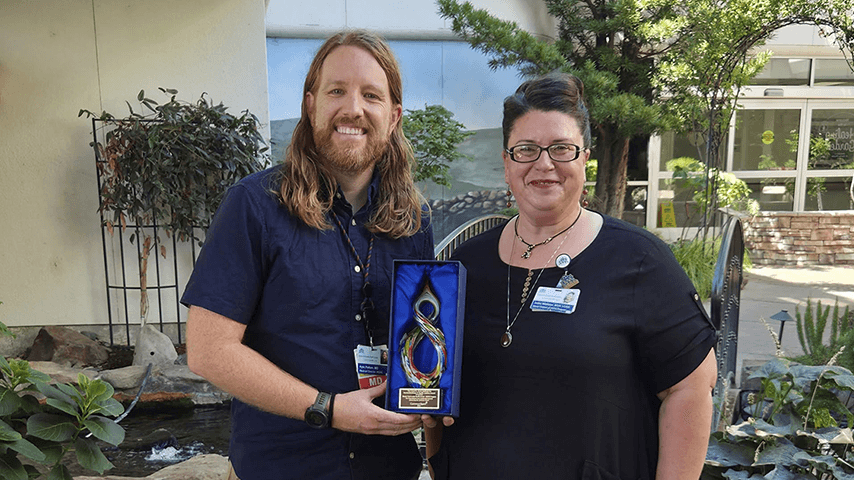
Photo of Shasta Community Health Center HOPE program Medical Director Dr. Kyle Patton, and Senior Director Amber Middleton with the Lloyd H. Dean Institute for Humankindness & Health Justice Award from Common Spirit Health courtesy Shata Community Health Center
This project was supported by the Administration for Community Living (ACL), U.S. Department of Health and Human Services (HHS) as part of a financial assistance award totaling $10,000,000 with 100 percent funding by ACL/HHS. The contents are those of the author(s) and do not necessarily represent the official views of, nor an endorsement, by ACL/HHS or the U.S. Government.
Sources
1. U.S. Interagency Council on Homelessness. Homelessness Prevention Series. Spotlight on Older Adults. Jan. 8, 2025. Found on the internet at https://www.usich.gov/guidance-reports-data/federal-guidance-resources/homelessness-prevention-series-spotlight-older
2. National Alliance to End Homelessness. Limited Access to Healthcare and Other Voluntary Services. Found on the internet at https://endhomelessness.org/limited-access-to-healthcare-and-voluntary-services/
3. National Alliance to End Homelessness. Paint by Numbers: Older American and Homelessness. May 7, 2024. Found on the internet at https://endhomelessness.org/blog/paint-by-numbers-older-americans-and-homelessness/
4. Convoy of Hope. 7 Most Common Types of Hygiene Kits. Nov. 19, 2024. Found on the internet at https://convoyofhope.org/articles/hygiene-kits/
5. Shasta Community Health Center. The HOPE Program: Health Outreach for People Everywhere. Found on the internet at https://www.shastahealth.org/hope
6. National Conference of State Legislatures. Housing and Homelessness Legislation Database. Found on the internet at https://www.ncsl.org/human-services/housing-and-homelessness-legislation-database
7. U.S. House of Representatives. Find Your Representative. Found on the internet at https://www.house.gov/representatives/find-your-representative